E para aquelas criaturas estranhas como eu que não têm FB?
Guardian music na net (é do mui bom jornal the guardian) "How indie labels changed the world" é comprido e vale mesmo a pena, q ando farto de pregar aos peixes. [

]
Melhor - sai copy/paste:
How indie labels changed the world
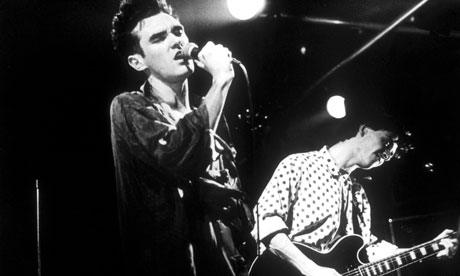
The Smiths in their 80s heyday. Photograph: Paul Slattery/RetnaUK
Thursday 22 March 2012
Run by mavericks with little or no business sense, independent record labels turned the music industry on its head in the 80s. And their sound and aesthetic remains a huge influence to this day
When
Johnny Marr and
Morrissey met for the second time in 1982 to discuss plans for their newly formed band, the pair wrote down ideas in a notebook in the singer's bedroom. One of their first decisions was that the
Smiths would sign to an independent label. Although Morrissey and Marr, along with anyone in Manchester with a passing interest in contemporary music, had links with
Factory, the duo placed the London-based
Rough Trade at the top of their wishlist.
For a band to sign to an independent record company was to make a decision that went beyond musical style or genre. "The very act of being on Rough Trade at the time was a statement in itself," Marr says. "It cut across our whole aesthetic."
Until its messy unravelling in 1991, Rough Trade and its distribution wing were the independent sector's conscience, shop floor and corn market. At its peak, Rough Trade Distribution, along with its rival Pinnacle, was responsible for almost 30% of the music market. The company had been founded along with its label namesake on the principles of access and mutualism and serviced the sector's most iconic record companies: Mute, Creation, Factory (who both later went to Pinnacle) and 4AD. Throughout the 1980s such labels were regularly challenging the majors in the Top 20, particularly in the album charts.
Each company was run by an individual or individuals with a singular vision and passion, an untutored approach to business and a devil-may-care attitude to the conventions of the record industry. Their names were Daniel Miller, Geoff Travis, Tony Wilson, Rob Gretton, Alan McGee and Ivo Watts-Russell – and if they were embarking on a career in today's streamlined multi-platform music industry, they would each struggle to make it past reception.
What differentiated Mute, Factory, Rough Trade and their contemporaries from other indies that came before and after was their ability to sustain a position in the mainstream – to populate it with a catalogue of releases that reflected whatever had captivated their imagination. These labels flourished in the aftershock of punk, embracing the incipient DIY ethos and building their own space alongside the established corporate music business. Independence meant self-financing the recording and distribution of music, operating on hand-to–mouth budgets and trading with like-minded partners in independent record shops and the scratchy network of fanzine editors and concert promoters that, along with the paternal figure of John Peel, represented an alternative media.
Since then the word "indie" has been appropriated for other uses, and often employed pejoratively. Whether to describe a film, a coffee house or, as I once overheard in Brooklyn, a property, it covers a patchwork of tropes and influences. At its most self-absorbed, which is often, indie suggests a carefully curated daydream life, the kind that might be enacted, with just the right degree of ennui, on the set of a Wes Anderson film.
In music, it serves as the masthead of a vast genre, or sometimes as a modifier: indie rock, indie folk, indie-tronica or indie pop to pick just a handful. A sympathetic understanding of indie music is to see it as a morass of signifiers: guitars, fringes, young or youngish groups of mainly white people connecting the highlights of their music collection in an ever-shifting reconfiguration of the past. A more critical assessment would be that indie is the pinnacle of disengaged, querulous solipsism. Such is the genre's listless omnipresence, so well characterised by the phrase "landfill indie", that it is often counteracted with an equally single-minded response, an assertion tantamount to Pop: There Is No Alternative.
The Smiths had been courted by the majors and after the release of
Hand In Glove were invited for an exploratory meeting with CBS, Warners and EMI, a process that placed the difference between the two sectors in sharp relief.
"I was immediately struck by the lack of records in these buildings," Marr says. "As someone who was a record freak, it made me want to get back to Rough Trade. On the few occasions that I'd been in the Factory flat, and certainly when I'd been around Rough Trade, they were like record companies trying to operate under mounds and mounds of vinyl. All they had in CBS and Warner Brothers were huge posters of their artists in reception."
Factory Records is celebrated, perhaps at times overcelebrated, for its mixture of regional pride, entrepreneurial elan and seductive brand of quasi-situationist hedonism. During the regeneration property boom Manchester's developers regularly invoked Factory's name while unveiling shiny glass and steel buildings. In reality, the Factory ethos with which the architects wished to be identified was born in a first-floor flat in a crumbly Victorian semi in an atmosphere of stoned conceptualism. For most of the company's life, Factory was run from a flat in Didsbury, whose threadbare sofas served as a meeting room and on whose doormat envelopes containing six-figure cheques from the label's distributors regularly landed.
Factory, Fast Product and later 4AD were all record companies whose sleeve designers and graphic language became as synonymous with the labels as the music they released. With their die-cut cardboard, high-end colour processes and overlaid photographic techniques, such sleeves occasionally cost more than the recording and were often more interesting, the sort of upside-down economics on which the creativity of the independent sector initially thrived.
Indeed, however much the majors liked to dismiss the indies as worthy amateurs, Rough Trade Distribution achieved two No 1 singles:
Pump up the Volume by M/A/A/R/S in 1987 and
Doctorin' The Tardis by The Timelords a year later. At the turn of the decade, Bill Drummond and Jimmy Cauty of the latter, now known as the KLF, would undertake a run of releases that made them the biggest-selling singles act in the UK for an 18-month period.
The KLF operated without an office, manager or lawyer. Nevertheless, by loading and unloading pallets of CDs and vinyl and coordinating deliveries with their distributors, the duo sold almost 2m records. "There was never a point where I wasn't unloading vans," Drummond says. "You could be having No 1s in 18 countries but still be unloading vans of records."
Towards the end of the Smiths' career, their label's finances were in such a parlous state that a member of staff drove around London on the back of a courier motorcycle, knocking on the doors of various recording studios to see if they would accept payment by credit card. Just as the KLF were enjoying a career as an international pop act, Drummond would have to attend emergency committees at Rough Trade to discuss the company's bankruptcy. At one such meeting he had to break away from negotiations with the auditors to listen down the phone to Cauty's final mixes for the single
America: What Time Is Love?
When the independent sector was starting to gain serious momentum 10 years earlier, the Scottish pop star
BA Robertson interviewed
Edwyn Collins and Alan Horne about their Postcard label for the BBC. In an attempt to draw comparisons with Postcard and the label he recorded for, CBS, Robertson mentioned that Horne's flat on West Princes Street in Glasgow was also located on a building with several floors, which was, surely, the point where any similarities ended. The resulting film included Horne, Collins and a mannequin sharing sofa space with a bemused and uneasy looking Robertson who tried unsuccessfully, despite his large sunglasses, to negotiate his interviewees' barbs and giggling.
Today most bands that qualify for a peak-time appearance on the BBC would in all likelihood have undergone some media training. The improvisatory space in which the indies thrived has shrunk for several reasons. One is the ever-prevalent and finely tuned ability for corporate culture to absorb fringe behaviour and repackage it and market it as cutting edge. Another is the formalising of Britain's creative industries, a process that has seen the development of college degrees in music business, music journalism and, indeed, being in a band, lead to industry standardisation. The independent sector's greatest attributes – its ability to ad-lib, to trust its instincts and to hang the consequences are both impracticable and unteachable in such rigid frameworks. The sort of behaviour that allowed Wilson, McGee, Watts-Russell and their contemporaries to conceive some of their more extreme and fanciful ideas would also be something of a stretch for a human resources department to manage.
At its most successful, the independent sector was a source of popular experimentation and improvisation that connected with a wide audience, even if its ad-hoc business practices would ultimately prove its downfall.
Orange Juice and the Smiths, with their lack of synthesisers, second-hand guitars and encyclopedic knowledge of 60s and 70s records, were both a key influence on the
C86 [a compilation cassette released in 1986 by the NME of new indie bands] generation whose hooped T-shirts and Ray-Bans fixed indie in the vernacular. Rough Trade certainly distributed boxes and boxes of the seven-inch singles, flexis and fanzines that became the bedrock of this characterisation of indie, one that has endured ever since. But Rough Trade also shipped some of the earliest acid house and bleep singles into the Top 20 singles chart, a place familiar to many of its other clients including New Order, Erasure and Depeche Mode, all as far removed, sonically and conceptually, from the rather pallid genre that nowadays rehearses the same tics and influences to a dwindling sales base.
In their respective use of sampling and mashup, even those Timelords and M/A/A/R/S records are perfect examples of the risk-taking innovation rife within indiedom of that era.
None of which is to deny the impact of independence, to say nothing of its continuing and growing success. It is worth noting that Adele's 21, now one of the country's bestselling albums of all time, was released by an independent record company, XL. In an industry that is suffering decline, it is an indie label that is reaping the benefits of adapting and experimenting with new technologies, thinking on one's feet and being open to new ideas.
They did it their way
The men behind the indie labels
Geoff Travis Rough Trade
Cambridge University graduate who founded Rough Trade Records and the Rough Trade chain of stores. Signed the Smiths (and umpteen others such as the Strokes) but lost them to a major.
Daniel Miller MuteSet up Mute to put out his own record, under the alias The Normal. Subsequently released the likes of Depeche Mode and Yazoo and recently regained its indie status from EMI.
Tony Wilson Factory
Founded Factory Records and the Haçienda, rebranded Manchester in his own image, and was played on screen by Steve Coogan in 24 Hour Party People five years before his death aged 57.
Ivo Watts-Russell 4AD
Co-founder in 1979 of 4AD, the label that released the Cocteau Twins and the Pixies as well as M|A|R|R|S; now part of the Beggars Group, along with Rough Trade Records and XL Recordings.
Alan McGee Creation
Co-founder of Creation Records, home to the likes of Primal Scream, Teenage Fanclub, My Bloody Valentine and then Oasis. Took a lot of drugs and sold half the company to Sony in 1992.
The best of indie What tunes would make your ultimate indie playlist? Let us know at guardian.co.uk/ultimateindie
Wednesday 21 March 2012 20:00 GMT
Read by 1,962 people
Facebook comments:
True, but nonetheless a bit too angelic.
In the end "Music" is a commodity just like anything else. You sign to a major you're selling yourself to a larger audience through their power to market you as a product. Nothing new in that. The Indie labels used lager labels to distribute in the past. But where's your integrity? Who really cares? Your shelf life is short - grab the cash whilst you can and don't look back.
How about IN TAPE they had some good artists Terry And Gerry was one the good point about this was it was driven by a love of music not MONEY if you see that tosser cowell tell him love music.
Edit: Só agora vi o post da Sereg


]


 ]
]



 ]
]