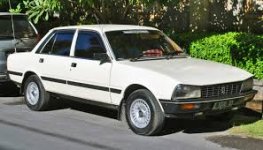
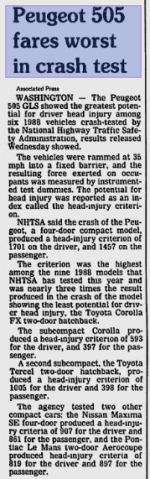
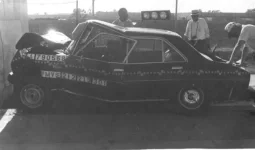
Algumas considerações sobre, o crash test realizado pelo NHTSA com o Peugeot 505
https://www.multinationalmonitor.org/hyper/issues/1990/01/dunlap.html
[TABLE="align: center"]
[TR]
[TD]
The federal standard is a "performance standard," not an "equipment standard." As long as the protection is automatic (no action required by the front-seat occupants) and passes a 30 mph crash test, manufacturers may decide how to meet the standard.
Most new cars are equipped with automatic seat belts, and although there is a trend toward air bags, some automakers are withholding the safety technology. Seeking to accelerate the availability of air bags, consumer and injury prevention organizations, led by Motor Voters, a grass-roots consumer group founded in 1979, are urging consumers not to buy cars produced by companies which refuse to offer the safety devices. Groups endorsing the effort include the Center for Auto Safety, the U.S. Public Interest Research Group, the Connecticut Public Interest Research Group, the Virginia Citizens Consumer Council and the Massachusetts Head Injury Association.
Their first boycott target is Peugeot. While 17 rival auto companies geared up to offer air bags in the United States, Peugeot devoted its resources to capturing a larger segment of the European market. The privately owned, family-run business is the third largest automaker in Europe, and the eighth largest in the world. Peugeot is now the largest auto manufacturer selling cars in the United States without offering any air bag-equipped models.
To those familiar with the company's history, it comes as no surprise that Peugeot lags behind when it comes to safety. Protecting drivers and passengers has never been a priority for the manufacturer, critics charge. Dr. Antione Chapdelaine, an injury prevention expert at Enfant Jesus Hopital in Quebec City, Canada, observes that "Peugeot is behind not only in engineering. It is behind in philosophy."
The company regularly suggests that safety devices are far more expensive than their actual cost. As recently as 1987, Peugeot submitted a technical paper to an international conference on vehicle safety purporting to show that air bags are not cost- effective. The company began with the premise that full-front air bags would cost $2200, including the adaptation to the car; in high volume it claimed the cost would be $800. The company gave no basis for its estimates. In contrast, the U.S. Department of Transportation (DOT) estimated that "full front air bags need cost no more than $320" in volume production (over 300,000 units).
Peugeot's estimates of costs for automatic seat belts are also wildly inflated compared to those of other manufacturers and the DOT.
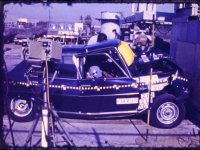
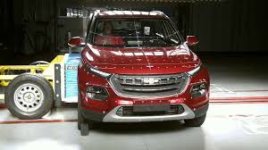
Ironically, DOT crash test results indicate that Peugeots provide dangerously inadequate protection in frontal crashes even when compared to competing models without air bags. The Peugeots, therefore, need air bags even more. In 1979, Peugeot registered the worst score in the entire 10-year crash test history. The driver-side dummy recorded an impact over four-and- one-half times the force likely to cause severe brain injury or death. Out of 10 Peugeot 35-mph-crash-test results, nine were disasters, with dummies in the front seats suffering impacts severe enough to kill humans. In 1988, and again in 1989, Peugeot registered the worst results in its class, and by far the worst results among all passenger cars tested.
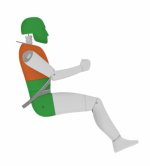
Faced with these appalling results, rather than installing air bags, Peugeot opted for an automatic belt system in the 1988 Peugeot 505. The belt system affords little protection, however, since it detaches on impact. Consumer Reports noted in April 1989 that the "Peugeot 505 with automatic shoulder belts anchored to the window frame proved to be a disaster for both driver and passenger. The crash pulled the door frames forward markedly, destroying the anchor points of the belts. Neither occupant would have been likely to survive the crash."
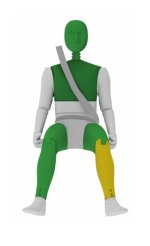
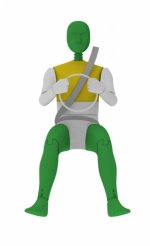
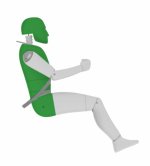
Even when NHTSA re-tested the 1988 model at only 30 mph, with crash forces one-third less than at 35 mph, the belted driver-side dummy's head and face still struck the steering wheel with considerable force.
In many of its newly designed 405s, Peugeot installed an automatic motorized belt system which does not even meet minimum federal safety standards. Intermittently, the shoulder portion of the belt either does not move at all or sticks part way around the track. Last July, NHTSA granted a petition from Motor Voters and opened an "Engineering Analysis" [the investigation which pre-cedes a government-mandated recall] of the motorized belts in Peugeot 405s. As a result, the company is now recalling about 4,000 cars equipped with that belt system.
Peugeot remains vague about its air bag plans, saying only that "research and development is underway," and that "at some future point" the company "plans to have them in some models." The manufacturer says it has no "precise reason" for not having them yet.
Although company representatives deny that the consumer boycott has had any effect, Peugeot has launched a campaign to counter the groups' charges. The company has condemned the boycott and attempted to discredit organizers, terming them "irresponsible."
The key component of Peugeot's strategy is to discredit the NHTSA crash test data which the boycotters are using to support their efforts.
Through the revolving door which all too often connects government regulatory agencies and the entities they regulate, Peugeot has enlisted the aid of former NHTSA officials to challenge the validity of the crash test data. The company hired Ron De Fore, director of public affairs at NHTSA during the Reagan administration. De Fore, in turn, has called on former NHTSA Administrator Diane Steed and auto industry representatives to attack the government crash tests.
Steed told Automotive News that she would have abolished the crash test program, but feared the furor that would have created among consumer groups. Jack Gillis, a former NHTSA official, author of The Car Book and Motor Voters board member, disputes Steed's claim, however. "The Reagan administration didn't keep the crash test program because consumer advocates would object if it were scrapped," " he says. "They kept it because its very nature embodies the free marketplace spirit � manufacturers don't have to 'pass' the tests, the information is simply released to the marketplace so that those buyers and sellers who are interested can use it." Gillis goes on to point out that "It's ironic that the Reagan officials who oversaw the program for eight of its 10 years are now attempting to earn a living in the private sector by trashing the very program for which they were responsible."
Peugeot acknowledges its low crash test ratings, but claims the tests are flawed and do not reflect the actual safety record of its cars. Peugeot Motors of America President Pascal Henault argues that "Peugeot's commitment to building cars that are safe in the real world cannot be overshadowed by these experimental crash test results. Our top concern is protecting human beings, not dummies." Peugeot spokesperson Kim Derderian criticizes the crash tests, saying that they "are not the proper way to measure safety" and "the slightest variable can alter results."
Jim Leahy, Executive Director of the Connecticut Public Interest Research Group and a boycott organizer, counters that "the crash tests are a better indication of auto safety than Peugeot's empty rhetoric."
While agreeing with Peugeot that crash tests should "not be used as the sole criterion of safety," boycotters maintain that the tests provide vital data for consumers. The crash tests are the leading measure of a vehicle's crashworthiness in frontal crashes. Clarence Ditlow, Executive Director of the Center for Auto Safety, says that "NHTSA uses the same test procedures for determining compliance with safety standards." He also notes that other manufacturers give more credence to the test results. For example, when Audi earned exemplary test results, it took out full page ads, crowing about its score. Auto writers also touted the results, and � based on one score �an Audi dealer proclaimed the Audi 100 to be the "safest car in the world." "Auto manufacturers can't have it both ways," says Ditlow. "The results are meaningful when Audi does well, and they are equally valid when Peugeot does poorly."
Boycotters agree that real-world crash situations differ from test conditions in one important respect. In government crash tests the dummies are always wearing taut seat belts. But in the real world, most motorists do not buckle up. In a frontal crash, Peugeot offers those people virtually no protection.
NHTSA itself underscores the importance of frontal crash protection, explaining that "each year about 22,000 people are killed in the front seat of passenger cars and another 300,000 suffer injuries serious enough to require hospital treatment. Frontal crashes account for half of all occupant fatalities and air bags are most effective in frontal crashes."
Former acting NHTSA Administrator Jeffrey Miller states that "An air bag used with a safety belt provides the best protection available in all kinds of crashes. It's a 'winning combination' that greatly increases your chance of surviving a crash that otherwise would have been fatal." Tragically, it is a "winning combination" not avail-able in any Peugeot.
Although in 1988 Peugeot promised boycotters it would produce data from its own tests to refute NHTSA's results, the company has yet to do so. Instead, it points to data from the Highway Loss Data Institute (HLDI), which it claims shows that their cars perform well "in the real world."
There are a number of flaws in this argument. First, HLDI ranks vehicles based on insurance injury claims records. Therefore, its report is affected by factors other than crashworthiness, such as driver behavior and the age and sex of its drivers. Second, HLDI figures are based on injury claims filed for previous years, and do not include the 1989-90 models, which are the target of the boycott. Third, Peugeot's ratings are slipping even on the HLDI scale. The company's cars used to rank "better than average" in HLDI. The last two HLDI reports (covering 1985-1988 model years) ranked Peugeot only "average," with a rating worse than more than 90 other models. It is expected that as more vehicles include air bags, Peugeot's relative ranking will continue to decline.
Finally, although Peugeot says HLDI is a better indication of real-world safety performance than the NHTSA crash tests, even the Insurance Institute for Highway Safety, which is closely affiliated with HLDI, describes NHTSA's crash test program as one "designed to provide measures of relative performance in
real-world crashes within classes and sizes of vehicles" (emphasis added).
The NHTSA data are also uniquely valuable to consumers because they provide the only reliable means to rate cars' relative safety. Gillis states, "The bottom line is the U.S. Department of Transportation crash test pro-gram is the only way that consumers can compare the relative safety of the cars they are going to buy. Unlike insurance industry statistics, which are partially based on driver characteristics, the crash tests treat all cars equally."
Peugeot's Derderian says that Peugeot gets "innumerable" letters from Peugeot owners who say the "'car performed exceedingly well!" Yet the public record paints a far different picture. Among all cars sold in the United States, NHTSA receives the second highest percentage of safety-related complaints about Peugeot, ac-cording to Jack Gillis in the 1989 edition of The Used Car Book.
The boycott has received international coverage, and, judging by Peugeot's sales numbers, appears to be very effective. It was announced August 22, 1988, just as
[/TD]
[/TR]
[/TABLE]



 ]
]



 ]
]