Topico dos Crash-Tests ⚠️Euroncap- 10/10/2026

Toyota Hilux 4x4


Overall: 26.86 out of 37
star_4.gif
168.jpg
Variant: SR Double CabKerb Weight: 1860 kgYear: 2005Engine: 3 Litre Turbo DieselCategory: UtilityAirbags: Dual front airbags
Model_History_%26_Safety::ffffff::FFC300::11.png

The tested model of Hilux 4x4 was introduced in Australia during 2005.
Dual front airbags are standard equipment. ABS brakes are optional for the SR variant.

Pre-tensioners are fitted to the driver and outboard passenger seat belts to reduce slack in the event of a crash. A two point seat belt is fitted to the centre rear seat. This provides inferior protection compared with a three point seat belt. Child restraint anchorages are fitted behind the rear seat but are difficult to reach.

Overall_Evaluation::ffffff::FFC300::11.png

The Hilux 4x4 scored 10.86 out of 16 in the offset crash test. The passenger compartment held its shape well. Protection from serious chest and leg injury was marginal for the driver.
The vehicle was awarded a default score of 16 out of 16 in the side impact crash test.

Frontal_Offset_Crash_Test::ffffff::FFC300::11.png

Body region scores out of 4 points each: Head/neck 4 pts, chest 1.61 pts, upper legs 2 pts, lower legs 3.24 pts.

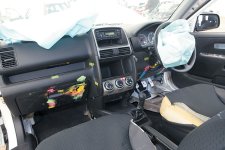
The passenger compartment held its shape well in the offset crash test. The brake pedal moved rearwards by 65 mm and downwards 17mm. The steering wheel hub moved rearwards 40 mm, upwards 15 mm and sideways 10 mm. The front ("A") pillar moved 20 mm rearwards. All doors remained closed during the crash. After the crash high manual effort was required to open the rear door on the driver's side. The other doors opened normally.

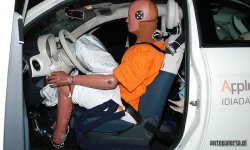
The airbag cushioned the head of the driver and contact was stable. Steering column components were a potential source of injury for the driver's knees. The passenger's head was cushioned by the airbag and contact was stable.

Side_Impact_Crash_Test::ffffff::FFC300::11.png

Default 16 points awarded for side impact test.

The side impact test normally used by ANCAP simulates a small car striking the driver's door of the vehicle under test. It is based on a regulation test but the regulation does not apply to vehicles with a high seat height like the Hilux 4x4. Experience shows that such vehicles can be expected to perform well in this test so ANCAP has decided to award full score for these vehicles instead of conducting a crash test.

The vehicle was not eligible for a Pole Impact Test since it did not have head-protecting side airbags. This test can earn eligible vehicles an extra two points.
 
Injury_Measurements::ffffff::FFC300::11.png

Offset Crash Test at 64km/hSide Impact Crash Test at 50km/hDriver Pass. Driver
Head::ffffff::708090::9.5.png
HIC535424NoneAcceleration56.948.9None
Neck::ffffff::708090::9.5.png
Shear0.50.88NoneTension1.171.64NoneExtension7.512.3None
Chest::ffffff::708090::9.5.png
Acceleration41.538NoneCompression38.729.4NoneViscous Criterion0.220.16None
Abdomen::ffffff::708090::9.5.png
ForceNoneNoneNone
Pelvis::ffffff::708090::9.5.png
ForceNoneNoneNone
Upper_Legs::ffffff::708090::9.5.png
Force Left0.730.1Force Right0.091.11Knee Displ. Left2.350.06Knee Displ. Right0.395.74
Lower_Legs::ffffff::708090::9.5.png
Force Left2.491.97Force Right2.821.89Index Left (Up/Low)0.31/0.570.32/0.32Index Right (Up/Low)0.49/0.330.4/0.18
Bonus_Points_%28Maximum_5%29::ffffff::FFC300::11.png
 
Pole Test: Zero points Seat Belt Reminders: None fitted - zero points
Modifiers_-_Offset_Test_Scores::ffffff::FFC300::11.png

HeadNo deduction
ChestNo deduction
Upper LegVariable & concentrated loading2 pt deduction
L & RLower LegNo deductionFoot ScoreScore 4 points
Modifiers_-_Side_Impact_Test_Scores::ffffff::FFC300::11.png

HeadNot assessed
ChestNot assessed
Upper LegNot assessed
Lower LegNot assessed
Foot ScoreNot assessed
Pedestrian_Rating::ffffff::FFC300::11.png

pedstar_1.gif
Total (out of 36) 5.01
Child head impacts 0.79
Adult head impacts 4.22
Upper leg impacts zero
Lower leg impacts zero

Status::ffffff::FFC300::11.png
 
Última edição:
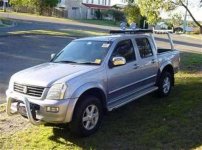
Holden Rodeo 4x4


Overall: 21.4 out of 37
star_3.gif
169.jpg
Variant: LX Crew CabKerb Weight: 1890 kgYear: 2005Engine: 3 Litre Turbo DieselCategory: UtilityAirbags: Dual front airbags
Risk_Notes::ffffff::FFC300::11.png

High risk of life-threatening chest injury
Model_History_%26_Safety::ffffff::FFC300::11.png

The tested model of Holden Rodeo 4x4 was introduced in Australia during 2003.

Dual front airbags are standard equipment on the LX Crew Cab. ABS brakes are optional.

A three point seat belt is fitted to the centre rear seat. This provides better protection than a two point seat belt. Child restraint anchorages are fitted behind the rear seat but are difficult to reach. Hazard lights activated during the crash.

Overall_Evaluation::ffffff::FFC300::11.png

The Rodeo 4x4 scored 5.4 out of 16 in the offset crash test. The passenger compartment held its shape reasonably well. Protection from serious chest injury was poor for the driver and weak for the passenger. Leg protection was marginal for the driver.

The vehicle was awarded a default score of 16 out of 16 in the side impact crash test.

Frontal_Offset_Crash_Test::ffffff::FFC300::11.png

Body region scores out of 4 points each: Head/neck 3 pts, chest zero pts, upper legs 2.000 pts, lower legs 0.400 pts.

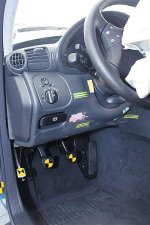
The passenger compartment held its shape reasonably well in the offset crash test. The brake pedal moved rearwards by 124 mm and upwards 36 mm. The footwell ruptured. The steering wheel hub moved rearwards 11 mm, upwards 100 mm and sideways 11 mm. The front ("A") pillar moved 56 mm rearwards. The driver's door opened very late in the crash but subsequent investigations revealed it was an isolated incident, not representative of the model and no points were deducted. After the crash the other doors opened with normal effort.

The airbag cushioned the head of the driver and contact was reasonably stable. Steering column components were a potential source of injury for the driver's knees. The passenger's head was cushioned by the airbag and contact was stable.

Side_Impact_Crash_Test::ffffff::FFC300::11.png

Default 16 points awarded for side impact test.

The side impact test normally used by ANCAP simulates a small car striking the driver's door of the vehicle under test. It is based on a regulation test but the regulation does not apply to vehicles with a high seat height like the Rodeo 4x4. Experience shows that such vehicles can be expected to perform well in this test so ANCAP has decided to award full score for these vehicles instead of conducting a crash test.

The vehicle was not eligible for a Pole Impact Test since it did not have head-protecting side airbags. This test can earn eligible vehicles an extra two points.
 
Injury_Measurements::ffffff::FFC300::11.png

Offset Crash Test at 64km/hSide Impact Crash Test at 50km/hDriver Pass. Driver
Head::ffffff::708090::9.5.png
HIC819656NoneAcceleration77.959.6None
Neck::ffffff::708090::9.5.png
Shear0.50.57NoneTension2.812.01NoneExtension39.134.2None
Chest::ffffff::708090::9.5.png
Acceleration60.340.5NoneCompression53.545.4NoneViscous Criterion0.620.26None
Abdomen::ffffff::708090::9.5.png
ForceNoneNoneNone
Pelvis::ffffff::708090::9.5.png
ForceNoneNoneNone
Upper_Legs::ffffff::708090::9.5.png
Force Left1.431.81Force Right1.65.1Knee Displ. Left0.681.33Knee Displ. Right0.994.47
Lower_Legs::ffffff::708090::9.5.png
Force Left3.264.38Force Right5.323.68Index Left (Up/Low)0.47/1.210.56/0.55Index Right (Up/Low)0.97/0.890.48/0.59
Bonus_Points_%28Maximum_5%29::ffffff::FFC300::11.png

Pole Test: Zero points Seat Belt Reminders: None fitted - zero points
 
Pole Test: Zero points Seat Belt Reminders: None fitted - zero points
Modifiers_-_Offset_Test_Scores::ffffff::FFC300::11.png

HeadSteering column upward movment1 pt deductionChestNo deductionUpper LegVariabel & concentrated loading2 pt deduction L &RLower LegNo deductionFoot ScorePedal rearward movementScore 3.04 points
Modifiers_-_Side_Impact_Test_Scores::ffffff::FFC300::11.png

HeadNot assessedChestNot assessedUpper LegNot assessedLower LegNot assessedFoot ScoreNot assessed
Pedestrian_Rating::ffffff::FFC300::11.png

pedstar_1.gif
Total (out of 36) 7.67
Child head impacts zero
Adult head impacts 7.67
Upper leg impacts zero
Lower leg impacts zero


Holden Rodeo 2003

digiads_car_ads_91387_1.jpg
 
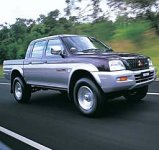
Mitsubishi Triton 4x2**


Overall: 13.98 out of 37
star_2.gif
171.jpg
Variant: GLX 4x2 Single Cab/ChassisKerb Weight: 1340 kgYear: 2005Engine: 2.4 Litre PetrolCategory: UtilityAirbags: No airbags
Risk_Notes::ffffff::FFC300::11.png

High risk of life-threatening head injury
Model_History_%26_Safety::ffffff::FFC300::11.png

The tested model of Mitsubishi Triton 4x2 was introduced in Australia during 2002 and ceased production in late 2005.

Dual front airbags and ABS/EBD brakes are optional on the GLX variant and standard on some variants. The tested vehicle did not have airbags.

Overall_Evaluation::ffffff::FFC300::11.png

The Triton 4x2 scored 3.8 out of 16 in the offset crash test. The passenger compartment was moderately deformed. Protection from serious head injury was poor for the driver. Chest protection was marginal and leg/foot protection was poor.

The vehicle scored 10.18 out of 16 in the side impact crash test. There was a high risk of serious chest injury for the driver and head protection was marginal.

Frontal_Offset_Crash_Test::ffffff::FFC300::11.png

Body region scores out of 4 points each: Head/neck zero pts, chest 1.8 pts, upper legs 2 pts, lower legs zero pts.

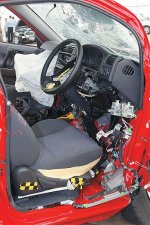
The passenger compartment was moderately deformed in the offset crash test. The brake pedal moved rearwards by 218 mm and upwards 120 mm. The footwell ruptured. The steering wheel hub moved rearwards 73 mm, upwards 112 mm and sideways 19 mm. The front ("A") pillar moved 74 mm rearwards. All doors remained closed during the crash. After the crash tools were required to open the driver’s door.

Steering column components were a potential source of injury for the driver's knees. The hand brake control was a concern for leg injury, although it was outside the zone assessed for knee hazards.

Side_Impact_Crash_Test::ffffff::FFC300::11.png

Body region scores out of 4 points each: Head 4pts, chest zero pts, abdomen 2.05pts, pelvis 3.71pts.

The vehicle was not eligible for a Pole Impact Test since it did not have head-protecting side airbags. This test can earn eligible vehicles an extra two points.


**
Será a mesma pickup? triton.jpg
 
Holden Epica


Overall: 26.41 out of 37
star_4.gif
239.jpg
Variant: CDX sedanKerb Weight: 1540 kgYear: 2007Engine: 2.5 litreCategory: Medium CarAirbags: Dual front + side + head airbags
Model_History_%26_Safety::ffffff::FFC300::11.png

The tested model of Holden Epica was introduced in Australia during 2007.
Dual front airbags and side airbags with head-protection are standard equipment. Antilock brakes (ABS) with electronic brake distribution (EBD) are also standard. Side curtains are standard on the CDXi. An intelligent seat belt reminder is fitted to the driver seat.
The front seat belt buckles are mounted on the seats and the upper anchorages are adjustable. These features improve the fit of the seat belt. Pretensioners are fitted to the front seat belts to reduce slack in the event of a crash. A three point seat belt is fitted to the centre rear seat. This provides better protection than a two point (lap) seat belt.

Overall_Evaluation::ffffff::FFC300::11.png

4 Stars. The Holden Epica scored 8.91 out of 16 in the offset crash test. The passenger compartment held it shape well. Protection from serious leg injury was weak for the driver and chest protection was marginal.
The vehicle scored 14.5 out of 16 in the side impact crash test. There was a slight risk of serious chest and pelvic injury for the driver. A further 2 points were earned in the optional pole test.

Frontal_Offset_Crash_Test::ffffff::FFC300::11.png

Body region scores out of 4 points each: Head/neck 4 pts, chest 1.67 pts, upper legs 2.31 pts, lower legs 0.93 pts.
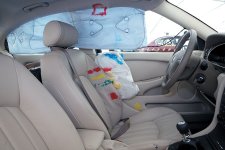
The passenger compartment held its shape well in the offset crash test. The brake pedal moved rearwards by 58 mm and upwards 39 mm. The steering wheel hub moved rearwards 75 mm, downwards 16mm and sideways 28 mm. The front ("A") pillar moved 33 mm rearwards. All doors remained closed during the crash. After the crash all doors could be opened with normal effort.
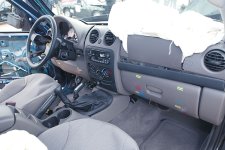
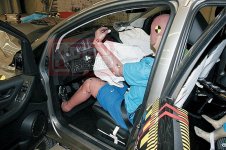
The airbag cushioned the head of the driver. The head rolled off the side of the airbag after the peak of the crash. Steering column components were a potential source of injury for the driver's knees. The passenger's head was cushioned by the airbag.

Side_Impact_Crash_Test::ffffff::FFC300::11.png

Body region scores out of 4 points each: Head 4 pts, chest 2.82 pts, abdomen 4 pts, pelvis 3.68 pts.
The vehicle was eligible for an optional pole impact test, since it had head-protecting side airbags and scored four points for the head in the side impact test. The manufacturer decided to go ahead with the pole test and the vehicle earned a further two points and a 4 star rating.
 
Lower LegNo deductionFoot Score4 points
Modifiers_-_Side_Impact_Test_Scores::ffffff::FFC300::11.png

HeadNoneChestNo deductionUpper LegNoneLower LegNoneFoot ScoreNone
Pedestrian_Rating::ffffff::FFC300::11.png

pedstar_2.gif
Child head impacts 5.54
Adult head impacts 2.50
Upper leg impacts Zero
Lower leg impacts 5.76
Total (out of 36) 13.80
 
Última edição:
Injury_Measurements::ffffff::FFC300::11.png

Offset Crash Test at 64km/hSide Impact Crash Test at 50km/hDriver Pass. Driver
Head::ffffff::708090::9.5.png
HIC535424NoneAcceleration56.948.9None
Neck::ffffff::708090::9.5.png
Shear0.50.88NoneTension1.171.64NoneExtension7.512.3None
Chest::ffffff::708090::9.5.png
Acceleration41.538NoneCompression38.729.4NoneViscous Criterion0.220.16None
Abdomen::ffffff::708090::9.5.png
ForceNoneNoneNone
Pelvis::ffffff::708090::9.5.png
ForceNoneNoneNone
Upper_Legs::ffffff::708090::9.5.png
Force Left0.730.1Force Right0.091.11Knee Displ. Left2.350.06Knee Displ. Right0.395.74
Lower_Legs::ffffff::708090::9.5.png
Force Left2.491.97Force Right2.821.89Index Left (Up/Low)0.31/0.570.32/0.32Index Right (Up/Low)0.49/0.330.4/0.18
Bonus_Points_%28Maximum_5%29::ffffff::FFC300::11.png

Convinha colocar um pouco de ordem neste post! [;)]
 
Injury_Measurements::ffffff::FFC300::11.png

Offset Crash Test at 64km/hSide Impact Crash Test at 50km/hDriver Pass. Driver
Head::ffffff::708090::9.5.png
HIC819656NoneAcceleration77.959.6None
Neck::ffffff::708090::9.5.png
Shear0.50.57NoneTension2.812.01NoneExtension39.134.2None
Chest::ffffff::708090::9.5.png
Acceleration60.340.5NoneCompression53.545.4NoneViscous Criterion0.620.26None
Abdomen::ffffff::708090::9.5.png
ForceNoneNoneNone
Pelvis::ffffff::708090::9.5.png
ForceNoneNoneNone
Upper_Legs::ffffff::708090::9.5.png
Force Left1.431.81Force Right1.65.1Knee Displ. Left0.681.33Knee Displ. Right0.994.47
Lower_Legs::ffffff::708090::9.5.png
Force Left3.264.38Force Right5.323.68Index Left (Up/Low)0.47/1.210.56/0.55Index Right (Up/Low)0.97/0.890.48/0.59
Bonus_Points_%28Maximum_5%29::ffffff::FFC300::11.png

Pole Test: Zero points Seat Belt Reminders: None fitted - zero points

Idem aspas!
 
Injury_Measurements::ffffff::FFC300::11.png

Offset Crash Test at 64km/hSide Impact Crash Test at 50km/hDriver Pass. Driver
Head::ffffff::708090::9.5.png
HIC47533170Acceleration6045.142.7
Neck::ffffff::708090::9.5.png
Shear0.40.54NoneTension1.741.18NoneExtension8.78.5None
Chest::ffffff::708090::9.5.png
Acceleration47.334.3NoneCompression38.3329.427.9Viscous Criterion0.140.080.25
Abdomen::ffffff::708090::9.5.png
ForceNoneNone0.71
Pelvis::ffffff::708090::9.5.png
ForceNoneNone3.24
Upper_Legs::ffffff::708090::9.5.png
Force Left4.710.55Force Right2.722.8Knee Displ. Left00.15Knee Displ. Right1.283.88
Lower_Legs::ffffff::708090::9.5.png
Force Left3.822.62Force Right1.82.82Index Left (Up/Low)1.09/0.410.27/0.24Index Right (Up/Low)0.38/0.590.49/0.46
Bonus_Points_%28Maximum_5%29::ffffff::FFC300::11.png

Igual aqui!
 
Lino, a Opel Sintra no crash test da AMS já evidenciava o descalabro que iria ser a prestação no crash test do Euroncap?
Qual foi o resultado do crashtest da Opel Sintra feito pela Auto Motor Und Sport?
Posta o do Opel Agila [br:)]
 
Lino, a Opel Sintra no crash test da AMS já evidenciava o descalabro que iria ser a prestação no crash test do Euroncap?
Qual foi o resultado do crashtest da Opel Sintra feito pela Auto Motor Und Sport?
Posta o do Opel Agila [br:)]

Sim, já no menos exigente teste da ams a Sintra teve resultados desastrosos, tendo a célula de "sobrevivência" [NOT] entrado em colapso! :sh)
Infelizmente, os maus resultados do Euro NCAP não foram, por isso, surpresa. [s)]

O Opel Agila, pelo contrário, teve um resultado até bastante aceitável, inclusivamente melhor que o seu gémeo Suzuki Wagon R, porque o Opel foi alvo de diversos reforços na sua estrutura, feitos pela própria Opel, que o Suzuki não possuía. :sh)
 
Voltar
Superior