
cloverleaf
New member
Bom fim de semana!




Bem ja fiz a volta de 600 km com o alfa GT. Em autoestrada a velocidades de. 90-110 consegue consumos de 8-8.5. Nada mau...e ainda teve uma ida aos 210 km/h num piscar de olhos.
Em cidade...bem...anda a media nos 18-20 litros.
Esta semana fiz a revisao. Troca de oleo, filtro e anticongelante
 ][]
][]

For a moment it seems Harald J Wester, Alfa Romeo CEO since 2010, is about to break the habit of a lifetime and reveal that bit too much about his company’s future.This is not usual. German-born Wester spent the first 14 years of his career as a young mechanical engineer rising rapidly through the ranks of the monolithic Volkswagen Group – where only those expressly authorised are free to speak in public – so he hardly ever utters a word out of place, even in his second language.
We’re discussing Alfa’s much-publicised expansion plan, announced last summer in Milan, to use eight new models and a much-delayed US launch to boost volume from last year’s sub-80,000 units to 400,000 in 2018 – and as an outsider, aware of the firm’s ropey record on expansions, I can’t resist saying it looks a scarily steep mountain to climb.
Read Andrew Frankel on the Alfa Romeo 75 and original Giulia
Wester is as reasonable and softly spoken as any country vicar, but you can tell that after 15 months of justifying the recovery plan, he’s a little fed up with having to rationalise the validity of his task, especially when the interviewer poses the obvious supplementary: if you couldn’t succeed before, how can you succeed now?
“Look,” he says, with an edge of exasperation, “a volume around 400,000 for all those new models won’t even be a particularly big success for Alfa. Some would say it represents too much new product for too little volume. In the second generation, an investor would probably expect sales to go significantly beyond those numbers.”
How big could Alfa become?
For a second, there’s a hint of an open goal: how much Alfa volume might the investor foresee? How about 600,000? In my dreams, I’ll get a positive answer and an exclusive. The prospect of Alfa Romeo volume achieving viability is especially enticing to someone like me who has chronicled the company’s losses and failed recoveries for 40 years. But the glimpse of a farther future goes in a flash. “Our first job is to make a start,” he says with finality.
“An important part of our job is to make the existing Alfisti happy,” he acknowledges. “It is wonderful, knowing how many people have continued to support our brand in its bad years. But there are not enough of these people available to build a strong future. We have to find more customers, and the way to do that is by providing what they want. Fancy niche models will not contribute very much to our stability.” He does not say “like the 4C” but it is clear this is what he’s thinking.
Where are these new customers?
Wester slips into the ‘professor’ guise he wears rather well. Last year, he explains, around 90 million cars were sold worldwide. Nine million were premium cars – and a remarkable two-thirds of those fell into just four sectors: full-sized saloon, full-sized SUV, mid-sized saloon and mid-sized SUV. Who can be surprised that Alfa plans to launch products in these classes to build its eight-model future?
“Let’s talk Maserati for a minute,” says Wester, continuing the lesson, this time with his second CEO’s hat on (perhaps there will be time to learn something of Abarth, the third string to his busy bow). The total volume of the classes into which Maserati’s models fit makes a million sales worldwide. Of those, 550,000 are SUVs. “You can remain pure and ignore the crossover trend,” says Wester. “But if you do, you can look forward to a beautiful death.”
If his Alfa plan works, Wester says, it will right most of the company’s enduring wrongs by bringing back exciting and emotional products, greatly increasing car manufacture and car-making jobs in Italy (where the Alfas are to be made) and restoring the company to sectors where decent margins can be earned. It sounds like a kind of Italian Nirvana.
However, understanding Wester’s view of the future requires you to appreciate his view of the past: what, exactly, went wrong at Alfa. Given that he has occupied a ringside seat since joining the Fiat Group as chief technical officer in 2004 (after a short stint as Ferrari’s director of product development) his view carries an impressive ring of authority.
When did it all go wrong?
Things started going wrong as far back as 1986, he believes, when Fiat’s bosses found themselves in charge of Alfa Romeo. Understandably, Alfa’s leaders started looking for economies and synergies, instantly finding productive possibilities in the Fiat range. However, they lacked vision and “completely forgot” that one of the prime jobs of the new cars was to continue Alfa’s unparalleled heritage.
As an example of a bungled product, Wester singles out the 159 of 2005, the result of a deal between GM and Fiat that paid only minimal attention to being an Alfa. “It was a mess,” he admits, “an enormous investment in a model that wasn’t even state of the art. The past 30 years were a continuous story of over-promise and under-delivery. Some of Alfa’s managers were disrespectful to everything it stood for in the past. But now we are starting from scratch.”
When will it start going right?
When you enquire, as politely as possible, why the yearned-for renewal is only beginning now, Wester looks weary. Someone as hard working as this isn’t going to respond well to the inference that he and his colleagues have spent years sitting on their hands.
“Ten years ago, we were nearly broke,” Wester explains, “which meant we could not afford to build the products we knew were needed. On top of that, we lacked a proper distribution network, another essential for success. These things have become available recently, because of our association with Chrysler. The game is different now.”
Six of the proposed eight new Alfa models, as we read them, will be volume-builders: two new-generation Giulietta models (probably a saloon and five-door hatchback, maybe on a shortened Giorgio rear-drive platform, although that’s not confirmed); two Giuliamodels off the new platform (the new four-door saloon and probably an SUV-cum-crossover); and a new full-sized saloon and crossover (again using a modified Giorgio platform).
The remaining two models will probably be brand-new versions of the GTV coupé and Spider convertible, again built off the rear-drive architecture. The mid-engined four-cylinder 4C will continue for now, but there is no indication that it will be replaced.
Even though Wester insists it has been successful in the past, the Punto-based Mito definitely won’t have a replacement, simply because this is no longer an economic market sector in which a manufacturer like Alfa is able to operate. “Mito is premium, B-segment, three-door and made in Europe – nobody is buying cars like these,” he says.
On motorsport, Wester confesses that he loves track driving but has no plan to spend Alfa’s precious resources on high-profile racing. It may have helped build the company’s heritage, he says, but the ‘win on Sunday, sell on Monday’ adage simply isn’t appropriate in the modern era. “We will engineer our new cars so owners can enjoy them on the track,” says Wester. “Which means concentrating on lightness, good weight distribution, advanced engines, latest technology and emotional, ground-breaking design. If we can do these things well, we will succeed.”

Should the Grandi Formaggi at Alfa Romeo wish to remind themselves of the standards to which their new Giulia should aspire, they could do a lot worse than study the two cars in our picture, above, in detail.
One is a 75: Alfa Romeo’s last rear-drive saloon and, indeed, the last Alfa to be launched in the company’s pre-Fiat days of independence. The 75 was born 30 years ago, but my guess is that there would be shockingly little dissent among both the general public and Alfisti to my contention that Alfa Romeo has not produced a better saloon since.
The other car is the original Giulia. Old though it is (it was launched in 1962) and angular enough to look more like a small child’s doodle of a car, to me, at least, this is the greatest Alfa saloon of all. I’ll tell you why in a moment. For now, though, let’s consider what they have in common.
Remarkably, given that they hail from different generations, both share the same engine. Okay, the 75 has fuel injection, variable valve timing and two plugs per cylinder and it displaces 1962cc rather than the Giulia’s 1570cc, but at their core both use the same all-alloy, twin-cam motor that appeared in 1954.
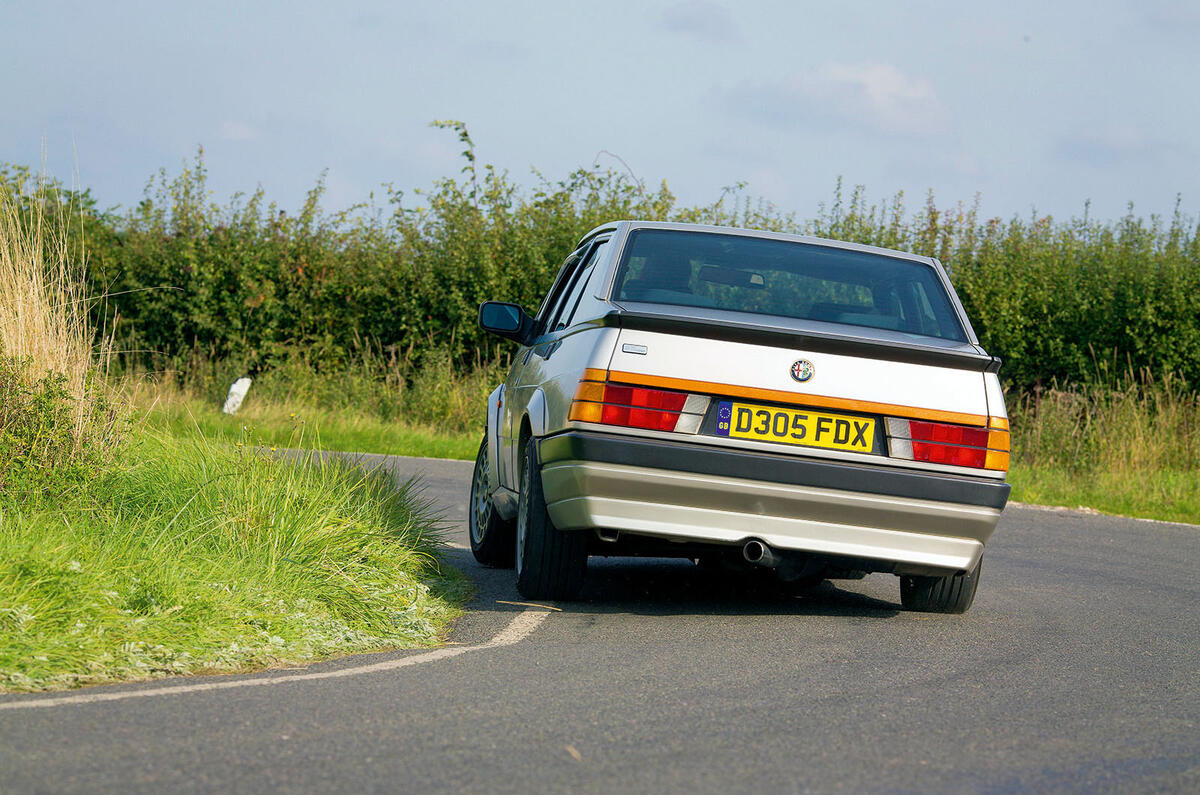
More relevant to today’s designers of the new Giulia is something else they share – less easy to define than a lump of metal under the bonnet, but far more important even than that. It’s an approach and, if you look back through the post-war history of Alfa Romeo, you’ll find every truly great car the company has made follows it.
Simply put, it is the pursuit of driving pleasure through the deployment of the best available engineering solutions. If the new Giulia really is to mark the rebirth of Alfa Romeo, it is this philosophy it must capture.
Read Steve Cropley's interview with Alfa CEO Harald Wester
Take the 75. The engine we already know. It directed its power via a gearbox mounted between the rear wheels – not great for boot space, but brilliant for weight distribution. Its rear disc brakes were located not behind the wheels but inboard either side of said gearbox because there they’d reduce unsprung mass.
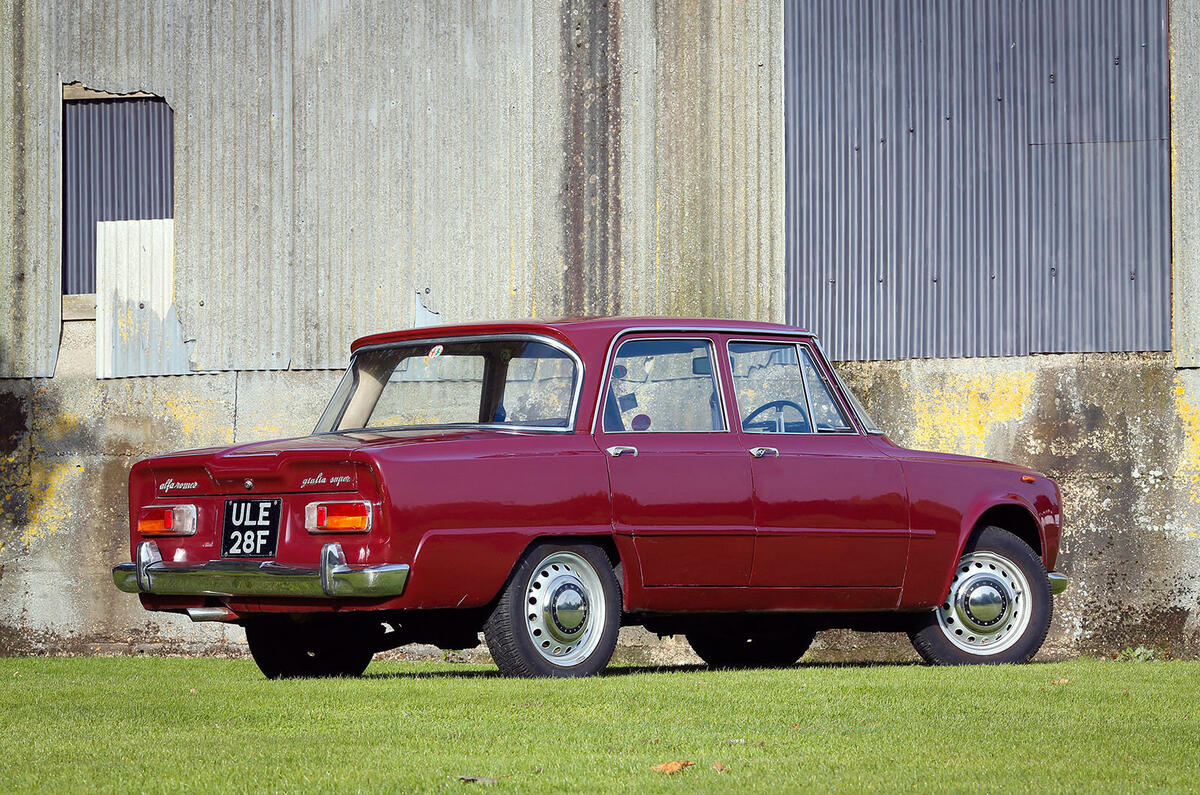
Its front suspension was sprung by torsion bars, its rear axle of De Dion design – once again to cut unsprung weight but also to minimize camber changes under load. A limited-slip differential came as standard.
As for the Giulia, it offered in 1962 a twin-cam engine, a five-speed gearbox and a coil-sprung rear axle, whereas even Ferrari’s staple product at the time, the 250GT, had a single cam per bank, a four-speed gearbox (plus troublesome overdrive) and cart-type leaf springs at the back. The Alfa also had disc brakes at each corner – an unheard of refinement in a saloon of its size at the time.
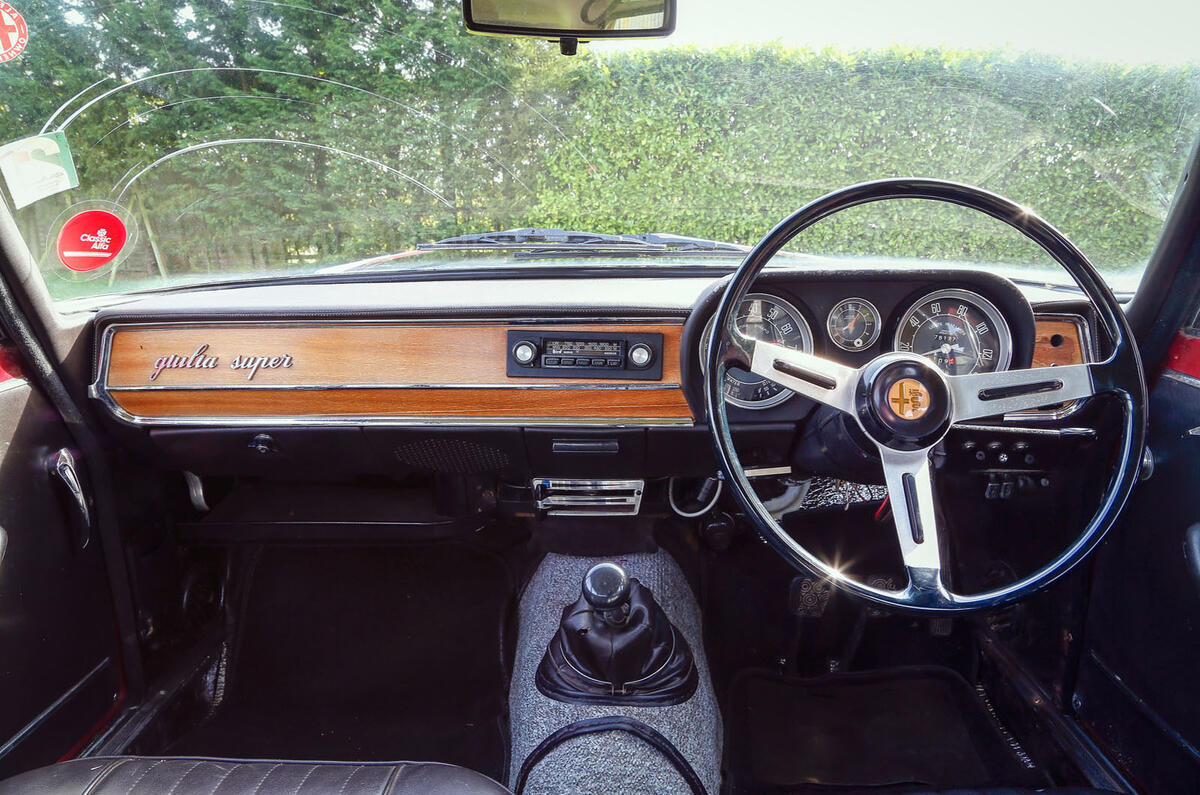
The result is extraordinary, like your blue-rinse grandma suddenly leaping to her feet at your sister’s wedding reception and throwing shapes all around the dance floor. The Giulia might look fuddy-duddy but that’s not how it drives. The car here is a 1967 Giulia Super with a brace of Weber carbs strapped to the sides of its twin-cam motor. Together they offer a fabulous sound and surprising pace. However, the real class act is the chassis.
On tyres skinnier than those fitted to most motorcycles, the Giulia feels taut, accurate and responsive. Steering feel is of a kind that’s been extinct in family saloons for decades and when you lob it into a corner at the improbable speed it will carry, the car may heel over but it will hit your apex every time. There’s not quite the power to boot the tail out but in quicker turns you just set your approximate trajectory with the wheel and fine tune your line with your right foot from thereon in. There is a driver’s car of rare skill lurking within that mumsy shape.
The 75 plays the same game, but at a rather higher level. You may be wondering why there’s a Twin Spark in these pictures rather than the full fat 3.0-litre V6. The answer comes in two parts. Firstly, the Twin Spark is better balanced, and second, you may have no idea just how difficult it is to find an unmolested example of any 75 these days, regardless of engine. V6s are far quicker and sound better but you lose something in the handling. One is neither better nor worse than the other – just different.
The Twin Spark doesn’t actually feel that quick. It spreads its 148bhp over a wide rev range and while fuel injection has robbed it of the inimitable Alfa growl, it’s still a cultured, pleasant voice in the car. Unexpectedly, given how terrible earlier Alfa transaxle gearboxes were to use, the 75’s is a delight. Again, though, it is the handling that makes the 75 honour its marque and why, over 20 years since the last one was built, we still felt the need to hunt down a 75 and try it out.
On fat modern tyres it has grip aplenty but, just like the Giulia, it is the car’s balance that distinguishes it from the Alfa saloons that followed it. It turns in so sweetly and with such poise that you’re tempted to look behind to make sure it really is a four-door saloon.
It shares the Giulia’s aversion to understeer and prefers to adopt a neutral stance, while feeding information about grip levels and the road surface through the seat and steering. Like the Giulia, the 75 offers an immersive and delightful experience. It plucks you out of the director’s chair and throws you into the action.
Both cars demonstrate how Alfa Romeo managed to stand out from the crowd then and how it could do so today. The new Giulia need not have the joke driving position of its forebear or the insane ergonomics of the 75. It just needs their character, innovation and verve.
With great looks, rear drive and a 50/50 weight distribution, the new Giulia represents Alfa’s best chance in 30 years of launching a great mid-size saloon. I hope with all my heart that it takes it.
Alfa’s best saloons since the 75
Alfa Romeo 164: Shares underpinnings with the Lancia Thema, Saab 9000 and Fiat Croma but comes with Alfa power and Pininfarina looks. With a spacious and sensibly arranged cabin, it was a fine effort undone only by 3.0-litre models’ prodigious torque steer and poor build quality.
Alfa Romeo 156 3.2 V6 24v GTA: This isn’t a great Alfa by any means — the requirement to send 250bhp through its front wheels saw to that — but it was hugely characterful by Alfa’s latter-day standards and was involving to drive, even if not always for the right reasons. Worth it for the noise alone.
Alfa Romeo 159 3.2 JTS V6 TI Q4: A complicated name for a car made far simpler to drive than its predecessor by the provision of four-wheel drive, there to deal with the power of the 3.2-litre V6. Overweight and not wholly engaging, the Q4 was at least competent, attractive and quick.
Alfa Romeo's global expansion is being reexamined because of the Chinese market's slowdown, said Sergio Marchionne, CEO of Alfa parent Fiat Chrysler Automobiles.Marchionne said the continued weakness of imported luxury vehicles in China had forced a reassessment of FCA's strategy for its struggling sporty brand.
FCA stands by its plan to boost Alfa's annual global sales to 400,000 in 2018, the CEO said. But a large portion of the volume projection that had been assigned to China would have to be absorbed by other regions, including North America and Europe, Marchionne told analysts on FCA's third-quarter results call on Wednesday.
FCA unveiled in May 2014 plans to invest 5 billion euros in Alfa including the addition of eight new models.
All of the planned Alfa vehicles will still be developed and FCA will still spend the same amount on developing Alfa, Marchionne said. But the new vehicles may come in a different order to satisfy consumer tastes in Europe and North America and the planned investment will be completed in 2019 or 2020, he said.
Marchionne said Alfa "still belongs in China" but the volume projections for the brand there are not achievable under current market conditions.
Alfa will need to "rejig" its plans to focus on launching cars that are more ideally suited to Europe and North America rather than China, he said. The revised sequence likely will be announced in January, he said.
Alfa sold fewer than 70,000 cars last year, mostly in Europe. Its current lineup comprises two core models, the Giulietta compact and MiTo subcompact, along with the limited-production 4C sports car.
The brand's first new model will be the Giulia midsize sedan. Giulia sales will start before the end of the year led by a high-specification Quadrifoglio launch edition that will start at 95,000 euros in Italy.
Other new cars under development or under consideration include a midsize SUV, a midsize coupe, a large sedan,a large SUV, a new compact family and a roadster.
]
e virou..... [
Mas compreende-se a decisão.
Vamos ver que alterações haverá ao plano original.
A meu ver, o Giulietta poderá subir na lista de prioridades para garantir o necessário volume e o seu desenvolvimento iniciar-se mais cedo que o previsto.
Isto em troca com o sedan de segmento E. Aposto que seria a aposta para a China, já que, nos premium, o segmento E consegue vendas superiores ao segmento D.
][]
e virou..... [
Mas compreende-se a decisão.
Vamos ver que alterações haverá ao plano original.
A meu ver, o Giulietta poderá subir na lista de prioridades para garantir o necessário volume e o seu desenvolvimento iniciar-se mais cedo que o previsto.
Isto em troca com o sedan de segmento E. Aposto que seria a aposta para a China, já que, nos premium, o segmento E consegue vendas superiores ao segmento D.
Marchionne revises Alfa strategy on China slowdown - Autonews
Stephen M. Reitman - Société Générale SA (Broker)
Yes, thank you. Good afternoon. Moving on to Alfa Romeo, I took your comments that you're keeping the 400,000 unit target for 2018. But you've – having adjusted your some of the definition in particular relation to China. Could you give some indication on where you think that you'll be redirecting these units?
Sergio Marchionne - Chief Executive Officer & Executive Director
Where else, but China. I mean that I'm going to have to give you a dumb answer because I gave you a broad indication of what I think market conditions in China are going to dictate us. Based on what I see today in terms of market performance, I still think that Alfa belongs in China, the expectations of volumes out of the total pool of 400,000 cars by that date were, I think given current market condition is not achievable. So, we need to find it somewhere else. And I think Europe and NAFTA are probably the best areas to deliver it.
But that's going to require rejigging on the launch of the cars because there are cars that are more ideally suited for these markets than they would have been for China. And so, we need to work over the next 30 days, 60 days to try and refine them and give you a better answer by January of next year. But look, two things, one, the product plan is confirmed, the sequencing is going to be adjusted in mainly of the capital phase overall by 2018, although over the term until 2019 or 2020 we'll spend the same amount of money as we had originally forecasted and the numbers are not shrinking.


