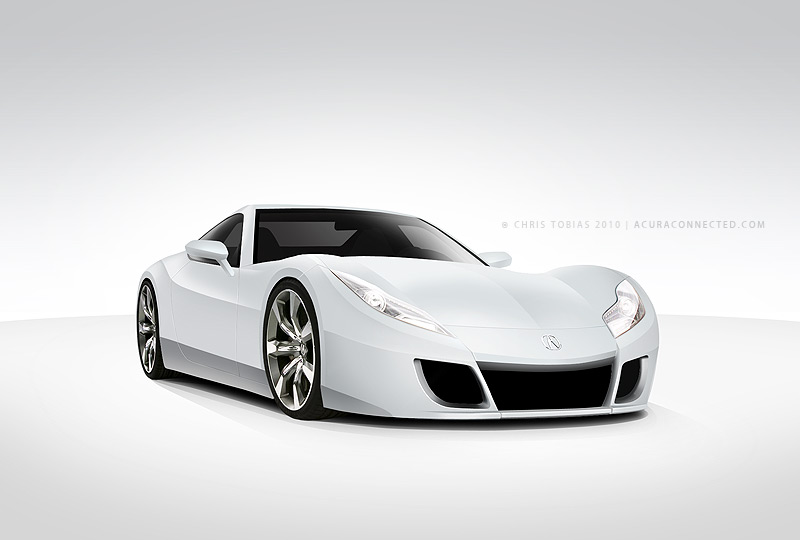
Honda NSX

Honda confirma lançamento de novo super-desportivo
Sucessor do emblemático NSX terá como objectivos excelente relação potência-peso e máxima eficiência
20/09/2011 em Geral

Takanobu Ito, actual presidente da Honda, confirmou oficialmente o lançamento de um novo super-desportivo, sucessor do emblemático NSX. O responsável máximo da marca nipónica garante que o próximo desportivo não vai tentar alcançar o característico som de motor de um Ferrari, apontando metas para uma excelente relação potência-peso e máxima eficiência.

O modelo original (na imagem) foi comercializado entre 1990 e 2005, contava com dois lugares e motor central-traseiro, e destacava-se pela carroçaria totalmente fabricada em alumínio, característica que contribuía para acusar na balança um peso de apenas 1350kg.

A ideia de desenvolver um novo super-desportivo não é de agora. Em 2007, a Honda demonstrou a intenção de criar um «novo» NSX, com o Acura Advanced Sports Car Concept mostrado no Salão de Detroit.

Também em 2008, surgiu o projecto de um desportivo com motor V10, entretanto cancelado devido à recessão global.

Para Ito, o próximo super-desportivo será também uma oportunidade de demonstrar que a marca japonesa não esqueceu a herança desportiva apenas porque mudou o foco para a eficiência no consumo de combustível nos seus últimos lançamentos.

link para as fotos

Revelados segredos do novo Honda NSX, Foto 0 - Autoportal
 
NSX híbrido?

NSX híbrido?

13676735161436548663.jpg


1317699199328413944.jpg


Surgiu na net a notícia de que o Acura de Tony Stark (do filme The Avengers) poderá ser a "base" do novo NSX e, tal como já escrito neste tópico, cujo protótipo deverá surgir no Detroit Auto Show.

Para além disso, o carro estará equipado com uma motorização híbrida.

Fonte: WorldCarFans
 
Um comparativo curioso da Inside Line
1991 Acura NSX vs. 2012 Audi R8
Battle of the Stoic Supercars
By Josh Jacquot, Senior Editor | Published Jan 17, 2012

It's likely that Acura's 21-year-old NSX is most famous for things it never actually did.

1990, you might recall, wasn't a year when supercars covered themselves in the glory of either shocking performance or metronomic reliability. The stink of '80s automotive misery hadn't yet worn off and the glory of middleweight performers like the RX-7, 300Z and fourth-generation Supra was yet to take hold. When it came to supercars, it was the era of the Ferrari 348, a machine so awful to drive it couldn't even find a private investigator drama in which to hide.

Following, in no particular order, are some things most NSXs never did: leak, stall, stink, burn, ventilate their crankcase, cook their clutch, experience catastrophic electrical failure, overheat or simply strand their driver. The NSX, for all its hype, sprang from a time when mixing some mundane Honda Accord into the supercar stew, rolling it up in an aluminum body and dropping it into a market ripe for a real driver's car was a stupendously good idea. Good enough, in fact, to last for 15 years.

Next to Porsche's ubiquitous 911, the NSX might just be the most practical, reliable real-world supercar ever built. But in 1990 there was something more exotic about a low-slung, midengine, aluminum-bodied supercar than there was about any Porsche. And there's still truth in that statement today. Which is why we think Audi's R8 might be the best spiritual successor the NSX could have.

Here, then, is how they stack up.

The Basics
It's the cab-forward, engine-behind-cockpit layout that's the defining similarity between the R8 and NSX. Following modern trends, the R8 is bigger in every dimension. It is 1.2 inches longer, 3.2 inches taller, 4.7 wider and its wheelbase is 4.7 inches longer than the NSX.

If raw output is all that matters, the NSX's transverse-mounted 3.0-liter, 270-horsepower V6 is no match for the Audi's longitudinally mounted 4.2-liter 430-hp V8. Gears are selected in the NSX via a five-speed manual transmission, while cogs are slotted home via a gated six-speed manual in the R8. And when it comes to powertrains, that's where the similarities stop.

The Audi, naturally, drives all four wheels through three differentials that produce a distinctly rear-drive balance. The NSX's rear-drive balance is more authentic thanks to a conventional transaxle and clutch-type limited-slip differential driving, well, the rear wheels.

The Numbers
The performance data in this test serve to demonstrate how far supercars have come in 21 years more so than to help determine a winner.

Accordingly, let's look first at one area where progress isn't so easy to gauge. At 3,010 pounds the NSX might be the only car we've ever rolled onto our scales that exactly matches its manufacturer's claimed weight. And because it's 611 pounds lighter than the R8 (3,621 pounds) it demonstrates one area where technology and cubic megadollars are yet to produce a positive impact in performance cars.

Fortunately, performance hasn't suffered the same decline.

Ripping to 60 in 4.5 seconds (4.3 with 1 foot of rollout as on a drag strip) gets the R8 there a solid 1.1 seconds quicker than the NSX (5.6 seconds, 5.3 with rollout). The 0.9-second gap at the quarter-mile demonstrates that it's the Audi's launch that produces its biggest advantage. Here, even the 21-year-old NSX holds its own by running a 13.7-second pass at 102 mph. The R8's 12.8-second pass at 110.1 mph is quicker, but not as much as its 21-year advantage might lead one to believe.

Handling, too, is beyond the NSX's years. It shimmied through the slalom at 69.3 mph on nine-year-old rubber, (we tested it on new tires, too, but the numbers were inexplicably worse) a feat the Audi handled at 72.1 mph. Lateral acceleration worked out to 0.88g and 0.98g for the Acura and Audi, respectively.

When it comes to stopping, the Audi's contemporary rubber and ABS technology are far superior. It required only 105 feet to come to a halt from 60 mph. The NSX needed an additional 26 feet.

The Similarities
Through the magic of the Inside Line time machine we were able to experience these two cars on the same piece of unoccupied driver's road at the same time. And the gap between them at the top of the road was nearly as substantial as the years between them. But, spiritually, there were ample parallels.

Perhaps the biggest of these is the compact, balanced sense of confidence that begins in each car's powertrain layout and culminates in confident, direct inputs from its driver. There's a deftness possessed by midengine cars that is distinctly absent in any other layout. Wood the throttle in either of these machines and its nose rises with an immediacy and directness that could never exist in a car with its mass centered farther forward.

Similarly, both cars demonstrate a willingness to change direction not available in a car with its engine placed outside the axles. Mass centralization. Don't discount it. Even when it's 21 years old.

But there are differences.

Old vs. Bold
Performance car engineers — at least those developing contemporary cars like the R8 — are obsessed with reactions. Every input should be answered with an immediate and rewarding reaction, right? That's what they say.

The result is a mixed blessing.

Twenty-odd years ago the guys making these decisions on the NSX either had different goals or different expectations. Nowhere is this dissimilarity more apparent than in the way these two cars steer. The NSX's variable-ratio steering rack (18.2:1 to 20.8:1) is slower than the R8's fixed 17.3:1 ratio, but the numbers hardly tell the story.

Predictably, the effort required to corner both cars plays heavily into the experience. The Audi's hydraulically assisted steering makes nearly no demand on its driver and still supplies enough information to attack the road confidently. The NSX's weighty wheel is better than many full manual racks we've experienced, but leaves little reason to do anything but surrender to the car's relatively low limits once understeer is achieved.

Largely, this is because we fear finding ourselves in a situation that requires "fixing" any kind of oversteer without the benefit of modern assisted steering. Call us wimps, but not before you correct oversteer in a midengine manual-steering car yourself.

Still, this limitation doesn't diminish the reward of the NSX experience. It's just one element that makes it slower than its modern counterpart.

Here's Another
The R8's reaction to throttle input is insanely rapid by 1990 standards. Partially, this is due to the blunt honesty of the first-generation NSX's simple, cable-actuated throttle. The control provided by electronic throttles has supplied engineers with undue command over a car's character. The resulting eagerness has reached the point of absurdity in some cars. Fortunately, it's not so much a problem in the R8 as it is motivation to start paying attention.

Snap the Audi's throttle open and the chassis responds instantly and intuitively. Somehow, despite driving all four wheels, the Audi reacts like a rear-driver, offering a rewarding ability to balance power against steering without the need for heavily calculated metering. Its approachable limits are a blessing in a car that could easily have overlooked such details. Vorsprung durch Technik, indeed.

Not so in the NSX.

The Acura's response to throttle input carries far less consequence. Measured against the snap-to-it reactions of the more powerful R8, the NSX's response to big, aggressive movements of the throttle doesn't demand as much attention or reward as heavily. This, we'll admit, is in large part due to a significantly lower power-to-weight ratio (8.4:1 Audi vs. 11.1:1 NSX).

It's here that the NSX, when measured against the wildly involving R8, begins to show itself for what it is: old.

Oldie but Goodie
Still, there are genuinely striking qualities in this aged sports car that are distinctly absent in the R8. Like, for example, the simple, authentic way the NSX gets down the road. Forget about radical urgency. Forget about breakneck reactions. All of the NSX's controls perform their duty resolutely but without the Audi's pressing haste. It's like comparing Mother Love Bone to Mother Theresa. One screams its intent in your face and the other is content to let its actions do the talking over the whole of the experience.

The NSX's shifter slots into the selected cog with a fidelity lacking in most modern car/driver interfaces. It's especially striking considering this car's age. That's to take nothing from the R8, whose manual shifter might be the best in the world today.

Reality says that any car as old as the NSX is going to lack the speed and confidence provided by a modern supercar like the R8. But that doesn't mean the experience is bereft of passion. Perhaps the most potent bit of character is an intake note that tunnels down its driver's ear canal, shoots through his brain stem and penetrates his soul. Truly, there are few cars before or since the NSX that offer the audible reward produced by its 8,000-rpm anthem.

Also, we'd never have thought 21 years ago that we'd look back on Honda's '90s design ethos as soulful. But viewing modern cars through the lens of small pillars, a low waistline and simple controls makes us yearn for such unvarnished honesty in design. The R8 has a similar feel, but can't match the NSX's original brilliance.

The Final Calculus
There's no way to handily summarize the best car here. And that's not what we're trying to do anyway. The point is to capture each car's spirit. The NSX, 21 years ago, was ahead of its time — both in its construction and its attitude. It wasn't the fastest or most powerful car built, but it made a strong case for combining quality, durability and everyday drivability with engaging at-the-limit character. It's an enduring formula that's built into the most successful supercars made today — including the R8.

We're not picking a winner. Rather, we're answering this question: Which car would we want in our garage? Judged on the experience alone, the answer is easy. The R8's ability to engage, its outright speed, its sound and the reward it provides during hard driving easily outshines the 21-year-old NSX.

But experience tells us those qualities aren't all that will matter in 20-plus years. The Audi supercar's place in history will be also determined by its ability to endure time both mechanically and visually. And those are much, much larger demands.

We'll be keeping the NSX around just in case.

2012_audi_r8_group_fe_111122_717.jpg

2012_audi_r8_group_fe_111121_717.jpg

2012_audi_r8_group_fe_111124_717.jpg


Talvez fosse mais interessante comparar com o NSX pós-restyling, já com o 3.2.
Não deixa de ser um comparativo interessante. O NSX foi referencial a muitos niveis, dado as qualidades do produto e tecnologia apresentada.
E ainda hoje é relevante, dado ser tantas vezes referenciado como um bom caminho a percorrer no que toca a concepção automóvel ou abordagem ao projecto.
 
gostei bastante deste comparativo, o nsx mostra claramente as suas barbas brancas quando comparado com o r8, o que era expectável. um outro comparativo engraçado seria o s2000 vs gt-86

em relação ao novo nsx, só gostava que viesse o engenheiro chefe responsável por todo o projecto, explicar porque é que a estética do novo nsx não foi feita tendo como base o hsv que neste momento corre no campeonato de supergt
 
O HSV era para ser o sucessor do NSX. Depois do projecto cancelado, e já com tanta coisa feita, ainda assim aproveitaram a coisa para servir de base à máquina do campeonato Super Gt.
E ainda bem que não aproveitaram a estética do HSV. Por muito imponente e espectacular que seja o carro de super GT, quando "civilizado" para carro de produção daria algo com muito menos sal. ALém disso, é um carro que já deveria ter sido lançado faz uns aninhos. Actualmente, tanto Honda como Acura já caminham para outras permissas visuais.

E claro, tem uma arquitectura completamente distinta daquela que o futuro NSX irá usar. O HSV tem motor em posição central dianteira, o que o faz possuir as proporções clássicas de um GT, com capot longo e habitáculo recuado.
Ora, como é que isso encaixaria no novo NSX que tem o motor atrás dos seus ocupantes?

A adaptação seria ruinosa no ponto de vista estético. Já que se temos arquitecturas distintas, ao menos que se desenhe de acordo com elas, e não se façam adaptações forçadas que originem resultados manhosos. A Honda/Acura não têm propriamente acertado no look dos seus últimos lançamentos.
O NSX que apareceu em Detroit revela largos passos numa muito melhor direcção.
 
O HSV era para ser o sucessor do NSX. Depois do projecto cancelado, e já com tanta coisa feita, ainda assim aproveitaram a coisa para servir de base à máquina do campeonato Super Gt.
E ainda bem que não aproveitaram a estética do HSV.

epá, não o deviam ter cancelado, podia ter saído algo para concorrer com aston martins e maseratis...


Por muito imponente e espectacular que seja o carro de super GT, quando "civilizado" para carro de produção daria algo com muito menos sal. ALém disso, é um carro que já deveria ter sido lançado faz uns aninhos. Actualmente, tanto Honda como Acura já caminham para outras permissas visuais.

se formos a ver os restantes exemplos, supra, gt-r, nsx, os modelos de estrada destes continuam a reter alguma da agressividade, temos os casos extremos do mx5, mr2 e sc430 que conseguem transformar carros mais aborrecidos em termos estéticos em carros de corrida das "trevas"
 
EU considero que esse HSV foi muito bem colocado na prateleira. Estimava-se que teria um enorme V10 com 500-550cv, provavelmente tracção integral.
A Honda a fazer Godzillas não é algo que encaixe naqueles ideiais que vejo numa Honda.
O que espero de um Honda desportivo, é mesmo coisas como o NSX original, o s2000, os Type-R, um Integra. Máquinas ligeiras e focadas, com motores estridentes.
Deixemos os Godzillas para a Nissan... Não precisamos de mais bestas automóveis.

EDIT: vão ao site do jayleno's garage e procurem pelo teste ao seu Honda S600. E principalmente, oiçam aquele motor na altura do test-drive. É aquilo que espero de um Honda[:D]
 
Last edited:
Esse HSV que desconhecia (não sigo desporto automóvel) parece um TVR Sagaris.

Ou então fez-me lembrar um...

Gostei da parte final:

The Final Calculus
There's no way to handily summarize the best car here. And that's not what we're trying to do anyway. The point is to capture each car's spirit. The NSX, 21 years ago, was ahead of its time — both in its construction and its attitude. It wasn't the fastest or most powerful car built, but it made a strong case for combining quality, durability and everyday drivability with engaging at-the-limit character. It's an enduring formula that's built into the most successful supercars made today — including the R8.

We're not picking a winner. Rather, we're answering this question: Which car would we want in our garage? Judged on the experience alone, the answer is easy. The R8's ability to engage, its outright speed, its sound and the reward it provides during hard driving easily outshines the 21-year-old NSX.

But experience tells us those qualities aren't all that will matter in 20-plus years. The Audi supercar's place in history will be also determined by its ability to endure time both mechanically and visually. And those are much, much larger demands.

We'll be keeping the NSX around just in case.

O NSX mesmo acusando a idade não se envergonha quando comparado com um projecto actual equivalente.

Será também interessante quando sair as duas novas versões de ambos e compara-las entre si mano-a-mano.

Tirando a traseira levantada acho que o NSX continua muito "actual" :)
 
EU considero que esse HSV foi muito bem colocado na prateleira. Estimava-se que teria um enorme V10 com 500-550cv, provavelmente tracção integral.
A Honda a fazer Godzillas não é algo que encaixe naqueles ideiais que vejo numa Honda.
O que espero de um Honda desportivo, é mesmo coisas como o NSX original, o s2000, os Type-R, um Integra. Máquinas ligeiras e focadas, com motores estridentes.
Deixemos os Godzillas para a Nissan... Não precisamos de mais bestas automóveis.

EDIT: vão ao site do jayleno's garage e procurem pelo teste ao seu Honda S600. E principalmente, oiçam aquele motor na altura do test-drive. É aquilo que espero de um Honda[:D]

O CEO da Honda quando viu o projecto questionou os engenheiros se aquilo era um S5000. Vou pesquisar alguns excertos da entrevista.
 
O novo NSX terá versão de pista
quierocorrer-1327452713.jpg

Según pudimos saber hace dos días, Honda preparará en paralelo al desarrollo de la versión de calle, un NSX de competición "carreras-cliente", para aquellos que quieran meterse en el mundo de las carreras con la nueva joya de la corona de Honda.

El modelo de competición conservaría el sistema híbrido, aunque desconocemos completamente dentro de qué homologación internacional se asentaría. Por lógica, lo suyo sería que la FIA abriera un capítulo dentro de la GT3 para híbridos y Honda tuviera allí su lugar, ya que GT3 es, ahora mismo, la categoría más "interesante" del mundo GT.

Con un coche de estas características Honda podría atacar el Mundial FIA GT, correr las 24 Horas de Nurburgring, las de Spa Francorchamps, o incluso llegar a correr Le Mans en categoría GTE (que debería, en 2014, converger con las regulaciones FIA GT).
 
Também acho o NSX e o R8 carros bastante comparáveis em conceito e até tecnologias.

Uma das principais características do Audi é o seu chassis Spaceframe, pessoalmente acho isto incrível, é como pegar num chassis tubular, substituir por aluminio e fazer a ponte entre isso e o normal monobloco. Custa a entender como o R8 não supera facilmente carros como 911. Só prova o quão soberbamente afinado é este Porsche.
É que a Audi podia dar-se ao luxo de ter prejuízo com este modelo, pode aplicar tecnologias mais dispendiosas se for caso disso, a Honda sabe-se perdia dinheiro por cada NSX que vendia, tal como o R8 com o seu chassis e carroçaria em aluminio, já a outra concorrente, a Porsche, não podia ter prejuízo com o 911, opta por uma solução mais barata e rápida de produzir conseguindo ainda assim ser uma referência, sem dúvida algo a reter e que marca a diferença de experiência destes construtores.

De qualquer forma o facto do NSX ser um produto tão maduro (ainda que o primeiro e único superdesportivo da marca nipónica) e utilizar tecnologias à frente do seu tempo faz com que a linha que o separa do R8 seja mais ténue. Acredito que um NSX com alguns updates podia ainda estar hoje à venda afinal a maior diferença entre a performance de ambos deverá ser potência e grip pois o espírito está todo lá e esse aí é mais difícil de conseguir.
 
EU considero que esse HSV foi muito bem colocado na prateleira. Estimava-se que teria um enorme V10 com 500-550cv, provavelmente tracção integral.
A Honda a fazer Godzillas não é algo que encaixe naqueles ideiais que vejo numa Honda.
O que espero de um Honda desportivo, é mesmo coisas como o NSX original, o s2000, os Type-R, um Integra. Máquinas ligeiras e focadas, com motores estridentes.
Deixemos os Godzillas para a Nissan... Não precisamos de mais bestas automóveis.

EDIT: vão ao site do jayleno's garage e procurem pelo teste ao seu Honda S600. E principalmente, oiçam aquele motor na altura do test-drive. É aquilo que espero de um Honda[:D]

Deixou-me húmido.... que som!!! [br:)][br:)][br:)]
 
Back
Top