
You are using an out of date browser. It may not display this or other websites correctly.
You should upgrade or use an alternative browser.
You should upgrade or use an alternative browser.
Mazda Mx5
- Thread starter crash
- Start date

reckoner00
New member
Mazda MX-5 by BBR


BBR will apply its considerable expertise to the fourth-generation Mazda MX-5when it arrives in the UK this summer, with these early depictions released to whet our appetites.With no physical car to work on, the tuner has given itself a head start by revising the 2-litre SkyActive engine inside a Mazda 3 hatch *– the same one that will be offered in the MX-5.
So far 200bhp has been massaged from its four cylinders using the camshaft and exhaust manifold modifications last seen on BBR’s MX-5 ‘Super 200’ package. Priced at £2195, this upgrade was and remains tempting next to the official Mazda-sanctioned MX-5 GT that was tuned by Jota and cost a heady £6,900 premium (albeit with adjustable Öhlins suspension).
BBR will offer several versions of the new MX-5, and once its engineers have outsmarted the SkyActiv’s sophisticated ECU encryption the door will be open for forced induction. Supercharging is preferred to turbocharging because of the engine’s high compression ratio, which means it won’t take high torque levels at low engine speeds.
BBR says it is ultimately aiming for at least 250bhp from the upcoming MX-5, something that bodes very well for drivers in light of the new car’s 100kg weight saving over the outgoing model and 50:50 weight distribution.
BBR has in the past been sparing with bodywork modifications, but the concept car pictured features a deeper front spoiler and sills than standard as well as a dainty bootlid spoiler (below which is the daintiest diffuser that ever was). With existing customers requesting only ‘subtle bodywork alterations’, however, any further aerodynamic changes will be slight.
evo Magazine readers will be familiar with BBR. The Brackley outfit’s MX-5 GT270 acquitted itself well against everything from Porsche’s 911 GT3 to theAriel Atom 3.5R at our recent Track Car of the Year contest, and at £29,995 the 268bhp roadster represents tantalisingly good value for money. Less expensively, the Super 180 also went down well when we reviewed it in 2013.
Watch us pit BBR's version of the outgoing Mk3 MX-5 against the Toyota GT86 TRD below
reckoner00
New member


Last edited:
reckoner00
New member
Primeiro teste do MX-5 pela Quattroruote - Mazda MX-5 - Al Volante Della Quarta Generazione [video] - Quattroruote
Edit: Teste da Autoexpress http://www.autoexpress.co.uk/mazda/mx-5/90240/convertible
Edit: Teste da Autoexpress http://www.autoexpress.co.uk/mazda/mx-5/90240/convertible
Last edited:
reckoner00
New member
Teste - Mazda MX-5 1.5 - Autocar

MX-5 goes back to basics, to become a car that’s as nimble and sweet as the beloved MkI.
MX-5 goes back to basics, to become a car that’s as nimble and sweet as the beloved MkI.
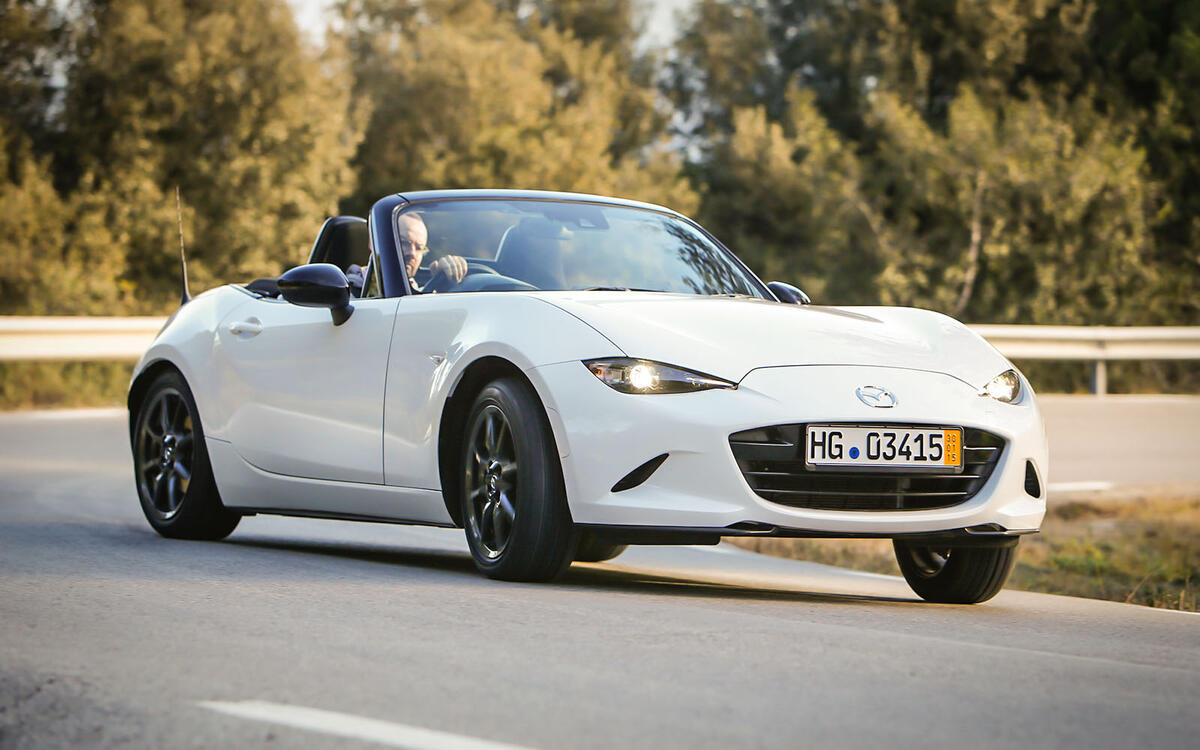
What is it?:
A ‘sneak peek’ and quick drive of the fourth-generation Mazda MX-5, some seven months before it becomes available in the UK.
There could be any number of reasons we’re invited to drive such an early car. Usually they’re cynical reasons: a carmaker wants to build customer anticipation, garner feedback, or try to steal some headlines from a rival product.
But I don’t think any of those applies here. The impression I get is that simply every engineer, designer, manager and administrator who has been involved in the development of the new MX-5 is so unbearably excited that they simply couldn’t keep it to themselves any longer. Like the owners of a new puppy, they just wanted to show it off.
You can see why. For one, it’s small: shorter than any MX-5 before. And it’s light. Talk is of a tonne.
That, as you’ll know, is precious little for a car that has a longitudinally-mounted front engine and is rear driven. Especially when you consider that the MX-5 isn’t miniscule like a Suzuki Cappuccino or stripped-out like a Caterham Seven. A couple of engineers name-checked the Seven during their presentations. These are the kind of people we’re dealing with. Our kind of people.
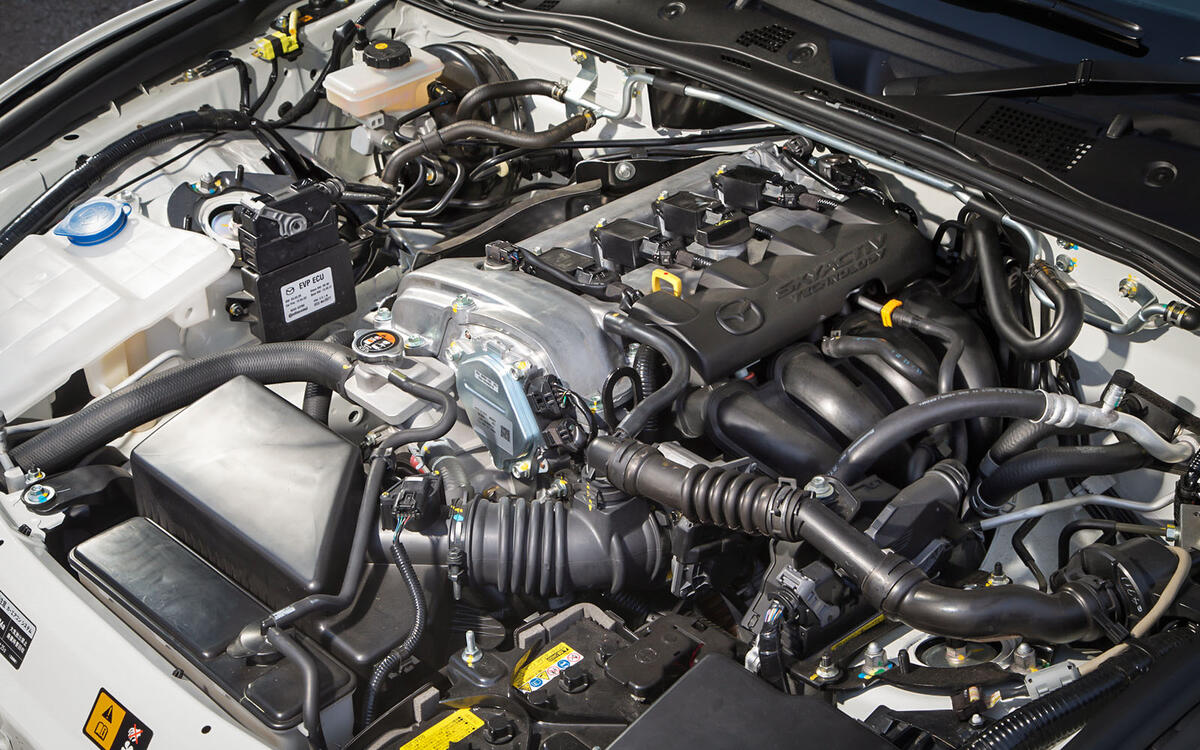
So there’s extensive use of aluminium and the base engine, a 1.5-litre unit (there’ll be a 2.0-litre too, but more on that another time), plus its new 6-spd gearbox, are smaller than the old powertrains.
That allows them to be set 13mm lower and 15mm further back than on the previous car. In turn that means the bonnet and overhang to be the lowest and shortest, Mazda claims, of any production car.
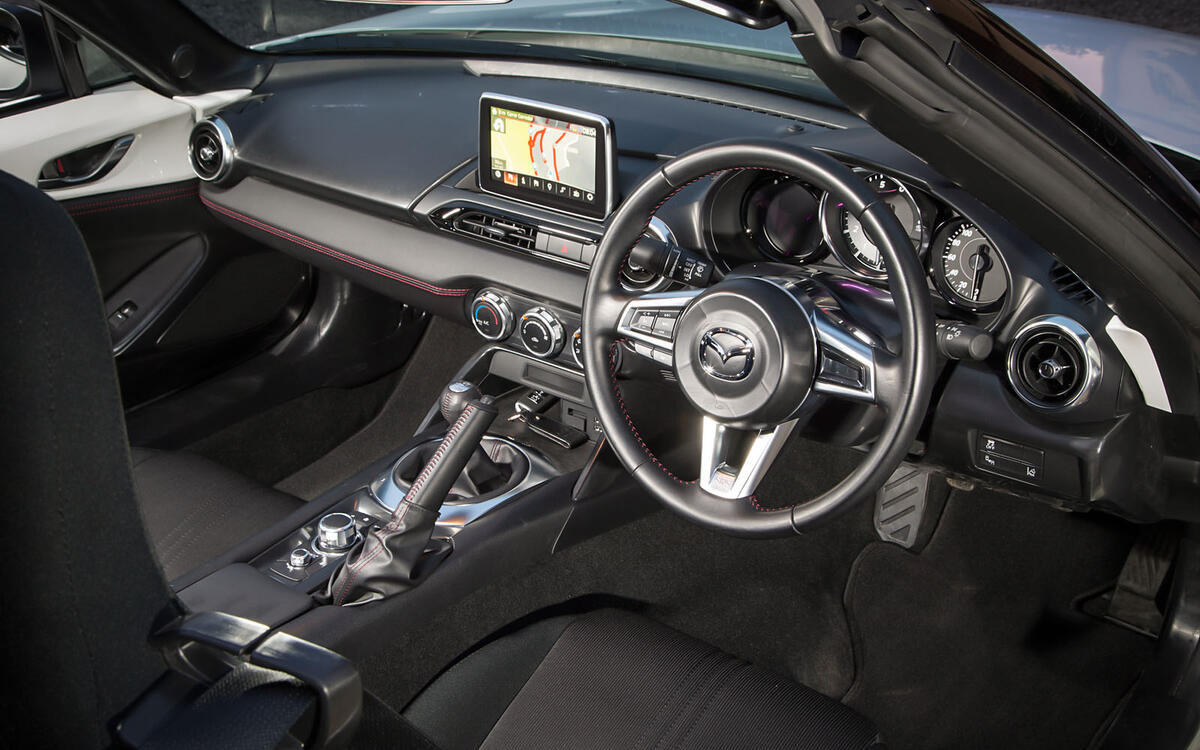
Inside a slightly unfinished but otherwise pleasing interior, the seat cushions are supported on netting rather than metal springs, making the seats more compact so the driver can sit lower.
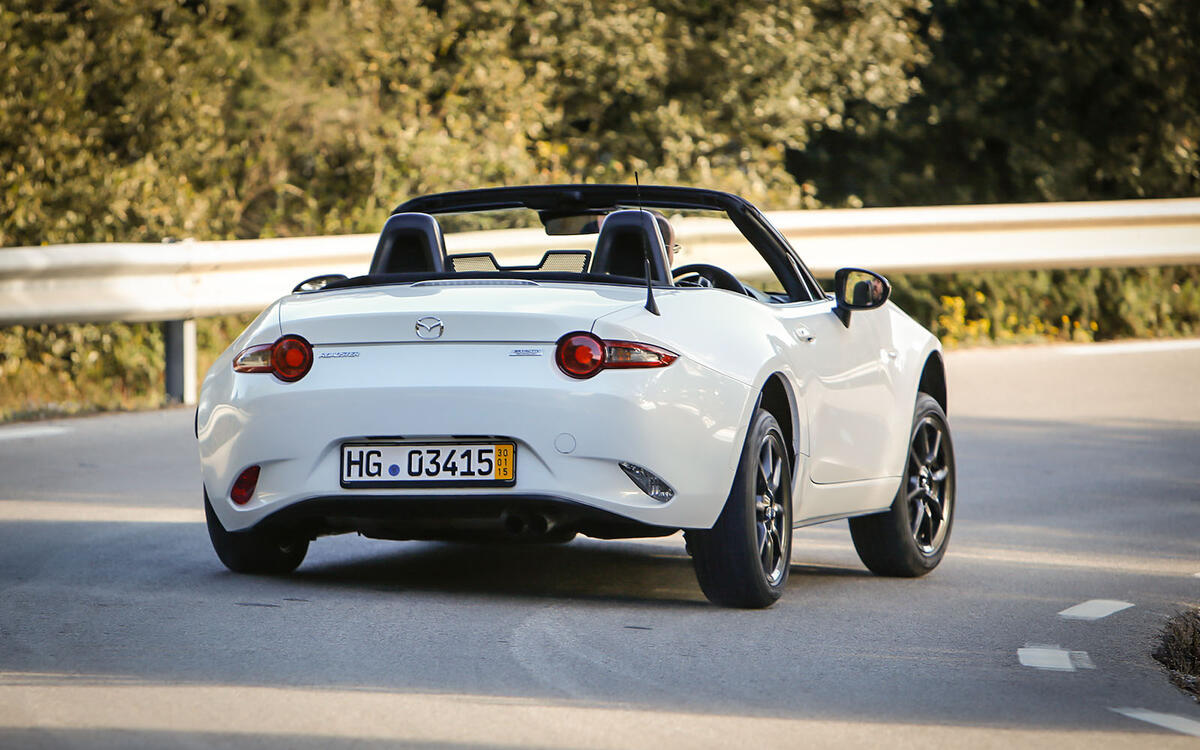
That also means the windscreen can been moved backwards by 70mm without eating headroom, which allows the hood – an utter doddle to raise or lower one-handed - to be smaller, so when it’s folded it occupies less room and the wheelbase can accordingly be shortened.
And so the virtuous circle goes on: like for like, a new MX-5 might weigh 100kg less than the car it replaces, so only needs 16in wheels with 195/50 tyres. Two words: happy days.
What's it like?:
Here is a car that is agile, not just because of the overall weight, but because so many kilos have been removed at the ends. Front and rear crash structures, the bonnet, bootlid and front wings are aluminium, focusing weight around the centre of the car and reducing the polar moment of inertia.
The MX-5 show real enthusiasm, then, for turning. The steering, middlingly quick at 2.5 turns between locks has the ‘right’ kind of weight, and its electrical assistance gives it good feel around straight ahead. On lock, it’s supremely linear and accurate and consistent. Mazda likens it to being able to reach out and “feel the tyre”. I’d say it’s the best electrically-assisted setup this side of a Renault Megane Trophy R.
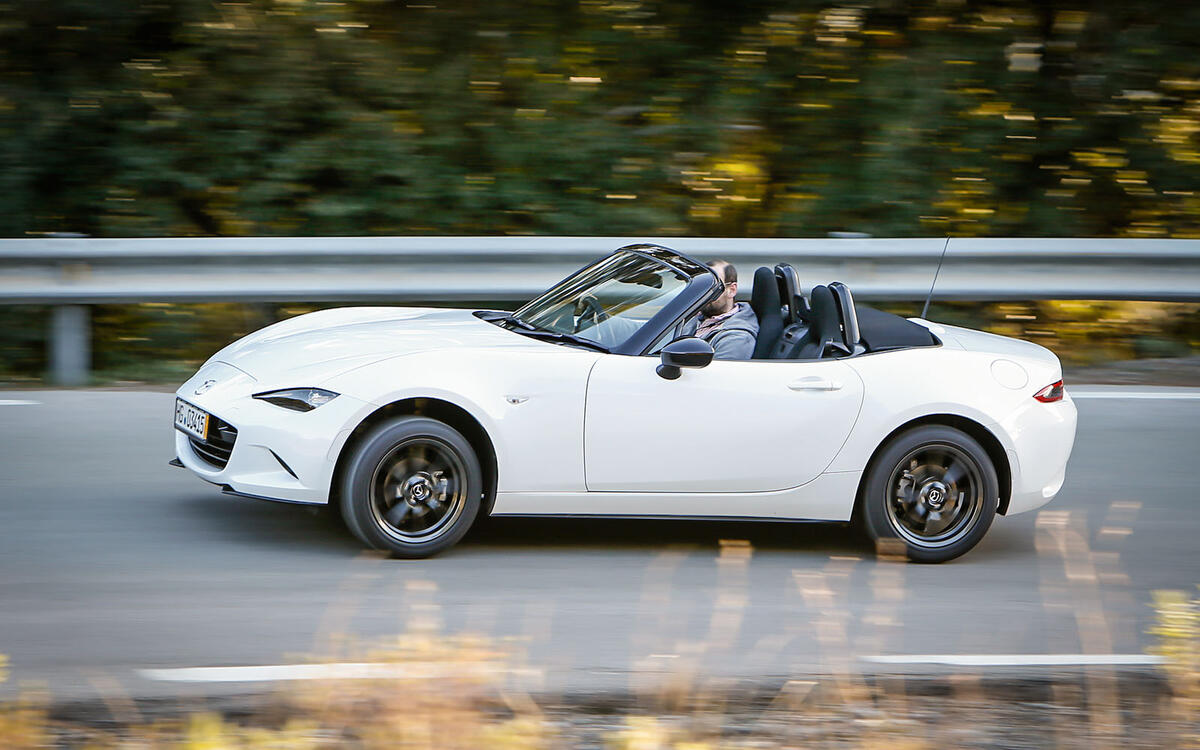
The Renault, of course, suffers torque steer: not an issue in a car whose rear wheels are driven. But even if the MX-5 was front-drive, I’m not sure its wheels would be particularly perturbed by the 130bhp of the 1.5-litre engine. This is developed from the 1.5-litre unit in the Mazda 3, but given its development has been so comprehensive, you might as well think of it as a new unit.
It revs to 7500rpm, and Mazda’s engineers encourage us to take it there. If you want to make the kind of progress a modern sports car will have you accustomed to, you’ll need to. Swift progress can be had at lower revs – 90% of torque is on tap from 2000rpm to 6000rpm – but blistering this car is not.
To that extent, it feels not unlike a Caterham Seven 160, though with the advantage that the Mazda’s 1.5-litre unit is happier to spin. The six-speed gearbox has pleasingly close ratios too, while its shift is a thing of pure joy; short, relatively light and positive, sucking the gearlever home once you’re part-way into the shift. Few do it better.
It’s backed by throttle, brake and clutch pedal weights that are expertly judged for this type of car: a sports car to be enjoyed by purists who’ll love the positivity; and moderate enthusiasts who’ll not just know why they find it easy.
Ditto a ride that’s compliant, with just a little shimmy from the body over bad surfaces to indicate that this is not as stiff as a coupe would be. The relative compliance of the suspension, though, means notable body movements under braking and cornering.
Not that body control is loose, mind. Merely, what weight transfer serves to do is telegraph precisely what’s going on during cornering.
You’re aware you’re leaning on a front outside tyre on turn-in, you’re aware that force has been transferred to the outer rear wheel on corner exit, and you know precisely how much your right foot is subjecting it to an ordeal. Not overly, is the most likely answer in the dry, where – again like the Caterham Seven 160 - the Mazda has a surfeit of grip over handling.
Should I buy one?:
If you think you’ll like it, you probably will. Mazda was reluctant to mention the 2.0-litre (or the optional automatic gearbox) because it thinks that this 1.5 is the mechanical specification that shows the MX-5 at its absolute purest. I can understand that, and love it for what it is.
The 2.0-litre engine’s extra weight will compromise some of the values, I don’t doubt, albeit it will still be a lightweight car with 50:50 weight distribution. And who knows, its throttle adjustability might even make it preferable. But be in no doubt, this 1.5-litre version is a gem; the MX-5 ideal followed to its conclusion.
Mazda MX-5 1.5
Engine: 4cyls in line, 1496cc, petrol Power: 130hp at 7000rpm Torque: 111lb ft at 4800rpm Gearbox: 6-spd manual Kerbweight:1000kg (est) Top speed: 125mph (est) 0-60mph: 8.5sec (est) Economy: 48mpg CO2 rating & BIK tax band: 139g/km/22 per cent
 ]
]

ShakesBeer
New member
Vendam muitos que daqui a uns aninhos vou buscar um
reckoner00
New member

reckoner00
New member
First drive: 2015 Mazda MX-5 - BBC Top Gear

What's this, then?
It's the all-new, fourth-generation Mazda MX-5.
And by all-new, you mean ‘a bit different to the old one'?
No, all-new. Fresh from the ground up, and both lighter and smaller than the car it replaces. The MX-5 has lost 10 per cent of its body weight, over 100kg, and is now even shorter than the 1989 original. That's virtually unheard of.
It looks dinky in the flesh, but has real presence, and yet there's more cabin space. The MX-5 is a very, very clever piece of packaging, as you'll deduce if you open the bonnet and see that the whole of the engine sits behind the front axle line. That's good for weight distribution, and the only penalty is a lump in the footwell underneath your calf, where the gearbox is.
Moreover, the engine is mounted lower in the chassis, which means the bonnet is lower. Thanks to that, the driver's hip point has been dropped, too. So you sit nice and snug in it.
Looks smart, too...
Doesn't it just? In fact, with its scowling eyes there's a newfound edge of aggression to the fourth-gen MX-5. Lightweight aggression, though. A bit of cheekiness. And the back end is very nicely sculpted indeed, even better than the front. There's a harmony to the design of the fourth-generation car that's been absent since the first one.

How's the cabin?
I'll tell you what's most impressive. You know how you can see where corners have been cut in cheap cars? In the MX-5 you can't, despite the fact prices are likely to start around £19,000.
I got in it for the first time at night and was immediately struck by how strong the headlights were, how simple the infotainment was to operate, that the stereo had good clarity, that the seats were brilliantly shaped (if a bit narrow across the shoulders), and how well assembled everything was.
It was even remarkably refined, too, with just a rustle of wind noise from the tops of the doors where glass meets roof. For a car that weighs less than a tonne, that's fantastic.
The boot's deep, there's somewhere to put your phone, and even a pair of USB slots. There's a lovely body-colour door cap that, when you sit in the car, makes a line that runs past the A-pillar, straight out along the front wing. The MX-5 melds interior and exterior design better than any car I can think of.
No fussy electric roof?
No, a simple manual with a single latch in the centre. Unclip that, throw it back and press down to click it in place. Simple. It takes about three seconds without moving from the driver's seat, and if you've got a bit of shoulder strength it's just as quick to throw it back up.
There's a feeling with the Mazda, before you even drive it, that there's real integrity to the design and engineering. They've kept it simple, but made sure they've done the simple stuff well.

How is it to drive?
It's just fun. Not wide-eyed fun like a Porsche GT3, or sweaty-palm fun like a muscle car. Just light, easy, peppy fun. The MX-5 moves really, really well, asking nothing of you but darting merrily along like it's having the time of its life. It seems to whistle cheerily to itself all the time.
The chassis is a peach, and because there's little weight involved, the skinny 195-section tyres grip better than you'd believe. Keep the power on and some squealing will eventually occur, but the front end doesn't give up on you.
Doesn't it have electric power steering? Is that a good thing?
Rarely, and if I'm honest it's the same here. There's not much feel, it's a bit light for my taste, and personally I'd like the nose to have a little more bite on the way into corners. But the MX-5 has been designed for your aunt as well as you, and aside from that, and the slight chassis shimmer over cats' eyes, there are few dynamic complaints.
The damping is great: gone is the weird initial lurch you got from early Mk3s when you turned into a corner. Well, most of it. It's capable of acting the grown-up on motorways, and is a proper hoot in towns: city car small, and with a responsive, perky engine.

Is it thirsty?
According to the trip computer, our car did 50.5mpg on a 100-mile trawl northwards out of Barcelona. On that evidence, you could well decide this little 1.5 litre four pot is all about efficiency. After all, with only 129bhp it's hardly a ripsnorter, is it?
But if I hadn't been told otherwise, I'd have sworn blind this was the 2.0-litre. It may not be turbocharged, but the base-engined MX-5 has enough low-down pick-up, and enough mid-range to run with it. True, it's not fast-fast - though Mazda hasn't released official performance stats, you're probably looking around eight seconds to 60mph - but it's got enough punch to make exiting corners fun.
And, although not as charismatic as a Honda VTEC, the little four-pot has a certain amount of character and a cheeky exhaust note. I also love that it gives you 500rpm more than you need when you fire it up, a chest-puffing little flare of revs.
Good gearshift?
The best. A cracker of a six-speed manual, and the pedals are nicely positioned for a spot of heel-and-toe if you like that sort of thing. Which you will do in this, as it comes so naturally.

A good egg, then?
Completely. The MX-5 is a simple car, but the simple stuff has been done really well. It hasn't been overcomplicated with active-this and electronic-that. It's a great little mover, one that enjoys being thrashed and always has a spring in its step.
With many European cars you get the sense that the marketing men identified a niche, and the engineers had to build something to fit it. The new MX-5, however, does what it's always done, but does it better, I think, than ever. It's got the design, engine and handling chops that have been absent as a package for a couple of generations.

So why have other car makers abandoned the small roadster market?
Who knows? Maybe they don't think they can better the MX-5, a car which, let's not forget, has now sold almost a million examples.
More likely it doesn't fit their marketing strategy, and it would be too expensive to develop a compact rear-drive chassis. Shame.
I'm just glad the MX-5 exists. The world deserves a small roadster as good as this. It brightens things up, and we all need a bit of that in our lives.
reckoner00
New member


reckoner00
New member


reckoner00
New member

reckoner00
New member
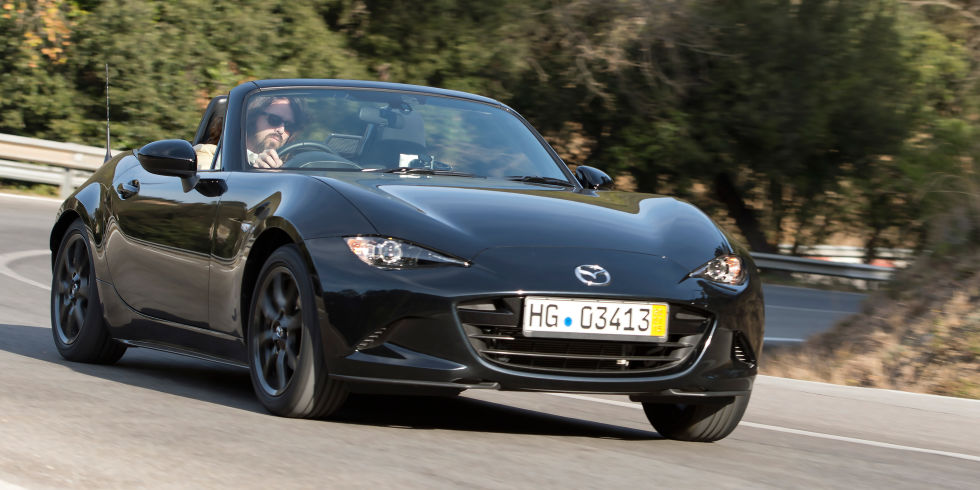
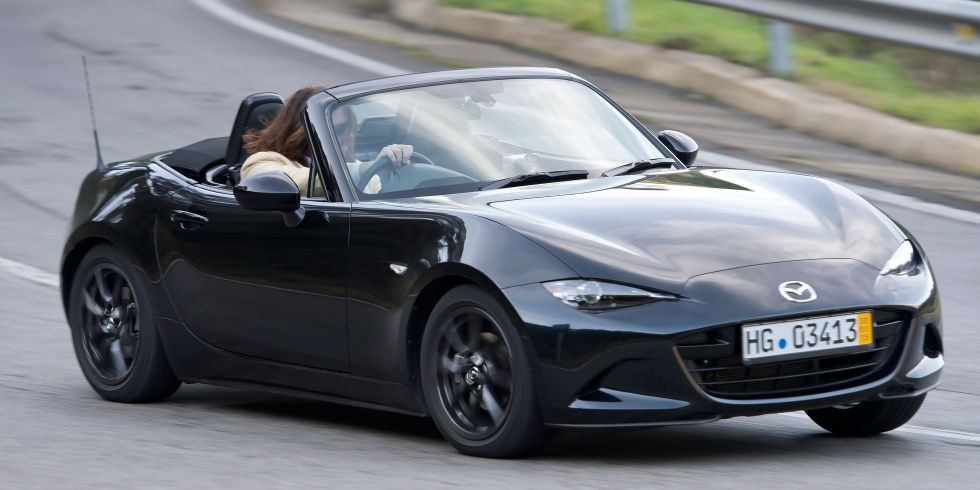
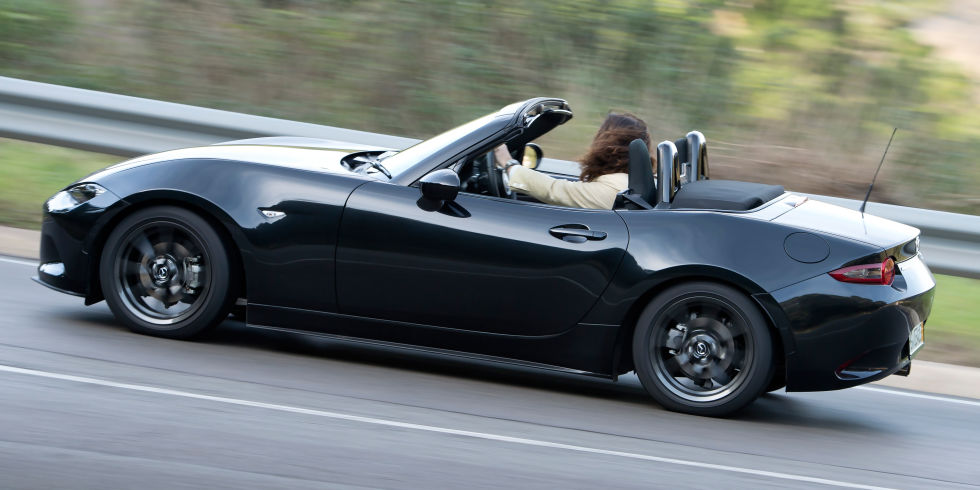
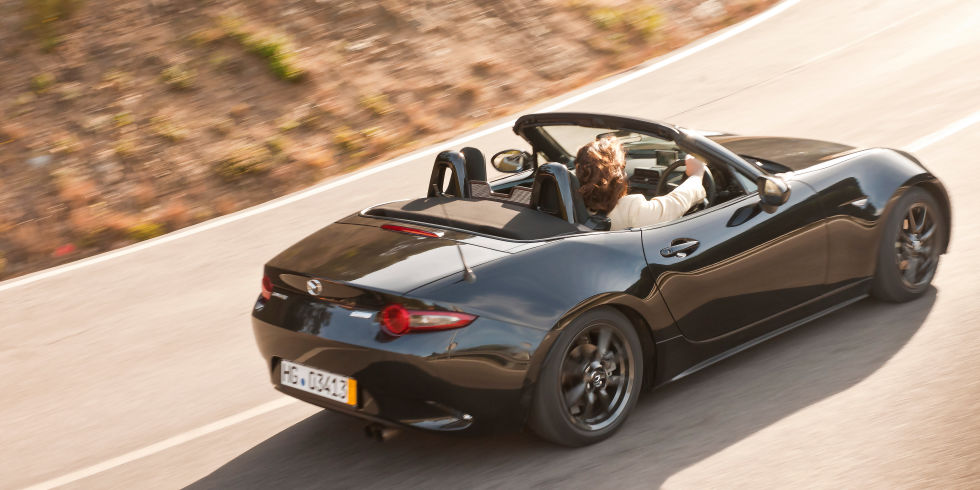
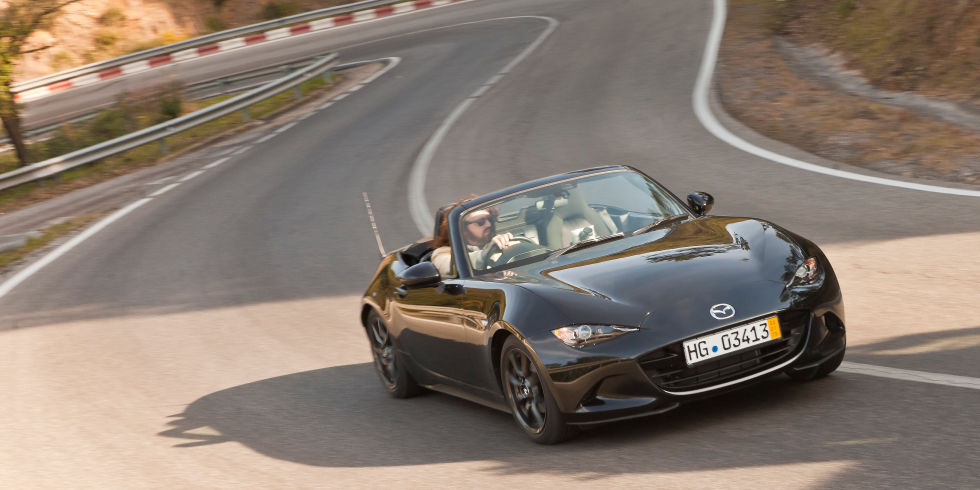
A top gear fez de média 4.7L aos 100km??? Incrível!
50.5mpg, inglesas, equivalem a 5.6 litros aos 100.
Para dar os 4.7 que referes, terias de usar milhas americanas.
Mesmo assim, 5.6 não é "nada". Os consumos são mesmo muito baixos.
O meu swift com o 1.6 e 125cv, o minimo que consegui com um depósito, foi 6.3 e maior parte do percurso foi a pastar a 80 atrás de camiões.
Mas no geral, anda sempre entre os 7.5-8
Last edited:
Relativamente às reviews iniciais, felizmente parece que é "business as usual"
E isso é muito bom.
Pelo que vi e li, parece que o motor não difere muito em carácter do que tenho no Swift. Há que puxar para animar[ ]
]
Ou seja, abaixo das 4000rpm não acontece nada de realmente emocionante.
Estou a apreciar bastante a criatura e os pormenores desta. Motor atrás do eixo dianteiro em posição mais baixa, bancos também mais baixos (uma das minhas criticas ao MX5 NA que tive), reposicionamento dos pilares A que tanto chateavam no meu.
A mala, pelas imagens, parece mais compacta do que aquilo que tinha no NA.
Uma nota para a direcção elétrica. Já deu para ver que vai ser leve, talvez em demasia. E um dos testes diz que é a melhor direcção elétrica aparte o MEgane Trophy, e outro diz que é desprovida de qualquer "feel".
Acho que só mesmo experimentando.
Pelo andar da carruagem, isto só deverá chegar lá para o Verão.
Tenho que o experimentar, definitivamente[ ]
]
E isso é muito bom.
Pelo que vi e li, parece que o motor não difere muito em carácter do que tenho no Swift. Há que puxar para animar[
]Ou seja, abaixo das 4000rpm não acontece nada de realmente emocionante.
Estou a apreciar bastante a criatura e os pormenores desta. Motor atrás do eixo dianteiro em posição mais baixa, bancos também mais baixos (uma das minhas criticas ao MX5 NA que tive), reposicionamento dos pilares A que tanto chateavam no meu.
A mala, pelas imagens, parece mais compacta do que aquilo que tinha no NA.
Uma nota para a direcção elétrica. Já deu para ver que vai ser leve, talvez em demasia. E um dos testes diz que é a melhor direcção elétrica aparte o MEgane Trophy, e outro diz que é desprovida de qualquer "feel".
Acho que só mesmo experimentando.
Pelo andar da carruagem, isto só deverá chegar lá para o Verão.
Tenho que o experimentar, definitivamente[
]
marelo
New member
50.5mpg, inglesas, equivalem a 5.6 litros aos 100.
Para dar os 4.7 que referes, terias de usar milhas americanas.
Mesmo assim, 5.6 não é "nada". Os consumos são mesmo muito baixos.
O meu swift com o 1.6 e 125cv, o minimo que consegui com um depósito, foi 6.3 e maior parte do percurso foi a pastar a 80 atrás de camiões.
Mas no geral, anda sempre entre os 7.5-8
Deve pesar o facto de ser caixa de 5. O actual swift já corrigiu esse "handicap" e gasta ligeiramente menos. Ainda assim, (aparentemente) gasta bem mais que este MX-5.
Modelo actual: Overview: Suzuki - Swift - Spritmonitor.de
Modelo anterior: Overview: Suzuki - Swift - Spritmonitor.de
Last edited:


