Porsche Macan

A questão que se impõe: para quando o Porsche "golf killer" ou mesmo, o primeiro utilitário Porsche[:D][:p]

Eu gosto do Macan mas os 100K€ parecem-me abusados neste segmento...
 
Porsche Macan terá motores de 4 cilindros

New junior SUV will be the first Porsche to use four-cylinder engines since the 968 in 1995

MacanSUV.jpg

The four-cylinder engines are likely to be offered from 2015

The Porsche Macan SUV will be sold with four cylinder engines “in the foreseeable” future, according to company engineers. That will make the compact SUV the first Porsche model with a four-pot engine since the 968 model ended production in 1995.
The four-cylinder petrol and diesel options are expected to be offered from 2015. The entry-level petrol side is tipped to be a turbocharged 2.0-litre unit with 280bhp. Also set for introduction is a 2.0-litre turbodiesel in a price-leading Macan Diesel. Both models will compete with higher-spec versions of the somewhat smaller Range Rover Evoque.
Porsche says the overwhelming aim of the project was to provide the Macan with “sports car” responses, claiming ‘best in class brake performance and steering precision’ as well as “very responsive” acceleration and gear-shifting abilities in addition to a more car-like driving position.

The launch Macan models include the £43,300 Macan S (which gets a 3.0-litre V6 bi-turbo 335bhp engine ) and the £43,300 Macan Diesel S which gets a 254bhp 3.0-litre V6 diesel engine good for 46.3mpg and 0-62mph in 6.3sec.The £59,300 Macan Turbo range-topping model has a 394bhp 3.6-litre V6 twin turbo and a 0-62mph time of 4.8sec.
The new Macan is based on the same basic steel structure as the Audi Q5 but, according to Porsche’s engineers, some “two thirds” of components have been replaced or modified. While the floor and bulkhead are the same as the Audi, the body’s upper structure and door structures are new. Porsche has also lowered the seating position and modified the position of the steering wheel, to make the driving position “more Porsche-like”.
While, like the Q5, the engine sits ahead of the front axle, Porsche's own 7-speed PDK transmission and ‘hang-on’ four wheel drive system ensure that – in steady state conditions – some 80 per cent of the engine’s torque is directed to the rear wheels. In extreme conditions, up to 100 per cent of torque can be directed to the front wheels for short periods.

The front suspension steering that has been redesigned to be “10 per cent quicker” and both axles get retuned bushes, dampers, springs and anti-roll bars. Porsche has fitted its own six-pot, aluminium, monobloc calipers to the front axle.
The Macan also gets the option of air suspension, which can be raised 40mm in off-road mode and lowered 10mm for high-speed driving. The rear of the car can be lowered 40mm to help with loading. Both the transmission and 4x4 system are claimed to react in “less than 100 milliseconds”.

Porsche is also offering the option of torque vectoring and a rear differential lock. The Macan has a 53/47 front/rear weight distribution and a 623mm high centre of gravity on the Turbo model and a 634mm on the diesel. Stop-start and a coasting function for the transmission are also standard.
The Macan is made at Porsche’s Leipzig plant, alongside the Cayenneand Panamera. Porsche has installed a 50,000 per year capacity at Leipzig, but it is expected to expand when the four-cylinder models arrive.
A partir de 2015 terá o gasolina turbo de 2 litros a debitar 280 ou, quiçá, 300cv, e 2.0 turbodiesel a devitar 190cv ou 225 se vier já com o novo biturbo do grupo VW. Os preços irão ficar consideravelmente mais baixos.
 
Confesso que não partilho da tua visão, que qualificaria de "saudosista", se quisesse ser simpático, ou de "anacrónica", se quisesse ser mais cru.

Back to basics para re-situar a questão do Macan em particular:

Os automóveis são um negócio como outro qualquer. O fim primário e básico de qualquer operador económico é 1 e só 1 = obter lucro. Esse é o propósito subjacente a qualquer sociedade (ou pessoa singular em nome individual) que exerça qualquer uma actividade de carácter comercial.

Tendo em conta que, como negócio de “escala”, a Porsche ganha mais dinheiro quantos mais carros vender, a Administração da marca (e os seus accionistas) terão enfrentado um dilema aquando da decisão do lançamento dos novos modelos (Cayenne, Panamera e, agora, Macan): como conseguimos ganhar mais dinheiro de forma sustentada no longo prazo?

A resposta só podia ser 1: lançar novos modelos que lhes permitam multiplicar o número de carros vendidos.

A outra parte do dilema tinha a ver com a “forma sustentada” de ganhar esse dinheiro no longo prazo. Leia-se “sustentada” como sinónimo de aumentar e muito a escala mantendo o glamour e factor premium distintivo da marca.

Esse factor “premium” é sem dúvida um dos factores mais distintivos de uma marca como a Porsche, tendo um (enorme) valor tangível para a empresa (diria até “inestimável”). Levou anos a construir e influencia todas as acções da marca.

Conjugados estes 2 pressupostos (aumentar a escala de forma sustentada) – acho que podemos deixar de lado a re-utilização de plataformas e motores do grupo (que contribuem, e muito, para a diminuição dos custos de produção) – acho sinceramente que a decisão da Porsche foi acertada:

Passaram a estar presentes em segmentos com um boom fantástico, mantendo-se como premium nesses mesmos segmentos. Hoje em dia e se perguntares a alguém que SUV gostaria de ter, uma percentagem significativa de pessoas responder-te-á “Cayenne” (eu serei um caso à parte, pois preferia um Touareg J)…

Se isto significa que vão perder o glamour? Acho que não…que aumentam (e muito) o lucro – não tenho quaisquer dúvidas…

Nos anos 70 e 80 muitos auguraram o mesmo fim à Porsche com o lançamento dos mal amados 944 e outro pequeno cujo nome/numeração não tenho presente…no entanto, manteve-se intocável…

também afino por esta bitola.
Os Mercedes, BMW, Audis e Porsches de sempre e de topo continuam a existir para quem os quiser comprar, isso não invalida outras formas de faturação.
 
também afino por esta bitola.
Os Mercedes, BMW, Audis e Porsches de sempre e de topo continuam a existir para quem os quiser comprar, isso não invalida outras formas de faturação.
Também concordo com o post, até porque a Porsche nos anos 80 quando lançou os 944/924 entre outros muita gente achava que era o fim da marca, nos anos 90, lança um 911 refrigerado a água e com a frente igual ao "plebeu" Boxster, e mundo é que ia mesmo terminar... em vez disso a marca cresce cada vez mais. Na 2ª década de 2000 temos 2 SUV's e uma berlina na gama, mas por outro lado o 911 nunca teve tão forte e tão cobiçados a par dos bem conseguidos Boxster e Cayman. Para não falar da jóia da coroa: 918

Continuo na minha desde que continuem a fazer desportivos de excepção, venham os SUV!

Comprava na boa o Macan 2.0tdi [kiss][:D]
 
Porsche Macan - first ride | Autocar

Our latest ride in Porsche's new SUV shows a snappy, agile car with plenty of comfort and refinement

P13_0825_a4_rgb%20copy.jpg

The familiar 911-inspired styling helps make the Macan fit well into the Porsche family

In recent times it’s not been unusual for Porsche to use a platform shared with the greater VW Group. The hugely successful Cayenne(which now accounts for around half of all Porsche sales) is based on the same architecture as the Volkswagen Touareg.

That architecture, however, is natively rear-wheel drive, with all the inherent dynamic and weight distribution advantages of having most of the engine’s torque sent rearwards and having the engine being mounted far back in the nose.
With the arrival of the Macan SUV, Porsche has adopted an Audi platform, which means a longitudinally mounted engine sitting ahead of the front axle line. Despite a couple of decades of massaging this unique layout, it is not an ideal starting point for a vehicle that Porsche insists on calling a ‘sports car’.

The Macan may be the sister car to the Audi Q5, but that does not mean it is a clone: Porsche says some ‘two thirds’ of the car’s components have been ‘replaced or modified’. Autocar understands that the Macan shares a floor and crash structure with the Q5, as well as the lower half of the door structures.

The front and rear suspension set-ups are also basically the same, though Porsche has re-tuned the springs, dampers, anti-roll bars and added quicker steering and its own six-pot monobloc brakes at the front. In terms of the running gear – aside from the option of air suspension, which the Q5 doesn’t get – the biggest change is the addition of Porsche’s own 7-speed PDK transmission.

This is natively a rear-wheel drive set-up and sends 80 per cent of the engine’s torque rearwards in normal driving conditions. This re-biasing of the drivetrain has necessitated a new, stronger, final drive unit on the rear axle.
What Porsche calls the ‘hang on’ four-wheel drive system – a propshaft which takes power from the rear end of the transmission and sends it forwards to the front wheels – can send 100 per cent of torque to the front wheels if the rear wheels have no traction.

The Macan is also marked out by a lower driving position than the Audi. The seat mounting has been modified, as have the mounts for the steering column, to allow the wheel to be mounted in a, flatter, ‘more 911-like’ position.
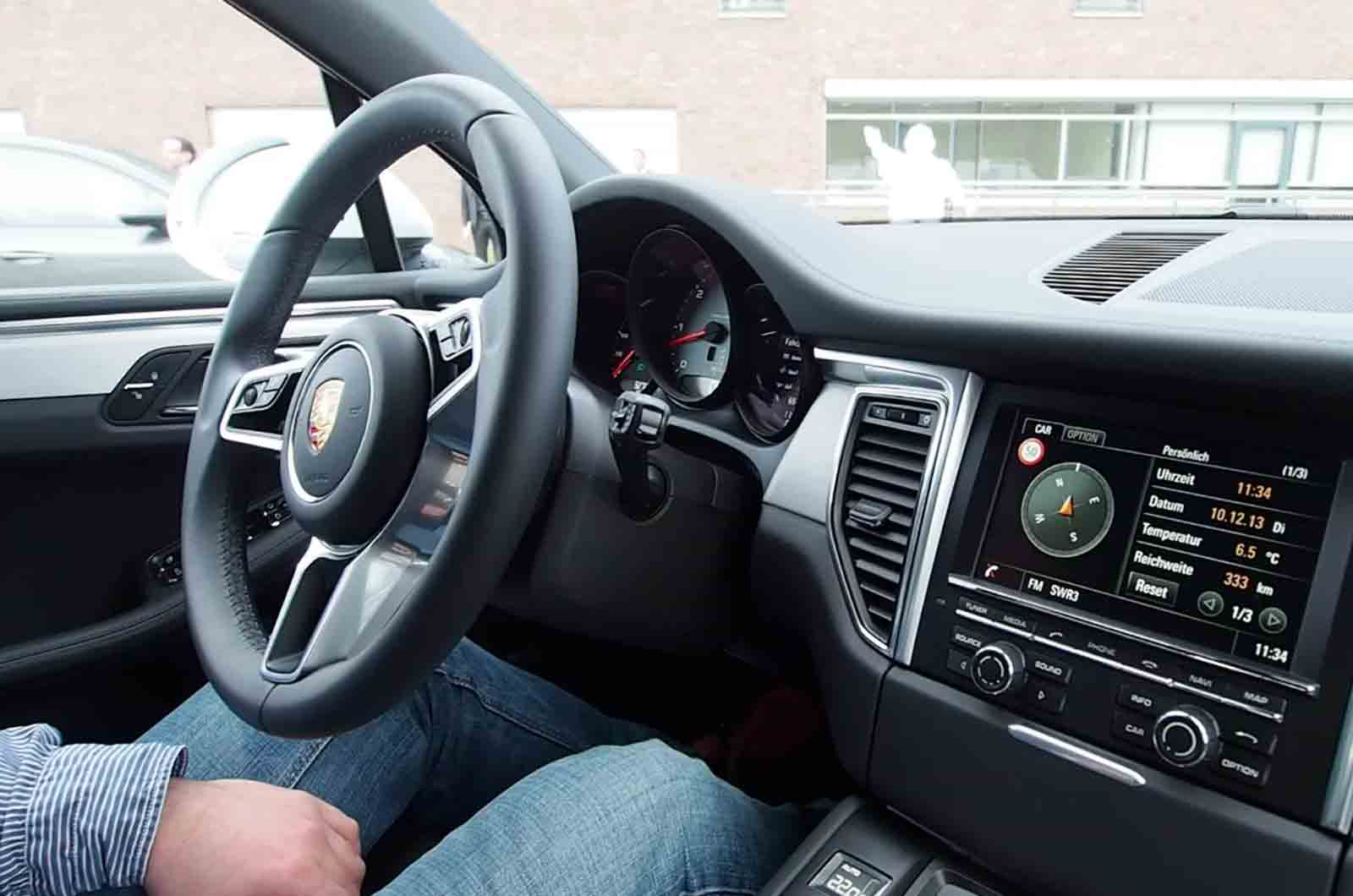
Porsche’s now-familiar interior design has also been plumbed into the car along with rather shapely sports seats. The upshot, for the driver, is that when sitting in the Macan you will never guess that there are the bare bones of an Audi Q5 under the carpet.

Porsche’s engineers say that the aim with the Macan was to provide the sharpest steering, snappiest acceleration and shift action and deliver the best all-round responsiveness of any SUV of this size.
Despite being the smaller sister to the Cayenne, the Macan is not as capacious as you might expect. The cockpit is satisfyingly snug (mainly thanks to the vast centre console) and beautifully made, but the rear package is tighter, with knee and headroom only just adequate for a six-footer. The boot is also on the smaller side because of a high floor and the steeply sloping tailgate.

A few laps of a test track and a short burst of off-roading in the front seat of the £43,300 Macan Diesel S (which has a 254bhp 3.0-litre V6 diesel engine good for 46.3mpg and 0-62mph in 6.3sec) was enough to test Porsche’s central claim of class-leading responsiveness.
This ex-Panamera and Cayenne engine is impressively refined in the Macan and has substantial low to mid-range punch, enough to make the two, rather thirstier, petrol engines redundant. As Porsche’s test driver pushed the car hard around the circuit, it appears to be much less understeery (hardly washing out when driven hard into a tight bend) than the Q5 as well less obviously nose heavy (the Macan has a weight spilt of 53/47 front-rear).

On air suspension, this Macan also has quite decent capability on off-road tracks (the ride height rises by 40mm) as well as having hill descent control.
The Macan is obviously especially snappy and agile. It doesn’t look like a Q5 (the low nose has necessitated a clamshell bonnet and an engine air intake routing that snakes between the bonnet’s upper and lower skins on the way to the air filters), and the driver gets a properly Porsche cockpit. It also looks like it will be priced very competitively against the higher-end Audi Q5 models.
With Macan production initially capped at 50,000 per year, expect long waiting lists and impressive residual values.
Screen-Shot-2013-12-11-at-1.jpg
 
RespectRequired, tendo em conta o que os responsáveis da Porsche disseram há um ano atrás "Porsches com menos de 200cv, nunca" prevejo que venha a ter o 2 litros diesel biturbo a ser estreado dentro de um ano com 225cv.

Spot publicitário
 
Última edição:
Acho muito interessante esta discussão sobre a democratização das chamadas marcas premium.

No caso específico do Macan contudo, não posso deixar de notar que este modelo, mesmo nas versões mais baratas que se adivinham, irá custar sempre pelo menos tanto como o modelo mais barato da marca, o boxter. Ou seja, julgo que não se pode falar propriamente de generalização ou democratização, pelo menos no nosso mercado, a nivel de preços. Creio que o que faz confusão não é tanto a descida de preços mas sim mudança de paradigmas. Se se vier a confirmar o lançamento de um desportivo com base partilhada com audi/vw abaixo do boxter/cayman (como já foi rumor várias vezes), acredito que as vozes de protesto quanto à democratização seriam bastante menos. E se assim fosse, não será o nosso preconceito (meu incluido) quanto a tipologias a funcionar? Não pode uma marca que faz um carro, com uma certa qualidade e aptidão, querer levar os seus produtos a mais mercados e audiências? Não será legitimo?

Como já alguem referiu, o facto de as marcas aumentarem as vendas, permite investirem mais em melhorar os seus produtos , e isso traz sempre benefícios ao consumidor. Como apaixonado por carros, há modelos que me fazem alguma confusão, mas racionalmente não encontro motivos para condenar o seu lançamento se o objectivo for lançar bons produtos que satisfaçam mais pessoas e mais mercados.
 
Voltar
Superior