Tópico da segurança rodoviária

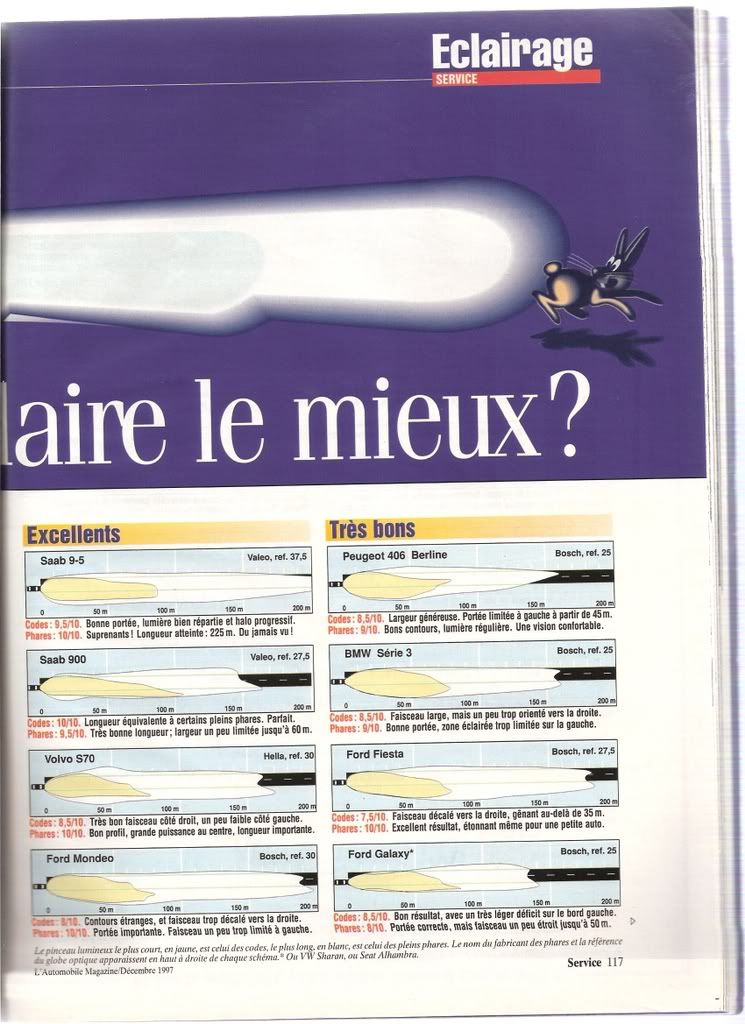
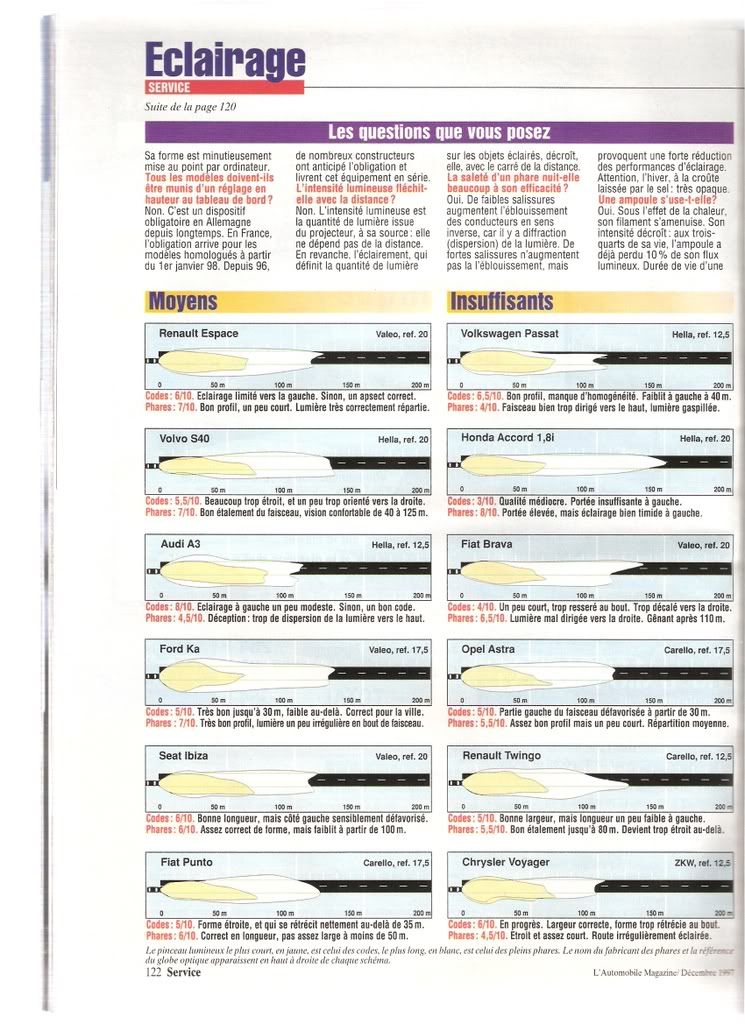
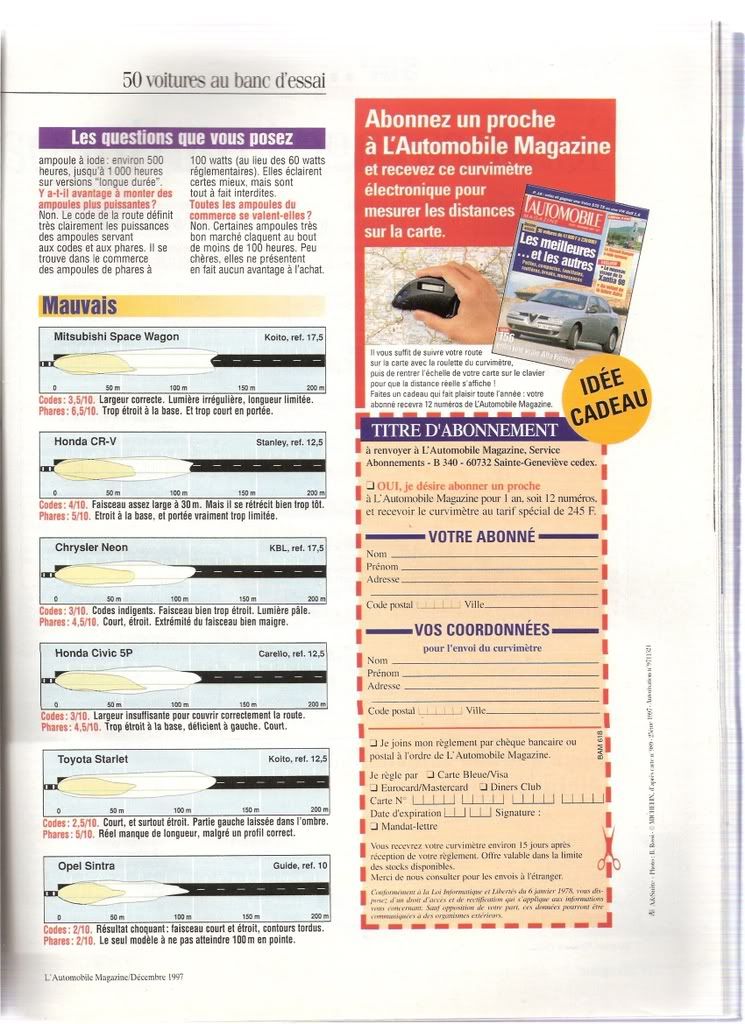
AMS magazine lies about Bravo brakes


"These articles have made quite a fuss here in Greece so I will try to share them with you.
The Greek Auto Moto und Sport magazine blames FIAT for not being interested that the new Bravo 1.4 totally lost its brakes after the 3rd brake test out of the ten scheduled.
Hope this google translation works well enough for you non-greeks to understand the content."


QUOTE]

A provar-se que de facto agiram de má-fé, a Fiat havia de os processar por tentativa de denegrir a imagem...é incrível como grande parte do jornalismo automóvel não faz aquilo que devia fazer: dar uma opinião isenta e limitar-se a relatar factos...o que vale é que as pessoas estão cada vez melhor informadas nos dias de hoje.

Cumps
 
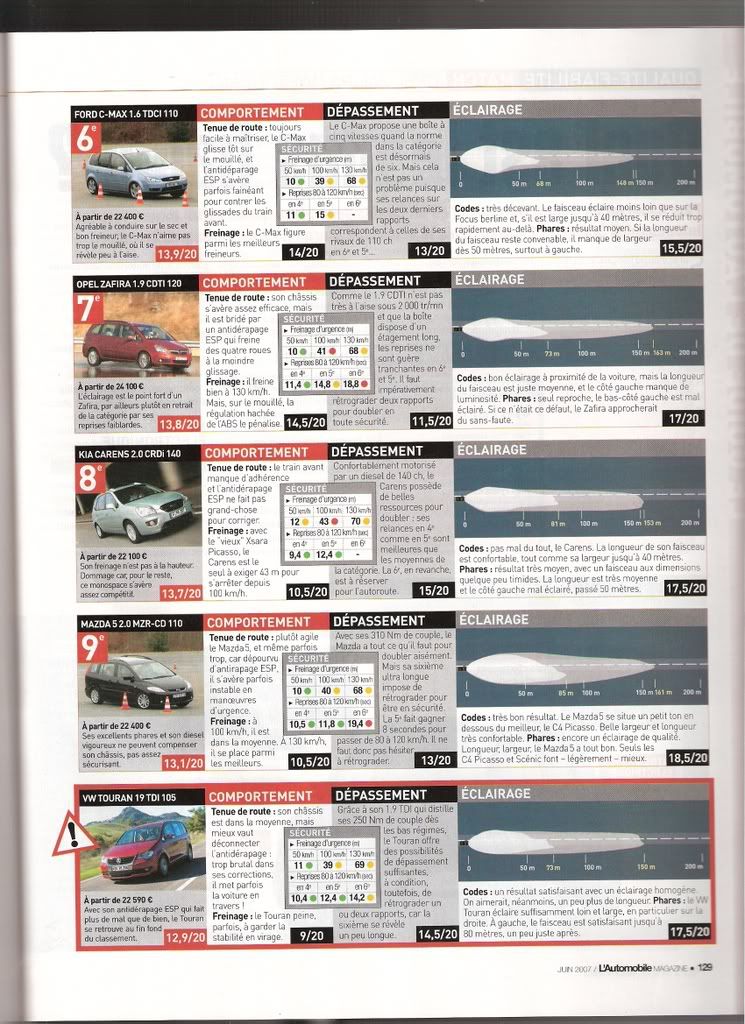
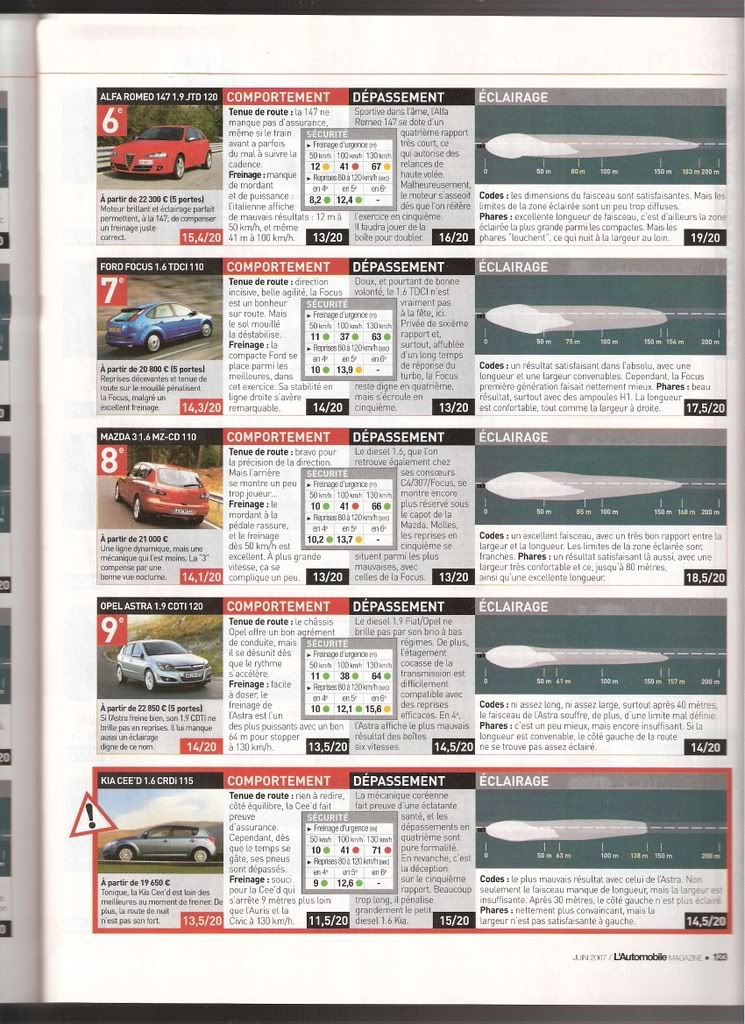
Digitalizar0033.jpg


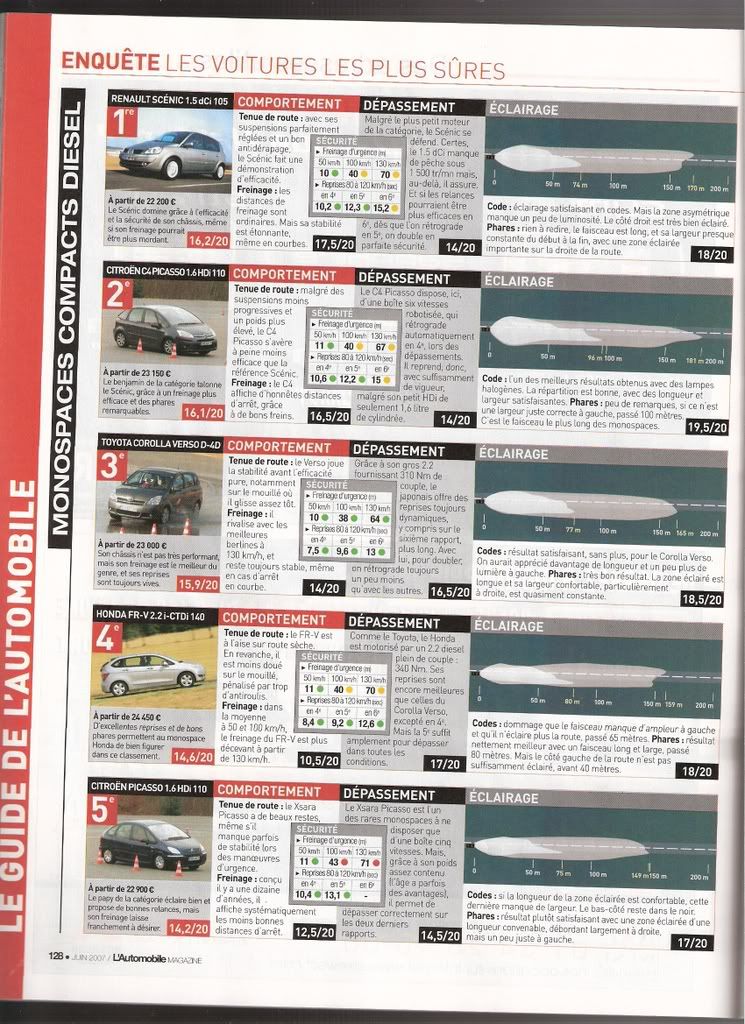
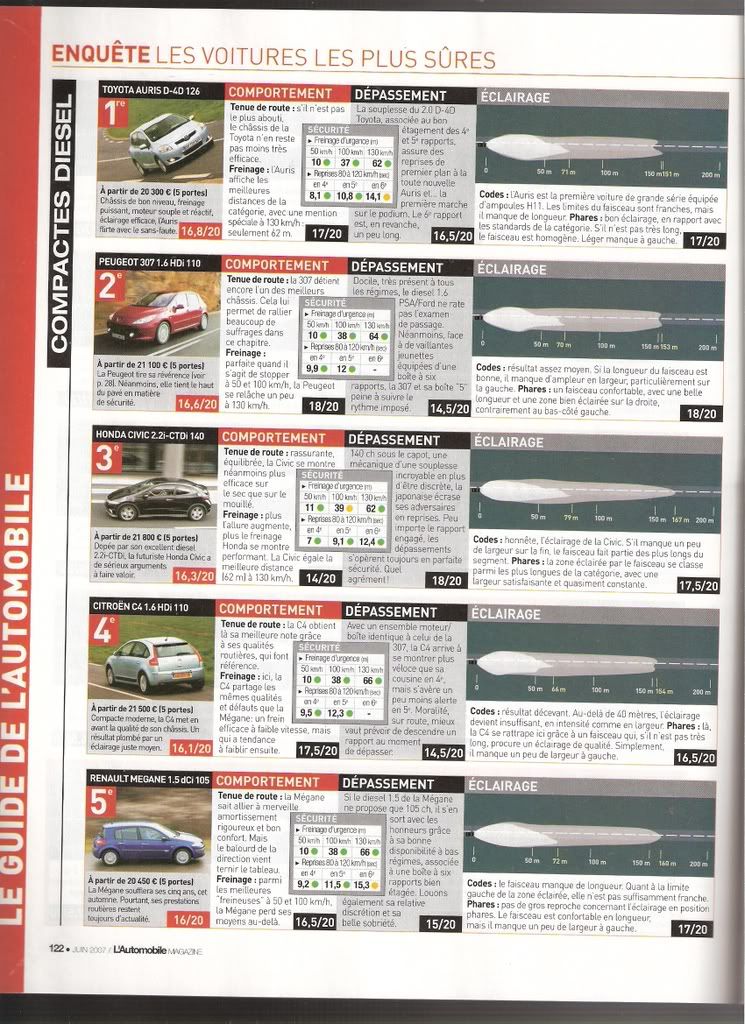
http://i295.photobucket.com/albums/mm129/nzfh12/Digitalizar0034.jpg[IMG]

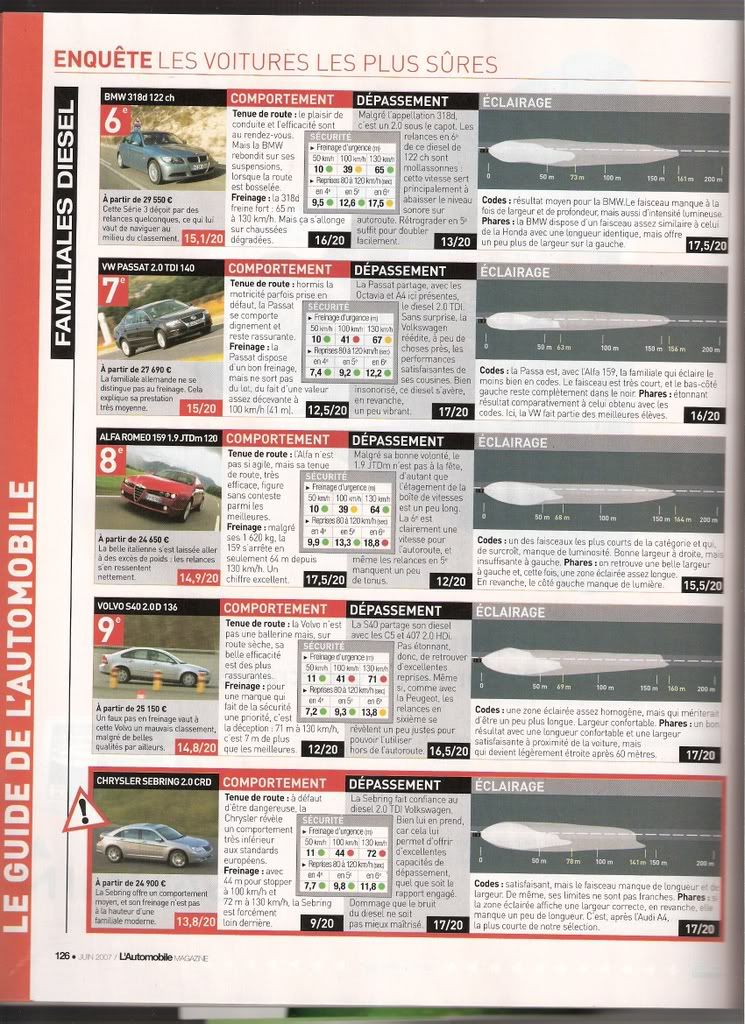
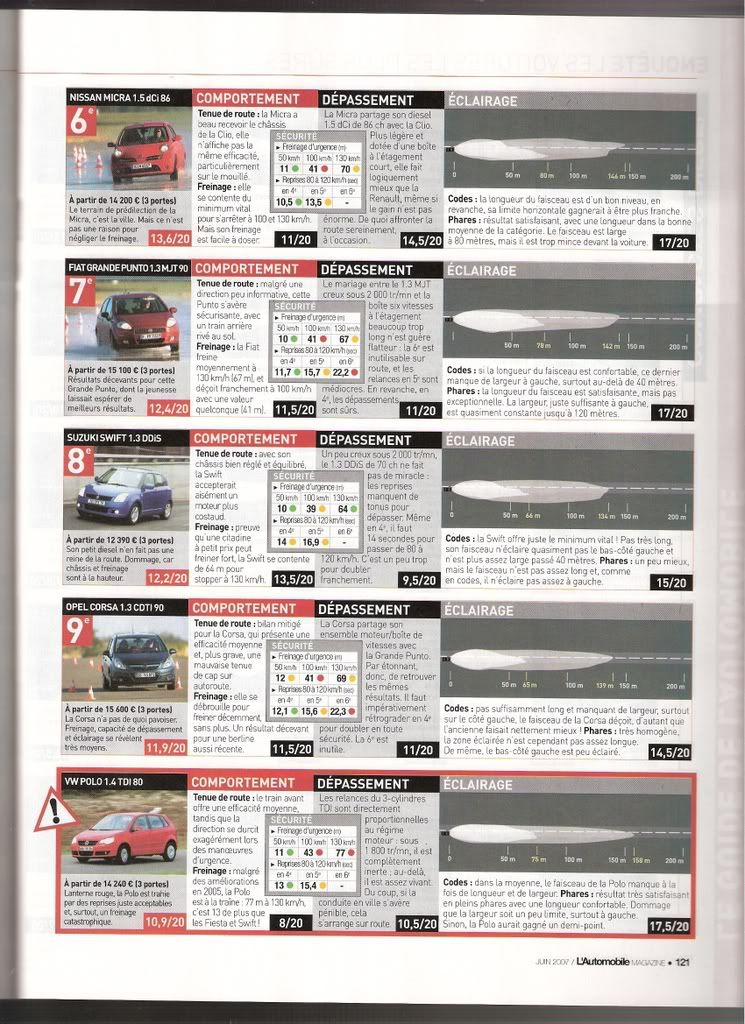
[IMG]http://i295.photobucket.com/albums/mm129/nzfh12/Digitalizar0035.jpg

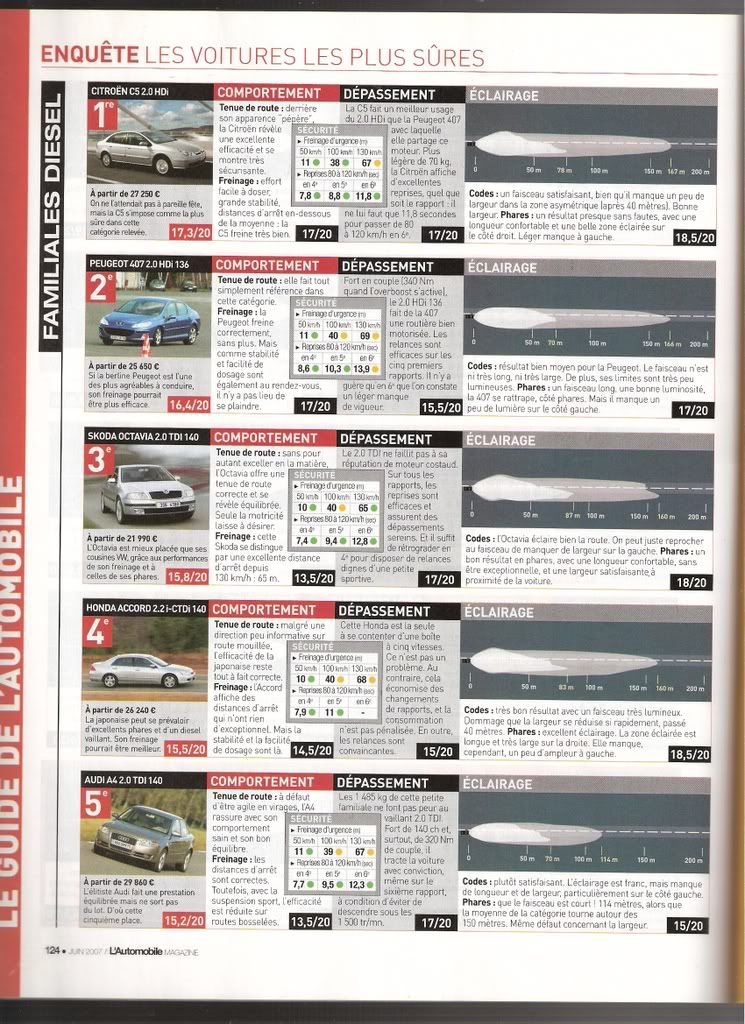
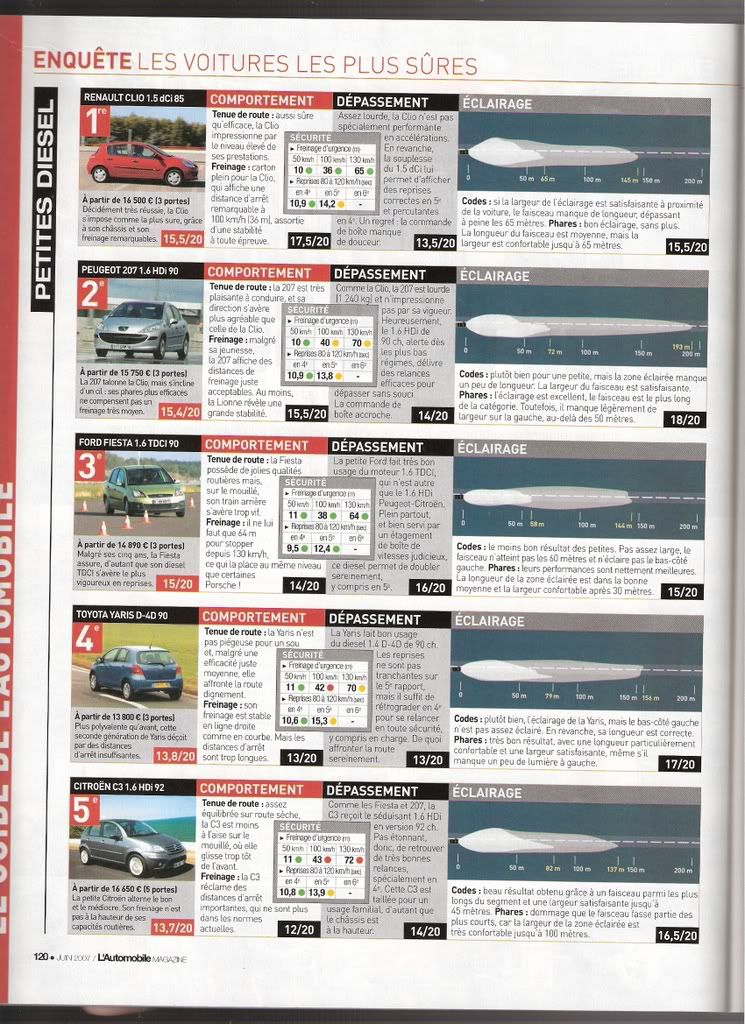
Digitalizar0036-2.jpg


Digitalizar0037-1.jpg
 
Last edited:
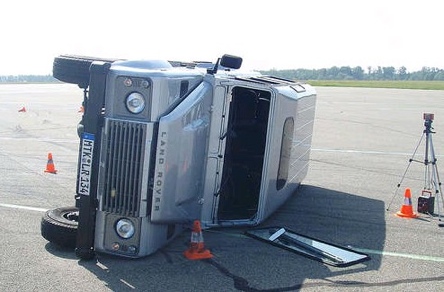
No es oro todo lo que reluce: Land Rover Defender

Publicado por Carlos en Sucesos y Land Rover.

defender.jpg
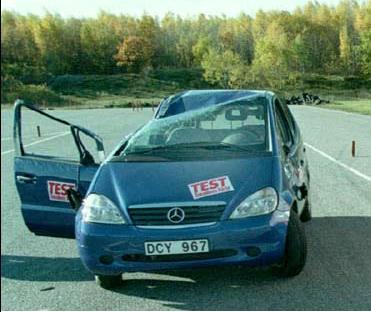
El Land Rover Defender, un todoterreno de los que ya no se hacen, el todoterreno de pata negra, también tiene sus defectos. Auto motor und sport, le puso recientemente las manos encima realizándole algunas pruebas típicas, como por ejemplo, la prueba del alce, y resulta, que en ésta última prueba, volcó.
Este hecho podríamos calificarlo de muy grave, ya que si bien todos los SUVs que tan de moda hoy en día también corren un riesgo bastante más elevado que una berlina o compacto cualquiera de volcar en condiciones similares a las pruebas del alce, ninguno lo hace en la actualidad gracias entre otras cosas, a todos los sistemas de ayuda electrónica que llevan instalados. El Land Rover Defender, vuelca por ese motivo, ya que no cuenta con ESP ni como opción, ni Land Rover tiene planeado ponerlo a disposición de los clientes aunque sea como opción. Está muy bien que Land Rover quiera que su Defender siga siendo un poco espartano para poder seguir siendo el mejor todoterreno para salir al campo, pero creo que es inadmisible que no traiga ESP aunque sea como opción sabiendo que con eso podría evitarse que vuelque en la prueba del alce.
Un problema similar tuvo Mercedes allá por el año 97 con el Clase A, el cual volcaba al hacer las pruebas del alce, y mercedes retrasó las entregas que tenía previstas para clientes para así realizar algunos cambios en las suspensiones para que no volcara en dicha prueba. Algo así por ejemplo no sería viable en el Defender, ya que entre otras cosas habría que rebajarle las suspensiones, y así se empeorarían sus habilidades camperas, por tanto, la mejor solución, repito, es ofrecer ESP aunque sea como opción.
Muy mal Land Rover, muy mal.
Vía: MotorFull
Más información: Auto motor und sport
 

Bremsentest 2006: Stopp-Tanz


154a7OT492iPRQ_335x223.jpg

Bild vergrößern


Ob Kleinwagen, Cabrio, SUV, Van oder Limousine - bei den Bremsen sollte die Klasse keine Rolle spielen. Im Test: Audi Q7, Chevrolet Captiva, Fiat Grande Punto, Ford S-Max, Hyundai Santa Fe, Lexus GS, Mercedes E-Klasse, Peugeot 207, Toyota Yaris und VW Eos.


defaultImage.gif

defaultImage.gif


Die Bilanz des großen auto motor und sport-Bremsentests ist über die Jahre stetig besser geworden - lupenrein ist sie aber immer noch nicht. Sechs von zehn Kandidaten in der aktuellen Testrunde erhalten die Note "gut", zwei Mal gibt es ein "befriedigend", aber die beiden "mangelhaft" trüben das positive Bild.

Der schlechteste Bremser im Gebirge ist der Chevrolet Captiva. Ganze 55 Meter benötigt er aus 100 km/h nach der Großglockner-Passabfahrt, die im letzten Gang und mit ständigem Bremsen absolviert wird, um die Bremsen maximal zu belasten. Dabei sind es noch nicht einmal überhitzte Scheiben, die das schlechte Abschneiden erklären könnten, denn die Temperaturen sind vergleichsweise moderat.

So ist dann auch bei den Tests in der Ebene kein Nachlassen der Bremswirkung auszumachen - der Captiva bremst einfach von Anfang an schlecht und bleibt auf diesem Niveau. Der begrenzende Faktor dürfte in diesem Fall eher die Bereifung als die Bremsanlage sein. Der Bremsweg auf einer rechts und links stark unterschiedlich griffigen Fahrbahn - μ-split - ist zumindest mittelmäßig, das Bremsverhalten hier weitgehend stabil.
Ebenfalls nur zu einer "mangelhaften" Bewertung reichte es dem Hyundai Santa Fe. Dabei hätte er mit seiner insgesamt guten Vorstellung durchaus weit vorn landen können. Doch der nicht akzeptable Bremsweg von 150 Metern auf μ-split führt zur Abwertung in der Endabrechnung.
Audi Q7 macht eine gute Figur


Dass schwere SUV nicht per se schlecht bremsen, beweist der diesjährige Testsieger Audi Q7. Er ist nicht nur bei den Prüfungen aus 100 km/h in der Ebene und am Berg ganz vorne mit dabei, sondern macht auch auf μ-split eine gute Figur.

Der Mercedes E 220 CDI hat diesem Stress nicht so gut standgehalten, obwohl er wegen seiner geringeren Höchstgeschwindigkeit nur aus 170 km/h getestet wurde. Die E-Klasse verzögert lediglich noch mit acht m/s² im Mittel, was einem Bremsweg von 139 Metern entspricht.

Nach dem Hochgeschwindigkeits-Fadingtest beim letztjährigen auto motor und sport-Bremsentest waren die hinteren Beläge des Lexus GS 430 fast vollständig abgetragen. Lexus hat reagiert und baut nun in Modelle für Deutschland Beläge ein, die bei Temperaturen von weit über 600 Grad noch stabil sind. Und tatsächlich übersteht der Lexus GS - diesmal als Hybridmodell 450h - in seinem zweiten Anlauf das komplette Testprogramm schadlos.

Starke Vorstellung der Kleinwagen

Das zweite Modell aus dem Hause Toyota, der Yaris, der am anderen Ende der Modell-Palette rangiert, wird ganz bestimmt nicht zur Nachprüfung antreten müssen. Er absolviert alle Prüfungen tadellos und legt dabei Anhaltewege hin, die vor einiger Zeit noch Sportwagen zur Ehre gereicht hätten.

Ähnliche Werte erreicht übrigens auch der Peugeot 207, der überdies auf μ-split noch vier Meter früher steht. Er verlangt jedoch beim Bremsen auf rechts und links unterschiedlich griffigem Untergrund nach einer kundigen Hand am Steuer, um einen Dreher zu verhindern.

Das gilt ebenso für den dritten Kleinwagen im Test, den Fiat Grande Punto, der sich beim Bremsen aus 100 km/h kaum hinter seinen Klassenkameraden zu verstecken braucht. Allerdings ist der Bremsweg auf μ-split mit 136 Metern erschreckend lang.

Der VW Eos präsentiert sich insgesamt ausgewogen mit kurzen Anhaltewegen aus 100 km/h - auch bei wiederholtem Bremsen mit voller Zuladung. Lediglich beim Bremsen auf μ-split und nach den Hochgeschwindigkeits-Fadingtest zeigt er leichte Schwächen.

Der Ford S-Max bringt es auf durchweg ordentliche Leistungen. Beachtlich ist dabei, wie gut die Bremsen mit der hohen Zuladung von über 800 Kilogramm fertig werden, die vor allem bei wiederholtem Abbremsen aus höherem Tempo die Bremsen stark belastet. Einzig am Berg ist der Anhalteweg nach der Passabfahrt mit 47 Metern nur mittelmäßig.

Raum für Verbesserungen haben vor allem die beiden Koreaner Hyundai und Chevrolet. Die Note "mangelhaft" darf sich in puncto Bremsen schließlich kein verantwortungsbewusster Hersteller einfangen.

Bremsentest: Stopp-Tanz

(24 Bilder)
zur Fotoshow


var display_show_teaser_article_count = '24';new Insertion.Top('relcount', display_show_teaser_article_count);

 
Whether small cars, Cabrio, SUV, Van or sedan - with the brakes the class should not play a role. In the test: AUDI Q7, Chevrolet Captiva, Fiat Grande Punto, Ford S-max, Hyundai Santa Fe, Lexus gs, Mercedes E-class, Peugeot 207, Toyota Yaris and VOLKSWAGEN Eos

The balance large car engine and sport braking test over the years became constantly better - magnifying glass clean is not it however yet. Six of ten candidates in the current test round keep the note " gut" , times there are two " befriedigend" , but the two " mangelhaft" cloud the positive picture. The worst Bremser in the mountains is the Chevrolet Captiva. It needs whole 55 meters from 100 km/h after the Großglockner Passabfahrt, which are completed in the last course and with constant braking, in order to load the brakes maximally. There is even not overheated disks, which could explain bad cutting off, because the temperatures are comparatively moderate. Like that no leaving the braking action is to then constitute also with the tests in the level - the Captiva brakes simply from the outset badly and remains on this level. The limiting factor might be in this case rather the tyre as the brake assembly. The braking distance on one on the right of and on the left of strongly differently handy lane - μ-split - is at least moderately, the brake behavior here to a large extent stably. Likewise only to one " mangelhaften" Evaluation handed it to the Hyundai Santa Fe. It could have landed with its altogether good conception quite far in front. But the not acceptable braking distance of 150 meters on μ-split leads to the devaluation in the final account. AUDI Q7 makes a good figure That heavy SUV does not brake by SE badly, the test winner of this year proves AUDI Q7. It does not participate only with the examinations from 100 km/h in the level and at the mountain completely in front also, but makes also on μ-split a good figure. Mercedes E 220 CDI so well did not withstand this stress, although it was tested because of its smaller maximum speed only from 170 km/h. The E-class retards only still with eight m/s ² on the average, which corresponds to a braking distance of 139 meters. After the high speed Fadingtest with the last year car engine and sport braking test were nearly completely threadbare the rear surfaces of the Lexus gs 430. Lexus reacted and builds now into models for Germany surfaces, which are still stable at temperatures from far over 600 degrees. And the Lexus gs - this time as hybrid model 450h - in its second approach actually gets over the complete test routine without loss. Strong conception of the small cars The second model from the house Toyota, which will not completely certainly have to begin Yaris, which ranks at the other end of the model pallet, to the check. It completes all examinations perfectly and puts thereby stopping distances down, which would have handed still sports cars some time ago in the honour. By the way also the Peugeot 207, which μ-split besides on still four meters in former times stands, achieves similar values. It requires however when braking on on the right of and underground differently handy on the left of for a well-informed hand at wheel, in order to prevent a turner. That is valid likewise for the third small car in the test, for the Fiat Grande Punto, which needs to hardly hide itself when braking from 100 km/h behind its school fellows. However the braking distance is on μ-split with 136 meters frightening long. The VOLKSWAGEN Eos presents itself altogether balanced with short stopping distances from 100 km/h - also with repetitive braking with full additional load. Only when braking on and after the high speed Fadingtest shows he μ-split easy weaknesses. Ford it brings S-max on throughout tidy achievements. Considerably, how well the brakes with the high additional load of over 800 kilograms become finished, those participates particularly burdening with repetitive deceleration from higher speed the brakes strongly. Only at the mountain the stopping distance is only moderate after the passport departure with 47 meters. Above all the two Koreans Hyundai and Chevrolet have area for improvements. The note " mangelhaft" no reliable manufacturer may finally catch itself in puncto brakes.
 

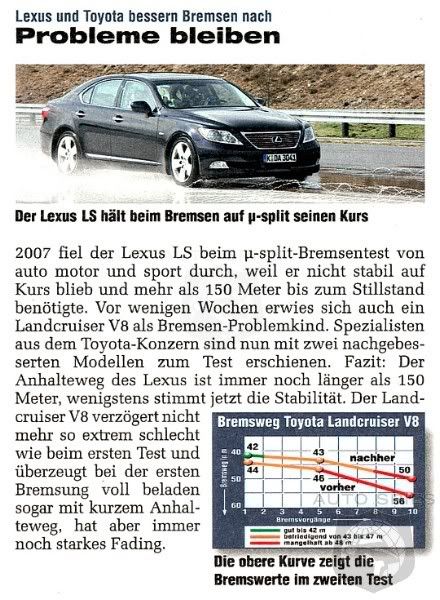
Toyota Landcruiser 4.5 V8 Diesel miserably fails Auto Motor und Sport braking test
www.autospies.com/.../

Auto Motor und Sport tested the new Toyota Landcruiser 4.5 V8. The testers praised its off-road capabilities and driving comfort. However, the rear seats were described as uncomfortable. The interior materials were good but the cockpit suffered from poor alignment and large panel gaps in certain parts. The interior ergonomics were described as confusing.

The engine was praised for refinement but the engine response was poor and the fuel consumption was rated as extremely poor. In normal driving conditions the Landcruiser needs 15.4 liters of diesel per 100 km. The testers said this does not fit into character with the green image Toyota wants to project. Such poor fuel economy is also frowned upon by consumers in the mainstream car market, where arguably the Landcruiser is still positioned.

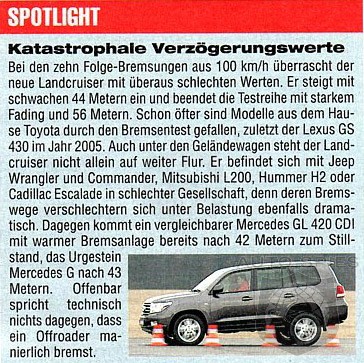
Where the 2.8 ton Landcruiser performed extremely poorly was in the braking department. 10 braking tests were perfomed beginning with cold brakes and ending with fully warmed up brakes With cold brakes, the Landcruiser needed 44 meters to come to a halt from 100-0 km/h. When the brakes were warmed up the car needed an alarming 56 meters to come to a complete stop. In the past, many cars from Toyota and Lexus have performed poorly in the braking department in various Auto Motor und Sport tests. The Landcruiser joins the Jeep Wrangler & Commander, Mitsubishi L200, Hummer H2 and Cadillac Escalade as the worst braking SUV's tested so far. For comparison purposes, a Mercedes GL420 CDI will come to a full stop at 42 meters with warm brakes - an old G-Class at 43 meters!

In the end the Landcruiser is not recommended because of the extremely weak brakes and poor fuel economy. Furthermore the only other engine option is an uneconomical 4.7-l gasoline V8 with 288-horsepower for 79,900 Euros. The testers also felt the car is overpriced and has lost much of its appeal.


Highs:
Good interior materials
Roomy interior
Comfortable seats (front)
Refined diesel engine
Smooth automatic transmission
Good driving characteristics in straight line
Good safety features


Lows:
Poor material alignment on certain aspects of the interior
Poor cockpit ergonomics
Extremely weak brakes
Poor fuel economy
Uncomfortable seats (rear)
Poor engine response
Poor handling
Lifeless steering

Rating: 2 / 5 stars

Source: Auto Motor und Sport, February

 
Incêndios sob investigação Página 1 de 2
18062008_onfire_368.jpg
Cadillac, Chevrolet, GMC e Hummer são as marcas com alguns modelos a serem investigados pela National Highway Traffic Safety Administration (NHTSA), nos Estados Unidos.

A operação deve-se ao facto de alguns automóveis se terem incendiado, com alguns casos a assinalarem danos graves. Em 16 das ocorrências conhecidas, as viaturas incendiaram-se quando estavam desligadas.

Os técnicos inspeccionarão diversas áreas e componentes, como motores, sistemas de refrigeração e sistemas eléctricos, para conseguirem detectar a causa dos incidentes.

Os casos registados nas quatro marcas são de modelos vendidos nos dois últimos anos.


adlog.php
 
Last edited:
Muito bom, e ja agora, muito obrigado, ja andava atras desse teste a ja algum tempo.

De nada. Este tópico é interessante para se poder ir buscar informação sobre os carros. Assim escusamos de andar a procura no pc ou na net.
 
Reifendruck_M_tcm8-227068.jpg
s.gif
Zu wenig Druck im Reifen
s.gif

ADAC sagt, warum die Luft im Reifen so wichtig ist

Etwa jedes zweite Fahrzeug ist europaweit mit falschem Reifendruck unterwegs. Zu geringer Druck erhöht aber nicht nur den Kraftstoffverbrauch sowie den Reifenverschleiß, sondern kann zudem Reifenschäden verursachen.
Eine aktuelle Untersuchung des ADAC zeigt jetzt zusätzlich den Einfluss von zu geringem Luftdruck auf die Fahrstabilität und damit auf die Fahrsicherheit. Außerdem kann es wegen zu geringem Reifendruck an einzelnen Rädern bei Fahrerassistenzsystemen wie ABS und ESP zu Fehlfunktionen kommen.Diese Auswirkungen zeigen sich besonders an den Vorderreifen. Bereits eine Druckminderung an einem Rad um 0,5 bar wirkt sich etwa auf das Aquaplaningverhalten in Kurven negativ aus. Bei stärkerem Druckverlust verschlechtern sich die Fahreigenschaften noch deutlicher, da der betroffene Reifen in der Kurve nur einen Teil der möglichen Seitenkräfte übertragen kann. Außerdem arbeitet bei zu niedrigem Luftdruck ein ABS nicht mehr optimal.
Nicht ganz so stark macht sich ein Druckverlust an nur einem Hinterrad bemerkbar. Hier kommt es vor allem dann zu Problemen, wenn die Seitenführungskräfte der Reifen gefragt sind, wie etwa beim Spurwechsel oder in Kurven. Fehlt in allen vier Reifen ein Druck von einem bar, verschlechtern sich die Fahreigenschaften insgesamt drastisch. Gleichzeitig steigt der Verbrauch um bis zu 0,3 l/100 km.
Generell erhöht sich bei zu niedrigem Luftdruck auch der Verschleiß. Weil Gummi und Karkasse während der Fahrt stärker verformt werden, erwärmt sich der Reifen, der Abrieb wird größer. Ist nur noch sehr wenig Luft im Reifen (unter 1,0 bar) kann es sogar zu Schäden am Innenleben des Reifens kommen.Weil man es einem Reifen kaum ansieht, ob er zu wenig Luft hat, rät der ADAC den Autofahrern dringend die Reifen regelmäßig - möglichst alle 14 Tage - auf korrekten Druck zu kontrollieren. Die Fahrzeughersteller sollten außerdem serienmäßig Reifendruck-Kontrollsysteme anbieten

http://www.adac.de/mitgliedschaft_l...onentID=227083&SourcePageID=20057&location=33

Tradução:

Too little pressure in the tire General German Automobile Association says, why air is so important in the tire About each second vehicle is European-wide with wrong tire pressure on the way. To low pressure increased however not only the fuel consumption as well as the tire wear, but can besides tire damages cause. A current investigation General German Automobile Association shows now additionally the influence of to small air pressure on driving stability and thus to driving safety. In addition it can come because of to small tire pressure at individual wheels with Fahrerassistenzsystemen such as ABS and ESP to malfunctionings. These effects particularly show up to the front tire. Already pressure reduction at a wheel around 0,5 bar affects approximately the aquaplaning behavior in curves negatively. With stronger pressure loss the handling characteristics worsen still more clearly, since the tire concerned can transfer one part of the possible components in the curve only. In addition a ABS does not work any longer optimally at to low air pressure. Not completely so strongly a pressure loss at only one rear wheel becomes apparent. Here it comes above all then to problems, if the Seitenführungskräfte of the tires are in demand, as for instance with the track switching or in curves. If a pressure of one is missing bar in all four tires, the handling characteristics worsen altogether drastically. At the same time consumption rises over up to 0,3 l/100 km. Also the wear generally increases with to low air pressure. Because rubber and carcass are while driving more strongly deformed, the tire, the abrasion warms up becomes larger. Only very little air is in the tire (under 1,0 bar) can it even to damage to the inner feelings of the tire come. Because one hardly regards it to a tire whether he has too little air, the General German Automobile Association guesses/advises to check urgently the tires to the drivers regularly - if possible every 14 days - for correct pressure. In addition the vehicle manufacturers should offer tire pressure control systems in series.
 
Back
Top