Topico dos Crash-Tests ⚠️Euroncap- 10/10/2026

Deve ter havido um erro qualquer, no site do Euroncap visto durante muito tempo surgir a informação que, a 14/3/2018 seriam apresentados novos resultados contudo, quando fui à pagina do Euroncap ontem a informação que vem é que, os novos resultados serão lançados somente a 24 de abril.

"The next Euro NCAP safety ratings will be published on 24/04/2018."
 
Última edição:
accident in the city without belts: the live crash test of the TCS

https://www.sicurauto.it/crash-test...senza-cinture-il-crash-test-live-del-tcs.html

21411-crash-test-tcs-cinture-in-citta-scenario-post-crash.jpg


21423-crash-test-tcs-cinture-in-citta-posizione-post-crash-passeggero-monovolume.jpg


The crash test of TCS resumes a typically urban scenario: a small car burns a stop or a red light and a minivan hits it in full at about 50 km / h. An accident that is not very violent but very frequent in the city.

The front passenger does not have a seat belt on board the minivan and the low deceleration of the impact does not require the airbags to be opened. If we were to report it to a classic crash against the wall, the impact speed is about 20/25 km / h. All occupants, the minivan driver, the child in the back seat on the seat and the driver of the car did not suffer injuries.

The non-belted passenger of the minivan instead goes to crack his head with the head, causing serious injuries or even fatal, despite the slow deceleration of the crash test
. They have to think about the consequences that are already necessary at these low speeds, after having already shown you what would happen at 64 km / h with the configuration of Euro NCAP crash tests (here the special) and at 70 km / h against a tree or a pole ( here our special). A simple and simple gesture is enough to reduce any serious consequences, even a trivial citizen accident. Do not think that fasten your seat belts only avoid us a fine of a few hundred euros, or that serve only to turn off that odious buzzer that increases in volume and intensity. The belts are used to save human lives, of all, both on the front seats and on the back ones.
 
Última edição:
[TABLE="class: MsoNormalTable, width: 100, align: left"]
[TR]
[TD="width: 546"] [FONT=&quot]O Latin NCAP apresenta um novo resultado de seus testes de colisão
21 de março - 11H00 (horário de São Paulo)
Transmissão ao vivo: [/FONT]
[FONT=&quot]www.latinncap.com[/FONT]
[FONT=&quot][/FONT]

[/TD]
[/TR]
[/TABLE]
 
[h=1]Good ratings for 5 small SUVs in passenger-side small overlap crash test[/h]http://www.iihs.org/iihs/news/desktopnews/good-ratings-for-5-small-suvs-in-passenger-side-small-overlap-crash-test

BMW-X1-dummy.jpg

Ford-Escape-dummy.jpg

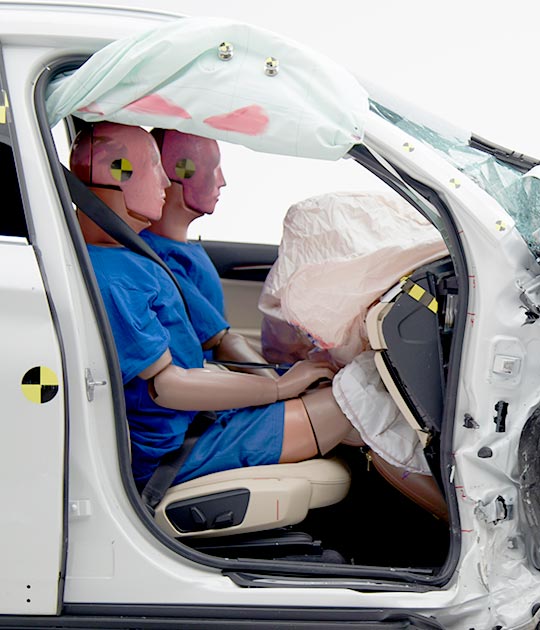
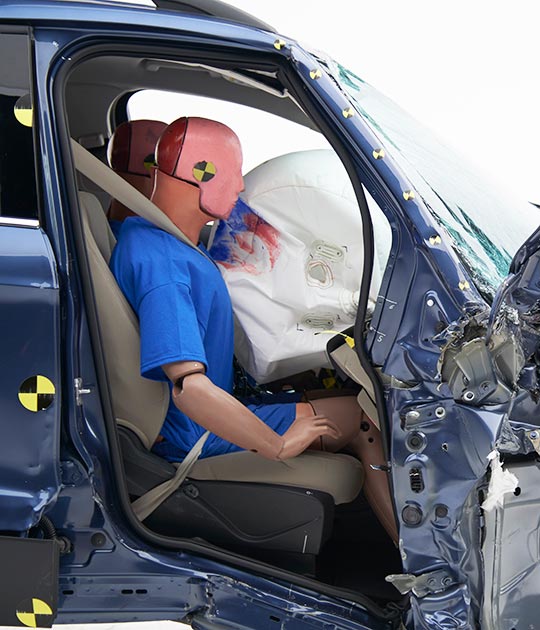
The passenger's survival space was maintained reasonably well in the BMW X1 (left) test. In contrast, the Ford Escape's (right) occupant compartment allowed too much intrusion.


None of the newly rated 2018 models earns better than acceptable marks for structure. (The Honda CR-V and Mazda CX-5 are the only small SUVs evaluated so far to earn good ratings for structure in the passenger-side small overlap front test.) The Outlander Sport is marginal, and the Escape is rated poor. Both the Outlander Sport and Escape allowed too much intrusion into the occupant compartment on the right side.


The Escape struggled in the test, as intruding structure seriously compromised space for the right-front passenger. Intrusion measured 10 inches at the upper door-hinge pillar, compared with 5 inches in the driver-side test. The passenger-side door sill was pushed 4 inches laterally into the occupant compartment. Measures taken from the dummy indicate that right hip injuries would be likely in a real-world crash of this severity.


Starting with 2017 models, Ford reinforced the structure on the driver side of the Escape to improve occupant protection in a small overlap front crash but didn't make the same change to the passenger side. The Escape earns an acceptable rating in the driver-side small overlap front test.
"Disparities like this one are why we decided to formally rate the passenger side in the small overlap test after five years of evaluating only the driver side," says Becky Mueller, a senior research engineer with the Institute who helped develop the passenger-side small overlap front test. "Manufacturers shouldn't shortchange protection for front-seat passengers."


The X1's structure resisted intrusion reasonably well to maintain the passenger space. The safety belt and front and side curtain airbags worked together to keep the dummy in place, and measures taken from the dummy showed there would be a low risk of injury in a similar real-world crash.
 
2018 IIHS BMW X3 crash test
http://www.iihs.org/iihs/news/desktopnews/redesigned-bmw-x3-earns-top-safety-pick-award

api-model-year-image.ashx


The previous generation of the X3 was never tested for small overlap protection on either side.

The new one performed well, with maximum intrusion of 2 inches on one side of the toepan on both the driver and passenger sides. It earns a good rating in both tests.


The 2018 X3 is available with two optional front crash prevention systems, Frontal Collision Warning with City Collision Mitigation and Frontal Collision Warning with Extended Collision Mitigation. Both earn a superior rating. X3s equipped with either system avoided collisions in IIHS track tests at 12 and 25 mph. Each system also has a forward collision warning component that meets National Highway Traffic Safety Administration criteria.
The headlights that come with the X3's Executive package are rated good. The two other available headlight systems earn a marginal rating.
 
Voltar
Superior