Crash Test Results
New Car Safety
HYUNDAI ACCENT
2006 on Dual front airbags
Occupant
Protection
Occupant
Protection
Occupant Protection Score 21.21 out of 37
Variant: Sedan S auto Eng: 1.6 litre
Kerb weight: 1180 kg Category: SMALL CAR
Vehicles built: 9/06
Model History and Safety Features
The tested model of Hyundai Accent was introduced in
Australia during 2006.
Dual front airbags are standard equipment. Antilock brakes
(ABS) with electronic brake distribution (EBD), side airbags
and head-protecting side curtains are standard on SLX
variants but are not available on the S variants in Australia.
This package is standard on all New Zealand variants. An
intelligent seat belt reminder is fitted to the driver seat.
The front seat belt buckles are mounted on the seats and
the upper anchorages are adjustable. These features
improve the fit of the seat belt. Pre-tensioners are fitted to
the front seat belts to reduce slack in the event of a crash.
A three point seat belt is fitted to the centre rear seat. This
provides better protection than a two point (lap) seat belt.
OCCUPANT PROTECTION: 3 Stars
The Hyundai Accent scored 9.37 out of 16 in the offset
crash test. The passenger compartment held its shape
well. Protection from serious chest and leg injury was
marginal for the driver. Passenger chest protection was
marginal.
The vehicle scored 10.85 out of 16 in the side impact crash
test. Chest protection for the driver was poor.
crash test. The passenger compartment held its shape
well. Protection from serious chest and leg injury was
marginal for the driver. Passenger chest protection was
marginal.
The vehicle scored 10.85 out of 16 in the side impact crash
test. Chest protection for the driver was poor.
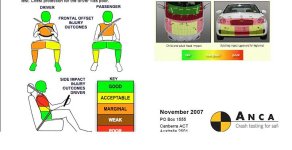
FRONTAL OFFSET CRASH TEST
(v4.1)
Body region scores out of 4 points each
: Head/neck 4 pts,
chest 1.77 pts, upper legs 2 pts, lower legs 1.6 pts.
The passenger compartment held its shape well in the
offset crash test. The brake pedal moved rearwards by 81
mm and downwards 13mm. The steering wheel hub moved
rearwards 24 mm, upwards 37 mm and sideways 8 mm.
The front ("A") pillar moved 30 mm rearwards. All doors
remained closed during the crash. After the crash tools
were required to open the driver’s door.
The airbag cushioned the head of the driver and contact
was stable. Steering column components were a potential
source of injury for the driver's knees. The passenger's
head was cushioned by the airbag.
chest 1.77 pts, upper legs 2 pts, lower legs 1.6 pts.
The passenger compartment held its shape well in the
offset crash test. The brake pedal moved rearwards by 81
mm and downwards 13mm. The steering wheel hub moved
rearwards 24 mm, upwards 37 mm and sideways 8 mm.
The front ("A") pillar moved 30 mm rearwards. All doors
remained closed during the crash. After the crash tools
were required to open the driver’s door.
The airbag cushioned the head of the driver and contact
was stable. Steering column components were a potential
source of injury for the driver's knees. The passenger's
head was cushioned by the airbag.
SIDE IMPACT CRASH TEST
(v4.1)
Body region scores out of 4 points each
: Head 4 pts, chest
zero pts, abdomen 2.85 pts, pelvis 4 pts.
The vehicle was not eligible for a Pole Impact Test since it
did not have head-protecting side airbags. This test can
earn eligible vehicles an extra two points.
zero pts, abdomen 2.85 pts, pelvis 4 pts.
The vehicle was not eligible for a Pole Impact Test since it
did not have head-protecting side airbags. This test can
earn eligible vehicles an extra two points.
PEDESTRIAN PROTECTION RATING
(v4.1)
Child head impacts 4.57
Adult head impacts 5.00
Upper leg impacts Zero
Lower leg impacts 0.80
Adult head impacts 5.00
Upper leg impacts Zero
Lower leg impacts 0.80
PEDESTRIAN PROTECTION
Total (out of 36) 10.37
accent06
Offset crash test at 64km/h
www.ancap.