Topico dos Crash-Tests ⚠️Euroncap- 10/10/2026

Crash Test Results​
New Car Safety​

HYUNDAI ACCENT​
2006 on Dual front airbags

Occupant
Protection​
Occupant Protection Score 21.21 out of 37​

Variant: Sedan S auto Eng: 1.6 litre

Kerb weight: 1180 kg Category: SMALL CAR

Vehicles built: 9/06​

Model History and Safety Features​

The tested model of Hyundai Accent was introduced in
Australia during 2006.

Dual front airbags are standard equipment. Antilock brakes
(ABS) with electronic brake distribution (EBD), side airbags
and head-protecting side curtains are standard on SLX
variants but are not available on the S variants in Australia.

This package is standard on all New Zealand variants. An
intelligent seat belt reminder is fitted to the driver seat.
The front seat belt buckles are mounted on the seats and
the upper anchorages are adjustable. These features
improve the fit of the seat belt. Pre-tensioners are fitted to
the front seat belts to reduce slack in the event of a crash.
A three point seat belt is fitted to the centre rear seat. This
provides better protection than a two point (lap) seat belt.​

OCCUPANT PROTECTION: 3 Stars​
The Hyundai Accent scored 9.37 out of 16 in the offset
crash test. The passenger compartment held its shape
well. Protection from serious chest and leg injury was
marginal for the driver. Passenger chest protection was
marginal.
The vehicle scored 10.85 out of 16 in the side impact crash
test. Chest protection for the driver was poor.​

FRONTAL OFFSET CRASH TEST​
(v4.1)

Body region scores out of 4 points each​
: Head/neck 4 pts,
chest 1.77 pts, upper legs 2 pts, lower legs 1.6 pts.
The passenger compartment held its shape well in the
offset crash test. The brake pedal moved rearwards by 81
mm and downwards 13mm. The steering wheel hub moved
rearwards 24 mm, upwards 37 mm and sideways 8 mm.
The front ("A") pillar moved 30 mm rearwards. All doors
remained closed during the crash. After the crash tools
were required to open the driver’s door.
The airbag cushioned the head of the driver and contact
was stable. Steering column components were a potential
source of injury for the driver's knees. The passenger's
head was cushioned by the airbag.


SIDE IMPACT CRASH TEST​
(v4.1)

Body region scores out of 4 points each​
: Head 4 pts, chest
zero pts, abdomen 2.85 pts, pelvis 4 pts.
The vehicle was not eligible for a Pole Impact Test since it
did not have head-protecting side airbags. This test can
earn eligible vehicles an extra two points.


PEDESTRIAN PROTECTION RATING​
(v4.1)

Child head impacts 4.57
Adult head impacts 5.00
Upper leg impacts Zero
Lower leg impacts 0.80​

PEDESTRIAN PROTECTION​
Total (out of 36) 10.37​

accent06​
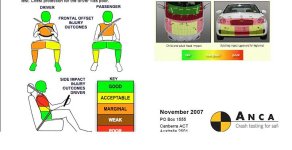
Offset crash test at 64km/h​
www.ancap.

Accent.jpg


Mahindra Pik-Up


Overall: 16.49 out of 37
star_2.gif
261.jpg
Variant: Dual Cab 4X4Kerb Weight: 2150 kgYear: 2007Engine: 2.5 Turbo DieselCategory: UtilityAirbags: No airbags
Model_History_%26_Safety::ffffff::FFC300::11.png

The tested model of Mahindra Pik-up was introduced in Australia during 2007.
The Pik-up has minimal safety features. ABS brakes are optional. The Australian distributor advises that driver and passenger airbags will become available during 2008. There are no top tether anchorages for child restraints so this vehicle is unsuitable for transporting children under the age of four (it is recommended that these children be in an approved child seat or infant capsule - both of which need a top tether anchorage). The distributor advises that this will be addressed during 2009.


Overall_Evaluation::ffffff::FFC300::11.png

2 Stars. The Mahindra Pik-up scored 3.44 out of 16 in the offset crash test. The passenger compartment held its shape reasonably well, except for steering column, footwell and pedal intrusion. Protection from serious leg injury was poor for the driver. Chest protection was weak for the driver and passenger. Driver head protection was also weak.
The vehicle was awarded a default score of 16 out of 16 in the side impact crash test. However, the low offset score meant that the vehicle was limited to a 2 star rating and an overall score of 16.49 (the maximum available for a 2 star rating).


Frontal_Offset_Crash_Test::ffffff::FFC300::11.png

Body region scores out of 4 points each: Head/neck 1 pts, chest 0.44 pts, upper legs 2 pts, lower legs zero pts.
The passenger compartment held its shape reasonably well in the offset crash test. However, the brake pedal moved rearwards by 223 mm and upwards 107 mm. The steering wheel hub moved 53 mm rearward, 141 mm upward and 23 mm sideways. The front ("A") pillar moved 84 mm rearwards. All doors remained closed during the crash. After the crash the driver’s door could be opened with high manual effort. The driver's head hit the hub of the steering wheel. Steering column and dash components were a potential source of injury for the driver's knees. The dash was a hazard for the passenger's right knee.


Side_Impact_Crash_Test::ffffff::FFC300::11.png

Body region scores out of 4 points each: Head 4 pts, chest 4 pts, abdomen 4 pts, pelvis 4 pts.
The side impact test normally used by ANCAP simulates a small car striking the driver's door of the vehicle under test. It is based on a regulation test but the regulation does not apply to vehicles with a high seat height like the Pik-up. Experience shows that such vehicles can be expected to perform well in this test so ANCAP has decided to award full score for these vehicles instead of conducting a crash test.
 
Toyota Hilux 4x4


Overall: 26.86 out of 37
star_4.gif
168.jpg
Variant: SR Double CabKerb Weight: 1860 kgYear: 2005Engine: 3 Litre Turbo DieselCategory: UtilityAirbags: Dual front airbags
Model_History_%26_Safety::ffffff::FFC300::11.png

The tested model of Hilux 4x4 was introduced in Australia during 2005.
Dual front airbags are standard equipment. ABS brakes are optional for the SR variant.

Pre-tensioners are fitted to the driver and outboard passenger seat belts to reduce slack in the event of a crash. A two point seat belt is fitted to the centre rear seat. This provides inferior protection compared with a three point seat belt. Child restraint anchorages are fitted behind the rear seat but are difficult to reach.

Overall_Evaluation::ffffff::FFC300::11.png

The Hilux 4x4 scored 10.86 out of 16 in the offset crash test. The passenger compartment held its shape well. Protection from serious chest and leg injury was marginal for the driver.
The vehicle was awarded a default score of 16 out of 16 in the side impact crash test.

Frontal_Offset_Crash_Test::ffffff::FFC300::11.png

Body region scores out of 4 points each: Head/neck 4 pts, chest 1.61 pts, upper legs 2 pts, lower legs 3.24 pts.

The passenger compartment held its shape well in the offset crash test. The brake pedal moved rearwards by 65 mm and downwards 17mm. The steering wheel hub moved rearwards 40 mm, upwards 15 mm and sideways 10 mm. The front ("A") pillar moved 20 mm rearwards. All doors remained closed during the crash. After the crash high manual effort was required to open the rear door on the driver's side. The other doors opened normally.

The airbag cushioned the head of the driver and contact was stable. Steering column components were a potential source of injury for the driver's knees. The passenger's head was cushioned by the airbag and contact was stable.

Side_Impact_Crash_Test::ffffff::FFC300::11.png

Default 16 points awarded for side impact test.

The side impact test normally used by ANCAP simulates a small car striking the driver's door of the vehicle under test. It is based on a regulation test but the regulation does not apply to vehicles with a high seat height like the Hilux 4x4. Experience shows that such vehicles can be expected to perform well in this test so ANCAP has decided to award full score for these vehicles instead of conducting a crash test.

The vehicle was not eligible for a Pole Impact Test since it did not have head-protecting side airbags. This test can earn eligible vehicles an extra two points.
 
Falcon (utility)


Overall: 25.92 out of 37
star_4.gif
172.jpg
Variant: XR6Kerb Weight: 1730 kgYear: 2005Engine: 4 Litre 6 CylCategory: UtilityAirbags: Driver airbag
Model_History_%26_Safety::ffffff::FFC300::11.png

The tested model of Falcon Utility was introduced in Australia during 2004.

A driver airbag is standard on all variants. A passenger frontal airbag is optional on some variants and standard on others. ABS/EBD brakes are also available. An advanced seat belt reminder is fitted to the driver's seat.

The front seat belt buckles are mounted on the seats and the upper anchorages are adjustable. These features improve the fit of the seat belt. Pre-tensioners are fitted to both seat belts to reduce slack in the event of a crash. The driver's seat belt retractor has a load limiter.

Overall_Evaluation::ffffff::FFC300::11.png

The Falcon Utility scored 10.56 out of 16 in the offset crash test. The passenger compartment held its shape well. Protection from serious chest injury was weak for the driver and passenger. There was a slight risk of serious lower leg injury for both occupants and a slight risk of neck injury for the passenger.

The vehicle scored 14.36 out of 16 in the side impact crash test. There was a marginal risk of serious chest injury for the driver.

Frontal_Offset_Crash_Test::ffffff::FFC300::11.png

Body region scores out of 4 points each: Head/neck 2.99 pts, chest 0.81 pts, upper legs 4 pts, lower legs 2.76 pts.

The passenger compartment held its shape well in the offset crash test. The accelerator pedal moved rearwards by 98 mm and downwards 14mm. By design, the brake pedal hinge separated during the crash, allowing the brake pedal to swing freely. This reduces the risk of lower leg injury. The feet were protected from footwell deformation by a laminated insert under the carpet. The steering wheel hub moved rearwards 15 mm, upwards 30 mm and sideways 4 mm. The front ("A") pillar moved 40 mm rearwards. All doors remained closed during the crash. After the crash high manual effort was required to open the driver’s door.

The airbag cushioned the head of the driver and contact was stable. There were no deductions for knee hazards. Although the passenger did not have an airbag there was no head contact with the dash.

Side_Impact_Crash_Test::ffffff::FFC300::11.png

Body region scores out of 4 points each: Head 4pts, chest 2.36 pts, abdomen 4pts, pelvis 4pts.

The vehicle was not eligible for a Pole Impact Test since it did not have head-protecting side airbags. This test can earn eligible vehicles an extra two points.
 
Ford Courier 4x4


Overall: 16.49 out of 37
star_2.gif
166.jpg
Variant: GL Crew CabKerb Weight: 1710 kgYear: 2005Engine: 2.5 L Turbo DieselCategory: UtilityAirbags: No airbags
Model_History_%26_Safety::ffffff::FFC300::11.png

The tested model of Ford Courier 4x4 was introduced in Australia during 1999. The Mazda Bravo is based on the same design and can be expected to have similar crashworthiness.

Dual front airbags are optional and were not fitted to the test vehicle.

A two point seat belt is fitted to the centre rear seat. This provides inferior protection compared with a three point seat belt. Child restraint anchorages are fitted behind the rear seat but are difficult to reach.

Overall_Evaluation::ffffff::FFC300::11.png

The Courier 4x4 scored 2.62 out of 16 in the offset crash test. The passenger compartment was severely deformed. Protection from serious leg injury was poor for the driver. Head and chest protection were weak for the driver. Chest protection was marginal for the passenger.

The vehicle was awarded a default score of 16 out of 16 in the side impact crash test.

The low offset score limited the overall rating to 2 stars and 16.49 points (the maximum points available for a 2 star rating). This provision was introduced in 2005 and so did not apply to the Bravo/Courier 4x2 utility that was rated by ANCAP in 2002. Test protocols have also changed since 2002.

Frontal_Offset_Crash_Test::ffffff::FFC300::11.png

Body region scores out of 4 points each: Head/neck 1 pt, chest 0.2 pts, upper legs 1.42 pts, lower legs zero pts.

The passenger compartment integrity was compromised in the offset crash test. The brake pedal moved rearwards by 418 mm and upwards 107 mm. The steering wheel hub moved rearwards 133 mm, upwards 119 mm and sideways 14 mm. The front ("A") pillar moved 227 mm rearwards. All doors remained closed during the crash. After the crash tools were required to open the driver’s door.

Steering column components were a potential source of injury for the driver's knees.

Side_Impact_Crash_Test::ffffff::FFC300::11.png

Default 16 points awarded for side impact test.

The side impact test normally used by ANCAP simulates a small car striking the driver's door of the vehicle under test. It is based on a regulation test but the regulation does not apply to vehicles with a high seat height like the Courier 4x4. Experience shows that such vehicles can be expected to perform well in this test so ANCAP has decided to award full score for these vehicles instead of conducting a crash test.

The vehicle was not eligible for a Pole Impact Test since it did not have head-protecting side airbags. This test can earn eligible vehicles an extra two points.
 
Ford Ranger


Overall: 22.46 out of 37
star_3.gif
269.jpg
Variant: Dual cab 4X4Kerb Weight: 1870 kgYear: 2007Engine: 2.5 Turbo DieselCategory: UtilityAirbags: Dual front airbags
Model_History_%26_Safety::ffffff::FFC300::11.png

The tested model of Mazda BT50 utility was introduced in Australia during 2007. The Ford Ranger is based on the same design and can be expected to have similar crashworthiness.
Dual front airbags and front seat belts with pretensioners are standard equipment on most BT50 variants but are optional on the single cab/chassis DX in Australia. They are standard on all Ford Rangers in Australia but airbags are not available on some New Zealand Rangers. Antilock brakes (ABS) with electronic brake distribution (EBD) are optional on some variants and standard other variants of the BT50 and Ranger. Side airbags with head and chest protection are optional on some variants of the Australian Ford Ranger as part of a safety pack. Side airbags are standard on some variants of the BT50 and Ranger in New Zealand.
A two point seat belt is fitted to the centre rear seat. This provides inferior protection compared with a three point seat belt. Child restraint anchorages are fitted behind the rear seat but are difficult to reach.

Overall_Evaluation::ffffff::FFC300::11.png

3 Stars. The BT50 scored 6.457 out of 16 in the offset crash test. Passenger compartment integrity was compromised. Protection from serious leg injury was poor for the driver. Chest and upper leg protection was marginal for the driver.
The vehicle was awarded a default score of 16 out of 16 in the side impact crash test.

Frontal_Offset_Crash_Test::ffffff::FFC300::11.png

Body region scores out of 4 points each: Head/neck 3 pts, chest 1.46 pts, upper legs 2 pts, lower legs zero pts.
The passenger compartment was severely deformed in the offset crash test. The brake pedal moved rearwards by 472 mm and upwards 139 mm, ending up near the front edge of the driver seat. The steering wheel hub moved 125 mm rearward, 106 mm upward and 18 mm sideways. The front ("A") pillar moved 230 mm rearwards. All doors remained closed during the crash. After the crash tools were required to open the driver door. The airbag cushioned the head of the driver and contact was marginally stable. Steering column and dash components and the park brake lever were potential sources of injury for the driver's knees. The passenger's head was cushioned by the airbag.

Side_Impact_Crash_Test::ffffff::FFC300::11.png

Body region scores out of 4 points each: Head 4 pts, chest 4 pts, abdomen 4 pts, pelvis 4 pts.
The side impact test normally used by ANCAP simulates a small car striking the driver's door of the vehicle under test. It is based on a regulation test but the regulation does not apply to vehicles with a high seat height like the BT50. Experience shows that such vehicles can be expected to perform well in this test so ANCAP has decided to award full score for these vehicles instead of conducting a crash test.

Injury_Measurements::ffffff::FFC300::11.png
 
Mazda BT 50


Overall: 22.46 out of 37
star_3.gif
268.jpg
Variant: DX Dual cab 4X4Kerb Weight: 1870 kgYear: 2007Engine: 3 litre Turbo DieselCategory: UtilityAirbags: Dual front airbags
Model_History_%26_Safety::ffffff::FFC300::11.png

The tested model of Mazda BT50 utility was introduced in Australia during 2007. The Ford Ranger is based on the same design and can be expected to have similar crashworthiness.
Dual front airbags and front seat belts with pretensioners are standard equipment on most BT50 variants but are optional on the single cab/chassis DX in Australia. They are standard on all Ford Rangers in Australia but airbags are not available on some New Zealand Rangers. Antilock brakes (ABS) with electronic brake distribution (EBD) are optional on some variants and standard other variants of the BT50 and Ranger. Side airbags with head and chest protection are optional on some variants of the Australian Ford Ranger as part of a safety pack. Side airbags are standard on some variants of the BT50 and Ranger in New Zealand.
A two point seat belt is fitted to the centre rear seat. This provides inferior protection compared with a three point seat belt. Child restraint anchorages are fitted behind the rear seat but are difficult to reach.

Overall_Evaluation::ffffff::FFC300::11.png

3 Stars. The BT50 scored 6.457 out of 16 in the offset crash test. Passenger compartment integrity was compromised. Protection from serious leg injury was poor for the driver. Chest and upper leg protection was marginal for the driver.
The vehicle was awarded a default score of 16 out of 16 in the side impact crash test.

Frontal_Offset_Crash_Test::ffffff::FFC300::11.png

Body region scores out of 4 points each: Head/neck 3 pts, chest 1.46 pts, upper legs 2 pts, lower legs zero pts.
The passenger compartment was severely deformed in the offset crash test. The brake pedal moved rearwards by 472 mm and upwards 139 mm, ending up near the front edge of the driver seat. The steering wheel hub moved 125 mm rearward, 106 mm upward and 18 mm sideways. The front ("A") pillar moved 230 mm rearwards. All doors remained closed during the crash. After the crash tools were required to open the driver door. The airbag cushioned the head of the driver and contact was marginally stable. Steering column and dash components and the park brake lever were potential sources of injury for the driver's knees. The passenger's head was cushioned by the airbag.

Side_Impact_Crash_Test::ffffff::FFC300::11.png

Body region scores out of 4 points each: Head 4 pts, chest 4 pts, abdomen 4 pts, pelvis 4 pts.
The side impact test normally used by ANCAP simulates a small car striking the driver's door of the vehicle under test. It is based on a regulation test but the regulation does not apply to vehicles with a high seat height like the BT50. Experience shows that such vehicles can be expected to perform well in this test so ANCAP has decided to award full score for these vehicles instead of conducting a crash test.
 
Toyota Hilux 4x2


Overall: 27.31 out of 37
star_4.gif
167.jpg
Variant: Workmate Single cab/chassisKerb Weight: 1480 kgYear: 2005Engine: 2.7 L PetrolCategory: UtilityAirbags: Dual front airbags
Model_History_%26_Safety::ffffff::FFC300::11.png

The tested model of Toyota Hilux 4x2 was introduced in Australia during 2005.

Dual front airbags are standard equipment. ABS brakes are not available for the Workmate but are available on other variants.
Pre-tensioners are fitted to the driver and outboard passenger seat belts to reduce slack in the event of a crash. A two point seat belt is fitted to the centre front seat. This provides inferior protection compared with a three point seat belt.

Overall_Evaluation::ffffff::FFC300::11.png

The Toyota Hilux 4x2 scored 11.31 out of 16 in the offset crash test. The passenger compartment held its shape well. Protection from serious leg injury was marginal for the driver. There was a moderate risk of serious chest injury for the passenger and a slight risk for the driver.

The vehicle was awarded a default score of 16 out of 16 in the side impact crash test.

Frontal_Offset_Crash_Test::ffffff::FFC300::11.png

Body region scores out of 4 points each: Head/neck 4 pts, chest 1.93 pts, upper legs 2 pts, lower legs 3.38 pts.

The passenger compartment held its shape well in the offset crash test. The brake pedal moved rearwards by 110 mm and downwards 10mm. The steering wheel hub moved rearwards 6 mm, upwards 8 mm and sideways 14 mm. The front ("A") pillar moved 5 mm rearwards. All doors remained closed during the crash. After the crash both doors opened with normal effort.

The airbag cushioned the head of the driver and contact was stable. Steering column components were a potential source of injury for the driver's knees. The passenger's head was cushioned by the airbag and contact was stable.

Side_Impact_Crash_Test::ffffff::FFC300::11.png

Default 16 points awarded for side impact test.

The side impact test normally used by ANCAP simulates a small car striking the driver's door of the vehicle under test. It is based on a regulation test but the regulation does not apply to vehicles with a high seat height like the Hilux. Experience shows that such vehicles can be expected to perform well in this test so ANCAP has decided to award full score for these vehicles instead of conducting a crash test.

The vehicle was not eligible for a Pole Impact Test since it did not have head-protecting side airbags. This test can earn eligible vehicles an extra two points.
 
Mitsubishi Triton 4x2


Overall: 13.98 out of 37
star_2.gif
171.jpg
Variant: GLX 4x2 Single Cab/ChassisKerb Weight: 1340 kgYear: 2005Engine: 2.4 Litre PetrolCategory: UtilityAirbags: No airbags
Risk_Notes::ffffff::FFC300::11.png

High risk of life-threatening head injury
Model_History_%26_Safety::ffffff::FFC300::11.png

The tested model of Mitsubishi Triton 4x2 was introduced in Australia during 2002 and ceased production in late 2005.

Dual front airbags and ABS/EBD brakes are optional on the GLX variant and standard on some variants. The tested vehicle did not have airbags.

Overall_Evaluation::ffffff::FFC300::11.png

The Triton 4x2 scored 3.8 out of 16 in the offset crash test. The passenger compartment was moderately deformed. Protection from serious head injury was poor for the driver. Chest protection was marginal and leg/foot protection was poor.

The vehicle scored 10.18 out of 16 in the side impact crash test. There was a high risk of serious chest injury for the driver and head protection was marginal.

Frontal_Offset_Crash_Test::ffffff::FFC300::11.png

Body region scores out of 4 points each: Head/neck zero pts, chest 1.8 pts, upper legs 2 pts, lower legs zero pts.

The passenger compartment was moderately deformed in the offset crash test. The brake pedal moved rearwards by 218 mm and upwards 120 mm. The footwell ruptured. The steering wheel hub moved rearwards 73 mm, upwards 112 mm and sideways 19 mm. The front ("A") pillar moved 74 mm rearwards. All doors remained closed during the crash. After the crash tools were required to open the driver’s door.

Steering column components were a potential source of injury for the driver's knees. The hand brake control was a concern for leg injury, although it was outside the zone assessed for knee hazards.

Side_Impact_Crash_Test::ffffff::FFC300::11.png

Body region scores out of 4 points each: Head 4pts, chest zero pts, abdomen 2.05pts, pelvis 3.71pts.

The vehicle was not eligible for a Pole Impact Test since it did not have head-protecting side airbags. This test can earn eligible vehicles an extra two points.
 
Holden Rodeo 4x2


Overall: 23.51 out of 37
star_3.gif
170.jpg
Variant: LX Single Cab/ChassisKerb Weight: 1570 kgYear: 2005Engine: 2.4 Litre PetrolCategory: UtilityAirbags: Dual front airbags
Risk_Notes::ffffff::FFC300::11.png

High risk of life-threatening chest injury
Model_History_%26_Safety::ffffff::FFC300::11.png

The tested model of Rodeo 4x2 was introduced in Australia during 2003.

Dual front airbags are standard equipment on all but the DX variants, where they are optional. The tested LX Rodeo had airbags. ABS brakes are available on some variants.

Hazard lights activated during the crash.

Overall_Evaluation::ffffff::FFC300::11.png

The Rodeo 4x2 scored 7.51 out of 16 in the offset crash test. The passenger compartment was moderately deformed. Protection from serious chest injury was poor for the driver. Leg/foot protection was marginal.

The vehicle was awarded a default score of 16 out of 16 in the side impact crash test.

Frontal_Offset_Crash_Test::ffffff::FFC300::11.png

Body region scores out of 4 points each: Head/neck 4 pts, chest zero pts, upper legs 2 pts, lower legs 1.51 pts.

The passenger compartment was moderately deformed in the offset crash test. The brake pedal moved rearwards by 111 mm and upwards 13 mm. The footwell ruptured. The steering wheel hub moved rearwards 17 mm, upwards 45 mm and sideways 27mm. The front ("A") pillar moved 40 mm rearwards. All doors remained closed during the crash. After the crash tools were required to open the driver’s door.

The airbag cushioned the head of the driver and contact was stable. Steering column components were a potential source of injury for the driver's knees. The passenger's head was cushioned by the airbag and contact was stable. A metal bracket behind the dash was a potential source of injury for the passenger's left knee.

Side_Impact_Crash_Test::ffffff::FFC300::11.png

Default 16 points awarded for side impact test.

The side impact test normally used by ANCAP simulates a small car striking the driver's door of the vehicle under test. It is based on a regulation test but the regulation does not apply to vehicles with a high seat height like the Rodeo 4x2. Experience shows that such vehicles can be expected to perform well in this test so ANCAP has decided to award full score for these vehicles instead of conducting a crash test.

The vehicle was not eligible for a Pole Impact Test since it did not have head-protecting side airbags. This test can earn eligible vehicles an extra two points.
 
Holden Rodeo 4x4


Overall: 21.4 out of 37
star_3.gif
169.jpg
Variant: LX Crew CabKerb Weight: 1890 kgYear: 2005Engine: 3 Litre Turbo DieselCategory: UtilityAirbags: Dual front airbags
Risk_Notes::ffffff::FFC300::11.png

High risk of life-threatening chest injury
Model_History_%26_Safety::ffffff::FFC300::11.png

The tested model of Holden Rodeo 4x4 was introduced in Australia during 2003.

Dual front airbags are standard equipment on the LX Crew Cab. ABS brakes are optional.

A three point seat belt is fitted to the centre rear seat. This provides better protection than a two point seat belt. Child restraint anchorages are fitted behind the rear seat but are difficult to reach. Hazard lights activated during the crash.

Overall_Evaluation::ffffff::FFC300::11.png

The Rodeo 4x4 scored 5.4 out of 16 in the offset crash test. The passenger compartment held its shape reasonably well. Protection from serious chest injury was poor for the driver and weak for the passenger. Leg protection was marginal for the driver.

The vehicle was awarded a default score of 16 out of 16 in the side impact crash test.

Frontal_Offset_Crash_Test::ffffff::FFC300::11.png

Body region scores out of 4 points each: Head/neck 3 pts, chest zero pts, upper legs 2.000 pts, lower legs 0.400 pts.

The passenger compartment held its shape reasonably well in the offset crash test. The brake pedal moved rearwards by 124 mm and upwards 36 mm. The footwell ruptured. The steering wheel hub moved rearwards 11 mm, upwards 100 mm and sideways 11 mm. The front ("A") pillar moved 56 mm rearwards. The driver's door opened very late in the crash but subsequent investigations revealed it was an isolated incident, not representative of the model and no points were deducted. After the crash the other doors opened with normal effort.

The airbag cushioned the head of the driver and contact was reasonably stable. Steering column components were a potential source of injury for the driver's knees. The passenger's head was cushioned by the airbag and contact was stable.

Side_Impact_Crash_Test::ffffff::FFC300::11.png

Default 16 points awarded for side impact test.

The side impact test normally used by ANCAP simulates a small car striking the driver's door of the vehicle under test. It is based on a regulation test but the regulation does not apply to vehicles with a high seat height like the Rodeo 4x4. Experience shows that such vehicles can be expected to perform well in this test so ANCAP has decided to award full score for these vehicles instead of conducting a crash test.

The vehicle was not eligible for a Pole Impact Test since it did not have head-protecting side airbags. This test can earn eligible vehicles an extra two points.

Hola, GTTDI.

Me llama bastante la atención que los dos Holden Rodeo probados por Ancap sacaran la primera versión del 2003, 5,4 puntos en la prueba frontal,

y otra más actual,
Holden Rodeo 4x2


Overall: 23.51 out of 37
star_3.gif
170.jpg
Variant: LX Single Cab/ChassisKerb Weight: 1570 kgYear: 2005Engine: 2.4 Litre PetrolCategory: UtilityAirbags: Dual front airbags

High risk of life-threatening chest injury

The tested model of Rodeo 4x2 was introduced in Australia during 2003.

Dual front airbags are standard equipment on all but the DX variants, where they are optional. The tested LX Rodeo had airbags. ABS brakes are available on some variants.

Hazard lights activated during the crash.

Overall_Evaluation::ffffff::FFC300::11.png

The Rodeo 4x2 scored 7.51 out of 16 in the offset crash test. The passenger compartment was moderately deformed. Protection from serious chest injury was poor for the driver. Leg/foot protection was marginal.

The vehicle was awarded a default score of 16 out of 16 in the side impact crash test.
Body region scores out of 4 points each: Head/neck 4 pts, chest zero pts, upper legs 2 pts, lower legs 1.51 pts.

The passenger compartment was moderately deformed in the offset crash test. The brake pedal moved rearwards by 111 mm and upwards 13 mm. The footwell ruptured. The steering wheel hub moved rearwards 17 mm, upwards 45 mm and sideways 27mm. The front ("A") pillar moved 40 mm rearwards. All doors remained closed during the crash. After the crash tools were required to open the driver’s door.

The airbag cushioned the head of the driver and contact was stable. Steering column components were a potential source of injury for the driver's knees. The passenger's head was cushioned by the airbag and contact was stable. A metal bracket behind the dash was a potential source of injury for the passenger's left knee.


Default 16 points awarded for side impact test.

The side impact test normally used by ANCAP simulates a small car striking the driver's door of the vehicle under test. It is based on a regulation test but the regulation does not apply to vehicles with a high seat height like the Rodeo 4x2. Experience shows that such vehicles can be expected to perform well in this test so ANCAP has decided to award full score for these vehicles instead of conducting a crash test.

The vehicle was not eligible for a Pole Impact Test since it did not have head-protecting side airbags. This test can earn eligible vehicles an extra two points.


hasta más de 7 puntos en la prueba frontal, concretamente 7,51 puntos(es decir de sacar una estrella y media en la prueba actual del año 2008 en contraposición con las 3 estrellas en Australia con exactamente misma metodología de puntuación y pruebas que Euroncap),

en contraposición con los 2 míseros puntos sacados por la Isuzu Rodeo-Dmax.

¿Es la misma estructura-plataforma-carrocería la del Isuzu DMax-Rodeo que la del Holden Rodeo?
http://www.euroncap.com/tests/isuzu_dmax_rodeo/316.aspx

Aunque puede que los 300 kgs de mayor peso del Isuzu DMax-Rodeo probado recientemente en Euroncap le perjudique claramente, no se explica que pesando igual que el Holden Rodeo de 2003, continuara sacando 3,4 puntos menos en la prueba frontal(bueno sí: peor estructura, así como funcionamiento irregular o decepcionante de airbags y cinturones...)


Post Data 1:


Por cierto ¿qué resultados obtendrían coches todoterreno como el Mercedes Clase G(que todavía se vende)

y que aunque se empezó a comercializar en 1979, puede llegar a tener airbags de techo solamente en su versión "larga",

pero que hasta hace unos años no tenía ni airbag de conductor...?

El de máximo equipamiento,

hasta se podría permitir el "lujo" de alcanzar 3 estrellas por los pelos(si el salpicadero y la parte inferior de la columna de la dirección la han hecho menos agresiva para el conductor y pasajero, y gracias a los airbags frontales y tanto pretensores como limitadores de esfuerzo, bien podría sacar en el mejor de los casos hasta 6 ó 7 puntos en la prueba frontal),

frente a la estrella y media

(De 2 a 4 puntos en la prueba frontal incluso en las primeras versiones sin airbag, con airbag de conductor o incluso también de pasajero, y en el mejor de los casos, respectivamente a partir de 1997 )

o media estrella(1 punto) que habría sacado hipotéticamente las versiones de Clase G que se vendían hasta principios-mediados de los años 90)

Post Data 2:

¿Y el caso del Land Rover Defender? Es cierto que empezó a venderse en 1948, pero todavía se comercializa y que yo sepa no tiene airbag ni tan siquiera de conductor, mucho tendría que cambiar de opinión para "suponerle" más de 1 ó 2 puntos en la prueba frontal

(ya que también me extrañaría mucho que las cargas sobre el pecho fueran igual de bajas

que otros coches de mucho menor peso como el "viejo" Beetle, o el Golf II, y en cuanto a la zona de los pies/piernas, muslos y rodillas, mucho más cercano al "pésimo" Golf II(color rojo tanto en rodillas/muslos como pies/piernas y exceso de desplazamiento del pedal de freno)

que la puntuación mínima o de 1 punto que sacó el Beetle entre pies/piernas(color marrón) y muslos/rodillas(color marrón)

o que el riesgo de lesiones en la cabeza no fuera igual o mayor que los coches citados anteriormente, o de tantos otros "viejos" probados por ejemplo en Rusia...)

Lo que supondría sacar entre 0,5 estrellas y 1,5 estrellas(otra "hipótesis" más) para el Land Rover Defender...


Saludos.

Globalcar.
 
Última edição:
Daewoo Kalos


Overall: 17.64 out of 37
star_3.gif
102.jpg
Variant: 5 Dr HatchKerb Weight: 1080 kgYear: 2003Engine: 1.5 LitreCategory: Small CarAirbags: Dual front airbags
Model_History_%26_Safety::ffffff::FFC300::11.png

The tested model of DAEWOO KALOS was introduced in Australia during 2003.

Dual front airbags are standard equipment. ABS brakes are available on the Limited Edition variant.

Overall_Evaluation::ffffff::FFC300::11.png

The DAEWOO KALOS scored 5.90 out of 16 in the offset crash test. The passenger compartment held its shape reasonably well in the offset crash test, except for pedal and footwell intrusion. Protection from serious lower leg injury was poor for the driver. Chest protection was marginal for the driver.

The vehicle scored 11.73 out of 16 in the side impact crash test. Protection from serious chest injury was marginal for the driver.

Frontal_Offset_Crash_Test::ffffff::FFC300::11.png

Body region scores out of 4 points each: Head/neck 4pts, chest 1.67pts, upper legs 0.23pts, lower legs 0pts.

The passenger compartment held its shape reasonably well in the offset crash test. However, the front part of the driver's floor was pushed rearwards 170mm. and the brake pedal moved rearwards by 273mm and upwards 136mm, relative to the driver’s seat. The dash moved 72mm towards the driver. The steering wheel hub moved rearwards 79mm, downwards 39mm and sideways 6mm, relative to the driver’s seat. The front ("A") pillar moved 91mm rearwards. The roof buckled upwards above the driver and the width of the driver's doorway shortened by 81mm. All doors remained closed during the crash. After the crash all doors could be opened with normal effort.

The airbag cushioned the head of the driver. The head rolled to the side but contact was stable. During rebound the driver’s head came partially out of the window. Steering column components and a metal plate behind the fascia were potential sources of injury for the driver's knees. The passenger's head was cushioned by the airbag.

Side_Impact_Crash_Test::ffffff::FFC300::11.png

Body region scores out of 4 points each: Head 4pts, chest 0.2pts, abdomen 3.55pts, pelvis 3.99pts.

The vehicle was not eligible for a pole impact test since it did not have head-protecting side airbags. This test can earn eligible vehicles an extra two points.
 
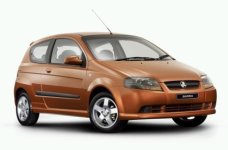
Holden Barina


Overall: 14.9 out of 37
star_2.gif
173.jpg
Variant: 5 door hatchKerb Weight: 1020 kgYear: 2005Engine: 1.6 LitreCategory: Small CarAirbags: Dual front airbags
Model_History_%26_Safety::ffffff::FFC300::11.png

The tested model of Holden Barina was introduced in Australia late in 2005.

Dual front airbags are standard equipment. ABS brakes are optional. Side airbags are not available in Australia.

The front seat belt buckles are mounted on the seats and the upper anchorages are adjustable. These features improve the fit of the seat belt. Pre-tensioners are fitted to the front seat belts to reduce slack in the event of a crash. A three point seat belt is fitted to the centre rear seat. This provides better protection than a two point seat belt.

Overall_Evaluation::ffffff::FFC300::11.png

The Barina scored 4.39 out of 16 in the offset crash test. The passenger compartment structure was compromised. Protection from serious chest and leg injury was poor for the driver.

The vehicle scored 10.51 out of 16 in the side impact crash test. There was a moderate risk of serious chest and abdomen injury for the driver.

Frontal_Offset_Crash_Test::ffffff::FFC300::11.png

Body region scores out of 4 points each: Head/neck 3 pts, chest zero pts, upper legs 1.39 pts, lower legs zero pts.

The passenger compartment structure was compromised in the offset crash test. The brake pedal moved rearwards by 332 mm and upwards 110 mm. It was designed release in this type of crash to reduce leg injury risk, but failed to do so. The steering wheel column released by design and no displacement modifiers were applied. The front ("A") pillar moved 121 mm rearwards. All doors remained closed during the crash. After the crash tools were required to open the driver’s door.

The airbag cushioned the head of the driver but contact was unstable with the head rolling off the side of the airbag. Steering column and dash components were a potential source of injury for the driver's knees. The passenger's head was cushioned by the airbag. No passenger knee contacts were evident.

Side_Impact_Crash_Test::ffffff::FFC300::11.png

Body region scores out of 4 points each: Head 4pts, chest 0.69pts, abdomen 1.81pts, pelvis 4pts.

The vehicle was not eligible for a Pole Impact Test since it did not have head-protecting side airbags. This test can earn eligible vehicles an extra two points.


TK_sunset_3door.jpg
 
Barina safety results causing concern

Joshua Dowling, , May 14, 2006


  • <LI class=print title="Print this Article" style="DISPLAY: inline">javascript:popUp('PrintArticle.aspx?id=11856 ');


Popular small car test marks are a problem, but sales still continue to rise, JOSHUA DOWLING reports.


15barinaM_m.jpg
A Korean made current model Holden Barina at the RTA crash lab after undergoing a crash test. The vehicle performed poorly compared with the previous European built model. Picture: Jon Reid.​


The safety of the Holden Barina has been called into question for the second time in three months.
Earlier this year, European independent crash test body New Car Assessment Program (NCAP) tested the Chevrolet Aveo, which is sold in Australia as the Barina sedan. It scored two stars out of a possible five because of the likelihood of "life-threatening" chest injuries to the driver.
The head of the European NCAP body used the test as an example to say that some manufacturers "have a long way to go" with crash safety.
General Motors, Holden's parent company, cried foul and immediately requested a retest, claiming the NCAP result did not match GM's internal crash test studies.
But, unknown to GM, another test had already been planned in Australia, where local NCAP representatives crashed a Barina hatch, pictured.
Last week Australian NCAP, funded by the Roads and Traffic Authority and motoring bodies such as the NRMA in each state, said the Barina hatch had scored the same two-star result as its sedan sibling.
Despite the damning test results of Holden's bargain basement car, which sells from $12,990, the company has no plans to withdraw the Barina from sale.
"[The Barina] meets what is one of the strictest set of safety standards in the world," Holden spokesman Jason Laird said.
"It doesn't make sense that [the crash test results] would dictate the future of a vehicle that's now been sold for four years around the world."
He said the Barina, as with all new cars sold on the Australian market, must meet Australian Design Rules regarding vehicle safety.
"The [Barina] comes standard with two air bags, which you wouldn't find in an older car," he said.
The original NCAP test noted that the crash dummy made contact with the car's steering wheel hard enough to distort the rim of the wheel - despite the air bags. Holden said it had no immediate plans to upgrade the safety of the Barina.
"We are not disputing the result and we're obviously disappointed with the result," Laird said.
"We will review the crash test data. Any extra testing is helpful.
"But at the end of the day, the car is sold in 95 countries around the world and must meet the safety standards of those 95 countries."
Of concern to local safety authorities is that the new Barina, a rebadged Daewoo from Korea, replaces the European-built Opel Corsa.
The Corsa scored a four-star rating in NCAP testing and also won the coveted Wheels Car of the Year award. It is unusual for a new model to score a lower safety rating than the model it replaces.
Holden said the same car that scored two stars in an NCAP test (a 64kmh crash into an offset barrier) scored five stars in a test in the US, which was a full frontal impact into a wall at 56kmh.
"The NCAP test is one test in one very specific set of circumstances," Laird said.
"[The NCAP test] reflects one specific behaviour in one set of conditions."
Despite the publicity that's resulted from the Barina's below-average crash test results, it remains one of Australia's biggest-selling small cars and the best-selling Barina model in the nameplate's history.


Fonte:
http://www.drive.com.au/Editorial/ArticleDetail.aspx?ArticleID=11856
 
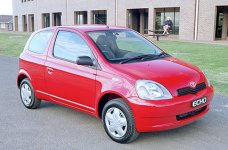
Toyota Echo


toyota Echo.jpg


Overall: 23.64 out of 37
star_3.gif
88.jpg
Variant: 3 Dr HatchKerb Weight: 930 kgYear: 2003Engine: 1.3 LitreCategory: Light CarAirbags: Driver airbag
Model_History_%26_Safety::ffffff::FFC300::11.png

The Toyota Echo was introduced in 1999. The previous ANCAP assessment (a four star result) was based on a Euro NCAP test of a vehicle fitted with driver and passenger airbags. A passenger airbag was optional (as part of a safety pack) in Australia at the time but is no longer available. ANCAP therefore decided to test a vehicle without the passenger airbag. Dual airbags are standard on Toyota Echoes in New Zealand and the previously published results still apply to those vehicles.

A driver’s airbag is standard equipment on the Australian model.
Pre-tensioners are fitted to the front seat belts to reduce slack in the event of a crash. A three point seat belt is fitted to the centre rear seat. This provides better protection than a two point seat belt.

Overall_Evaluation::ffffff::FFC300::11.png

The Toyota Echo scored 7.64 out of 16 in the offset crash test. The passenger compartment held its shape reasonably well in the offset crash test, except for clutch pedal movement. Protection from serious chest injury was marginal for the driver and passenger. Driver lower leg protection was poor.

The vehicle scored 16 out of 16 in the side impact crash test.

Frontal_Offset_Crash_Test::ffffff::FFC300::11.png

Body region scores out of 4 points each: Head/neck 4pts, chest 1.64pts, upper legs 2pts, lower legs zero pts.

The passenger compartment held its shape reasonably well in the offset crash test. The front part of the driver's floor was pushed rearwards 109. The clutch pedal moved rearwards by 225mm and the brake pedal moved upwards 88mm, relative to the driver’s seat. The dash moved 2mm towards the driver. The steering wheel hub moved rearwards 22mm, upwards 45mm and sideways 16mm, relative to the driver’s seat. The front ("A") pillar moved 26mm rearwards. The width of the driver's doorway shortened by 23mm. All doors remained closed during the crash. After the crash high manual effort was required to open the driver’s door.

The airbag cushioned the head of the driver and contact was stable. Steering column components were a potential source of injury for the driver's knees. There was no passenger head contact. Centre console components were a potential source of injury to the passenger’s right knee.

Side_Impact_Crash_Test::ffffff::FFC300::11.png

Body region scores out of 4 points each: Head 4pts, chest 4pts, abdomen 4pts, pelvis 4pts.

The vehicle was not eligible for a Pole Impact Test since it did not have head-protecting side airbags. This test can earn eligible vehicles an extra two points.
 
Toyota Echo


Overall: 28.53 out of 34
star_4.gif
89.jpg
Variant: 3 Dr HatchKerb Weight: 900 kgYear: 2000Engine: 1 Litre, 4 cylCategory: Light CarAirbags: Driver airbag
Risk_Notes::ffffff::FFC300::11.png

The left-hand-drive European Toyota Yaris was tested by EuroNCAP. Australasian specifications may vary and therefore models sold in Australasia might provide different levels of protection to those described on this page.

Model_History_%26_Safety::ffffff::FFC300::11.png

A driver's airbag is standard equipment in Australia. A passenger airbag is standard in Europe but optional in Australia.

The front seat belt buckles are mounted on the seats. This feature improves the fit of the seat belt. Pretensioners are fitted to the front seat belts to reduce slack in the event of a crash.

Overall_Evaluation::ffffff::FFC300::11.png

The Toyota Echo/Yaris performed well in the offset crash test (score 12.53 out of 16). The passenger compartment held its shape very well. Injury measurements indicated a low risk of serious injury but stiff structures in the knee impact areas resulted in reduced upper leg scores.

The vehicle performed very well in the side impact crash (score 16 out of 16). EuroNCAP noted that this was remarkable for a car without side airbags.

Frontal_Offset_Crash_Test::ffffff::FFC300::11.png

The passenger compartment held it shape very well in the offset crash test. The brake pedal moved rearwards by 8cm. The width of the driver's doorway shortened by 5cm. All doors remained closed during the crash. After the crash tools were required to open the driver’s door.

The airbag effectively cushioned the head of the driver and contact was stable. Knee impact areas had stiff structures and penalties applied to the upper leg scores.

Side_Impact_Crash_Test::ffffff::FFC300::11.png

The centre pillar and the side doors were pushed inwards moderately.
The injury measurements were all good but the driver's head moved completely outside the window. In a real crash this could be very hazardous.

The vehicle was not eligible for a Pole Impact Test since it did not have head-protecting side airbags. This test can earn eligible vehicles an extra two points, giving a maximum possible overall score of 34 points.
 
Toyota Yaris


Overall: 29.46 out of 37
star_4.gif
182.jpg
Variant: 3 Dr HatchKerb Weight: 1040 kgYear: 2006Engine: 1.3 LitreCategory: Light CarAirbags: Dual front airbags
Model_History_%26_Safety::ffffff::FFC300::11.png

The tested model of Toyota Yaris was introduced in Australia during 2005.

Dual front airbags are standard equipment. ABS/EBD brakes are also standard. Advanced seat belt reminders are fitted to both front seats. Side airbags, head-protecting side curtains and a knee airbag for the driver are available in a safety pack that is recommended by ANCAP. The tested vehicle did not have these features but a Yaris with them was awarded 5 stars by Euro NCAP (see separate ANCAP report).

The front seat belt buckles are mounted on the seats and the upper anchorages are adjustable. These features improve the fit of the seat belt. Pre-tensioners are fitted to the front seat belts to reduce slack in the event of a crash. A three point seat belt is fitted to the centre rear seat. This provides better protection than a two point seat belt.

Overall_Evaluation::ffffff::FFC300::11.png

The Yaris scored 13.38 out of 16 in the offset crash test. The passenger compartment held its shape well. Protection from serious leg injury was marginal for the driver.

The vehicle scored 14.1 out of 16 in the side impact crash test. Protection from serious chest injury was marginal for the driver.

Frontal_Offset_Crash_Test::ffffff::FFC300::11.png

Body region scores out of 4 points each: Head/neck 4 pts, chest 3.69 pts, upper legs 2 pts, lower legs 3.69 pts.

The passenger compartment held its shape well in the offset crash test. The brake pedal moved rearwards by 17 mm and downwards 9mm. The steering wheel hub moved rearwards 10 mm, upwards 22 mm and sideways 2 mm. The front ("A") pillar moved 30 mm rearwards. All doors remained closed during the crash. After the crash tools were required to open the driver's door.

The airbag cushioned the head of the driver and contact was stable. Steering column components were a potential source of injury for the driver's knees. The passenger's head was cushioned by the airbag.

Side_Impact_Crash_Test::ffffff::FFC300::11.png

Body region scores out of 4 points each: Head 4 pts, chest 2.08 pts, abdomen 4 pts, pelvis 4 pts.

The tested model was not eligible for a pole impact test since it did not have head-protecting side airbags. This test can earn eligible vehicles an extra two points. The curtain-equipped Yaris earned two points in the pole test by Euro NCAP.
 
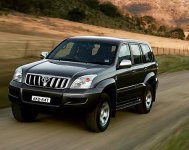
Toyota Prado GXL


Overall: 27.53 out of 37
star_4.gif
150.jpg
Variant: 4 Dr WagonKerb Weight: 2100 kgYear: 2005Engine: 4 Litre V6 (petrol)Category: Large 4WDAirbags: Dual front airbags
Model_History_%26_Safety::ffffff::FFC300::11.png

The tested model of Toyota Landcruiser Prado was introduced in Australia during 2003.
Dual front airbags are standard equipment on all variants. ABS brakes are optional on the GX variant and standard on other variants. Side (thorax) airbags, head-protecting side curtains and electronic stability control are standard on the VX and Grande variants.
The front seat belt buckles are mounted on the seats and the upper anchorages are adjustable. These features improve the fit of the seat belt. Pre-tensioners are fitted to the front seat belts to reduce slack in the event of a crash. A three point seat belt is fitted to the centre rear seat. This provides better protection than a two point seat belt.

Overall_Evaluation::ffffff::FFC300::11.png

The TOYOTA PRADO scored 11.53 out of 16 in the offset crash test. The passenger compartment held its shape well. Protection from serious chest and lower leg injury was marginal for the driver.
The vehicle was awarded a default score of 16 out of 16 in the side impact crash test. A separate report covers the Prado with curtain airbags.

Frontal_Offset_Crash_Test::ffffff::FFC300::11.png

Body region scores out of 4 points each: Head/neck 4pts, chest 2.57pts, upper legs 3pts, lower legs 1.96pts.
The passenger compartment held its shape well in the offset crash test. The brake pedal moved rearwards by 82mm and downwards 1mm relative to the driver's seat. The steering wheel hub moved forwards 4mm, upwards 58mm and sideways 12mm. The front ("A") pillar moved 25mm rearwards. The width of the driver's door opening shortened by 8mm. All doors remained closed during the crash. After the crash all doors could be opened with normal effort.
The airbag cushioned the head of the driver and contact was stable. Steering column components were a potential source of injury for the driver's knees. The passenger's head was cushioned by the airbag. The passenger's knees hit the glove box.

Side_Impact_Crash_Test::ffffff::FFC300::11.png

Default 16 points awarded for side impact test.
The side impact test normally used by ANCAP simulates a small car striking the driver's door of the vehicle under test. It is based on a regulation test but the regulation does not apply to vehicles with a high seat height like the Prado. Such vehicles can be expected to perform well in this particular side impact test so ANCAP has decided to award full score for these vehicles instead of conducting a crash test.

ANCAP chose to conduct a pole test as part of a research program. This is usually an optional test for vehicles with head-protecting side airbags such as curtains. The tested vehicle did not have these and head protection was poor so it scored zero points out of a maximum of two points for the pole test.


Toyota Prado = prado.jpg
 
Toyota Prado VX/Grande


Overall: 29.53 out of 37
star_4.gif
153.jpg
Variant: 4 Dr WagonKerb Weight: 2100 kgYear: 2005Engine: 4 Litre V6 (petrol)Category: Large 4WDAirbags: Dual front + side + curtain airbags
Model_History_%26_Safety::ffffff::FFC300::11.png

The tested model of Toyota Landcruiser Prado was introduced in Australia during 2003.

Dual front airbags are standard equipment on all variants. ABS brakes are optional on the GX variant and standard on other variants. Side (thorax) airbags, head-protecting side curtains and electronic stability control are standard on the VX and Grande variants.

The front seat belt buckles are mounted on the seats and the upper anchorages are adjustable. These features improve the fit of the seat belt. Pre-tensioners are fitted to the front seat belts to reduce slack in the event of a crash. A three point seat belt is fitted to the centre rear seat. This provides better protection than a two point seat belt.

Overall_Evaluation::ffffff::FFC300::11.png

The Toyota Prado scored 11.53 out of 16 in the offset crash test. The passenger compartment held its shape well. Protection from serious chest and lower leg injury was marginal for the driver.

The vehicle was awarded a default score of 16 out of 16 in the side impact crash test. A further 2 points were scored in the optional pole test.

Frontal_Offset_Crash_Test::ffffff::FFC300::11.png

Body region scores out of 4 points each: Head/neck 4pts, chest 2.57pts, upper legs 3pts, lower legs 1.96pts.

The GXL variant was tested but the results can be expected to apply other variants.

The passenger compartment held its shape well in the offset crash test. The brake pedal moved rearwards by 82mm and downwards 1mm relative to the driver's seat. The steering wheel hub moved forwards 4mm, upwards 58mm and sideways 12mm. The front ("A") pillar moved 25mm rearwards. The width of the driver's door opening shortened by 8mm. All doors remained closed during the crash. After the crash all doors could be opened with normal effort.

The airbag cushioned the head of the driver and contact was stable. Steering column components were a potential source of injury for the driver's knees. The passenger's head was cushioned by the airbag. The passenger's knees hit the glove box.

Side_Impact_Crash_Test::ffffff::FFC300::11.png

Default 16 points awarded for side impact test.

The side impact test normally used by ANCAP simulates a small car striking the driver's door of the vehicle under test. It is based on a regulation test but the regulation does not apply to vehicles with a high seat height like the Prado. Such vehicles can be expected to perform well in this particular side impact test so ANCAP has decided to award full score for these vehicles instead of conducting a crash test.

The VX and Grande variants of the Prado have head-protecting side curtain airbags. ANCAP conducted a pole test and the vehicle earned the maximum two points.
 
Toyota Rav 4 Cruiser


Overall: 27.11 out of 34
star_4.gif
146.jpg
Variant: 5 Dr hatchKerb Weight: 1380 kgYear: 2002Engine: 4 cyl 2 litreCategory: Compact 4WDAirbags: Dual front + side +curtain airbags
Model_History_%26_Safety::ffffff::FFC300::11.png

The tested model of Toyota RAV4 was introduced in July 2000. Knee protection was upgraded in December 2002. This assessment applies to the upgraded model with optional side curtain airbags.

Dual front airbags are standard equipment. An option pack for the Cruiser variant features side/thorax and side/curtain airbags, electronic stability control, traction control and brake assist. The front seat belt buckles are mounted on the seats and the upper anchorages are adjustable. These features improve the fit of the seat belt. Pretensioners are fitted to the front seat belts to reduce slack in the event of a crash. These seat belts also have load limiters. A three point seat belt is fitted to the centre rear seat. This provides better protection than a two point seat belt.

Overall_Evaluation::ffffff::FFC300::11.png

The Toyota RAV4 scored 10.19 out of 16 in the offset crash test. The passenger compartment held its shape reasonably well. There was a moderate risk of serious chest and leg injury for the driver.

The vehicle scored 14.92 out of 16 in the side impact crash test. There was a slight risk of serious chest injury for the driver. Zero points were scored in the pole test.

Frontal_Offset_Crash_Test::ffffff::FFC300::11.png

Body region scores out of 4 points each: Head/neck 4pts, chest 1.64pts, upper legs 2.20pts, lower legs 2.36pts.

The passenger compartment held its shape reasonably well in the offset crash test. The front part of the driver's floor was pushed rearwards 208mm and was folded. The brake pedal moved rearwards by 121mm and upwards 29mm. The dash moved 67mm towards the driver. The steering wheel hub moved rearwards 61mm, upwards 34mm and sideways 66mm. The front ("A") pillar moved 78mm rearwards. The roof buckled upwards above the driver and the width of the driver's doorway shortened by 72mm. All doors remained closed during the crash. After the crash tools were required to open the driver’s door.

The airbag cushioned the head of the driver. The head started to roll off the side of the airbag but was not sufficient to attract a deduction. The driver's knees hit the steering column and dash. The ignition switch barrel was a potential source of knee injury. Although an upgrade to the steering column design has improved the protection, a one point deduction for concentrated loading remains. The passenger's head was cushioned by the airbag. The passenger's knees hit the glove box and dash.

Side_Impact_Crash_Test::ffffff::FFC300::11.png

Body region scores out of 4 points each: Head 4pts, chest 2.92pts, abdomen 4pts, pelvis 4pts.

This test simulates a small car striking the driver's door of the vehicle under test. High-seat vehicles like the RAV4 can be expected to perform relatively well in this particular side impact test. There was, however, a slight risk of serious chest injury for the driver.
ANCAP chose to conduct a pole test as part of a research program. This is usually an optional test for vehicles with head-protecting side airbags such as curtains. The tested vehicle did not have these and head protection was poor so it scored zero points out of a maximum of two points for the pole test.
 
Voltar
Superior