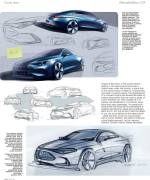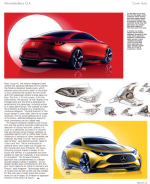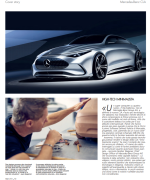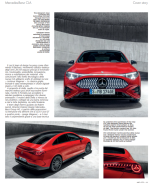
Mercedes CLA concept EV?

Por acaso está fixe, não tem como não se gostar, é um model 3 da Mercedes, conseguiram lançar finalmente uma cópia perfeita, aerodinâmica levada ao limite, baterias com capacidade idêntica as do model 3 com a de 58 em Lfp, tudo feito com ecrãs, teto em vidro igual, para mim está muito muito idêntico… só prova que a Europa está 6 anos atrasada, um modelo de 2019 está a chegar finalmente à Europa, e deve chegar por 50 e tal mil euros, tal como o model 3 da altura.

Não são baterias de 85kWh ou está previsto uma bateria de menor capacidade?

Em relação ao preço, e a confirmar-se que a bateria é de 85kWh, não creio que vá custar abaixo dos 60k, a rivalizar com o I4 e40, p.e.
 
Gosto dos puxadores retrácteis pois é um detalhe mais upmarket.
É interessante também a versão eléctrica ser RWD e a versão a combustão FWD.
 
Além de conseguir a proeza de ser mais feio que o CLA a combustão, consegue ser ainda mais pesado que o classe S!
 
por fora é mais ou menos, não gosto da monocelha, mas por dentro é um aborto completo. Uma parede. Seja como for, se a construção tiver mais qualidade do que os mercedes recentes até isso se pode perdoar.

Do ponto de vista técnico a bateria LFP deveria ter mais uns KW/h, pelo menos 60-63. O carro parece aerodinâmico pode ser que tenha uma boa eficiência.
 
https://www.autocar.co.uk/car-news/new-cars/new-mercedes-benz-cla-unable-use-400v-dc-chargers

​​​​​​This means the third-generation CLA, based on the German firm's new MMA electric car platform, is incompatible with many older 50kW units and most Tesla Superchargers currently in operation.

This is because it lacks a DC-to-DC voltage booster, meaning it can only fast-charge at stations that supply 800 volts - typically found on newer HPC (high-power charging) networks that can charge at speeds almost double that of 400V.

​​​​​​The UK currently has 14,448 public charge points capable of 50kW charging or faster, according to Zap-Map. Although the data doesn't include the voltage of the chargers, Zap-Map does confirm that while 800V charging (up to 350kW) is available at some locations, it's not nearly as widespread as 400V charging (up to 250kW), given that it's a newer - and therefore much more expensive - technology.

The omission of a 400V DC converter is thought to be a cost-saving measure, the likely thinking being that the majority of customers will charge their CLA mostly at home via an AC connection –there, 400V AC flows into an onboard charger and is converted into 800V DC internally for battery use.

​​​​​​Mercedes confirms the charging limitation on its German website configurator with the message "charging at 400V charging stations is not possible".

Backing its decision, a spokesperson for the car maker told Autocar that "the share of 800V DC-fast-charging stations in the entire charging network is constantly increasing" adding that drivers will only be "directed to a compatible charging station" via the navigation system. "The update of available and compatible charging stations works almost in real time," it said.

Asked if there would be a paid option to fit a DC converter for the UK market, the spokesperson said: "We cannot comment on this now."

Rival car makers have taken a different approach. Hyundai and Kia equip their E-GMP-platform EVs, including the Ioniq 5 and EV6, with internal voltage boosters to allow 400V-800V conversion, enabling charging even from older DC stations.

Meanwhile, Porsche and Audi use a split-pack battery strategy with their PPE-platform EVs, such as the Macan Electric and A6 E-tron, dividing the battery into two 400V sections for charging (albeit at reduced speeds).

Mercedes has chosen not to implement either solution in the CLA EV sold in selected European markets. There is still a DC-DC converter onboard, but it's only used to supply 12V power to auxiliary systems such as seat heating and infotainment.

While 400V chargers are being replaced by 800V chargers across Europe, many 400V chargers still remain, particularly in countries such as Norway, where the EV charging infrastructure was established much earlier than in other countries.

Reports suggest the new CLA EV to be sold in Norway will be fitted with the DC-to-DC booster, but it remains unclear if this will be included on models offered in other European countries.

Mercedes' Belgian and Dutch online configurators make no mention of the charging limitation.

Autocar has asked Mercedes for clarification on the specification of the CLA EV to be sold in the UK but has yet to receive a reply.

 
Já há preços e configurador.

CLA 250+ por 55.500€. 790km WLTP e 6.7s 0-100km/h.

CLA 350 4matic por 60.050€. 768km WLTP e 4.9s 0-100km/h.

Para empresas, com o desconto frota e possibilidade do IVA dedutivel vai vender bem certamente.
Para o mercado dos particulares, duvido. :(
 
Isso de não carregar em carregadores 400V é muito grave ou é impressão minha?

Uma das coisas que menos gosto é o tablier completamente vertical.
 
  • Like
Reactions: DMA
Isso de não carregar em carregadores 400V é muito grave ou é impressão minha?

Uma das coisas que menos gosto é o tablier completamente vertical.

Também não gosto muito do interior tão vertical; parece uma parede. Mas não é suficiente para descartar como um carro que gostaria de ter.

Em relação aos carregadores CC de 400V já começaram a corrigir a cgda ... pelo menos nos USA. Há rumores que em outros mercados também vai poder usar os carregadores de 400V, mas do que tenho lido a situação ainda está confusa.

A minha intuição diz-me que vão acabar por fazer o roll over desta função para a maioria dos mercados relevantes.

Para um comprador atento só carregar com 800V acaba por ser um ponto bastante negativo pois retira-te poder de escolha e capacidade de usar a rede (que mesmo contando com os PCR de 400V continua a ser limitada ... estar a descartar opções de carregamento válidas só porque a Mercedes quis poupar uns cobres não faz sentido).

https://www.arenaev.com/2026_mercedes_cla_ev_for_the_us_market_to_support_ 800v_and_400v_chargers-news-4704.php
 
Last edited:
Curiosamente o tablier vertical é um dos (poucos) aspectos de design do interior que aprecio. Remete-me para os carros mais antigos e em concreto para os tabliers dos Porsches (que nas últimas gerações voltaram a ganhar linhas mais retilíneas e verticais, depois de terem sido atenuadas).
 
Autonomia a 130 km/h de 640km, impressionante!

edit: Site de onde tirei a informação.

https://jesmb.de/26987/

CeNu29o.png
 
Last edited:
Isso de não carregar em carregadores 400V é muito grave ou é impressão minha?

Uma das coisas que menos gosto é o tablier completamente vertical.

sim

o sistema da audi-porsche nos macan/q6/a6 permite carregar a 150 kW nos 400v, faz um split virtual da bateria em duas e carrega em paralelo.
 
Back
Top