Europe’s EV industry status is quite promising, if you ask me, but please do not take me as saying Europe has caught up with China. Categorically, it has not.
Chinese EV makers rely on the most efficient battery supply chain the world has ever seen, with prices as low as $50/kWh this year (though, likely to be slightly higher on average). According to a recent report by Transport & Environment, Europe’s battery prices this year stand at almost three times that amount, and by 2030 will only reach $75/kWh, meaning we could say Europe is now 5 years behind China regarding battery costs, and perhaps even more regarding materials supply chains. 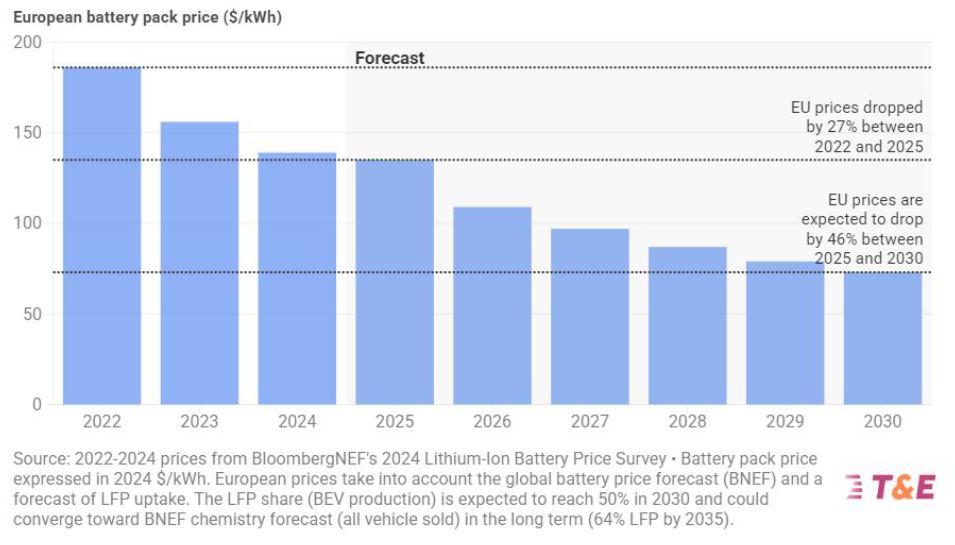
Europe battery prices forecast, as per T&E.
China has also entered a state of hyper-competition that the EU will simply not allow, meaning that it’s likely innovating faster and that pricing in the local market is far below export markets, so should the need arise, they can easily cut prices overseas. This also means that even if the nominal price is the same, the Chinese’s margin is higher, and European brands could be incentivized to extract the last penny out of their ICEV models instead of entering with less profitable EVs, even if that means ceding the electric market to the Chinese. You know, make a nice profit now even if the business model goes down the drain in a few years, and all that.
At last, cheap energy remains a critical input for industrial success, and Europe’s situation, though much improved since 2021, is still precarious. The region has somewhat freed itself from Russian gas dependency, but the cost has been significant, and the massive deployment of renewables (plus nuclear, if perhaps France can pull it off once again) required to forego the costly LNG has not fully materialized yet. Europe requires a massive amount of storage, of high-voltage lines to reduce curtailment, and of new solar and wind farms if it wants to get energy prices to a point where it can meaningfully compete with China. But even here, it seems that Southern Europe, thanks to abundant sun and massive solar deployment, has been able to keep energy prices under control, thus providing an industrial base not as affected by high costs.
I do not expect 2026 to be a year of strong competition from European brands, as they still need to ramp up and increase sales in local markets to abide by the EU’s emissions standards. But by 2027, they should be capable of bringing at least a fight to our shores, lest they end up ceding all initiative to the Chinese. Alternatively, they could rely on local production (as the Chinese are doing in Brazil) while importing batteries from China or purchasing local batteries from Chinese companies, something that should allow them to overcome one of their most important hurdles.
(I, for one, would
love to see Renault’s plant in Colombia churning out affordable EVs).
What I do know is that European automakers, historically reliant on exports and sales in foreign markets, cannot afford to lose these to the Chinese, so they better start putting up some competition. Yet, it seems, there is still hope.




 ]
]


