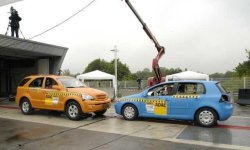
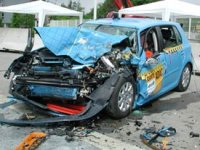
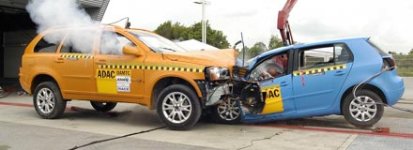
Topico dos Crash-Tests ⚠️Euroncap- 10/10/2026

Comparação entre alguns resultados do IIhs e do Euroncap
O que pode levar a estas diferenças?
O metodo utlizado não é o mesmo?


1.Honda CRV 2002-2006
image.ashx


FRONTAL OFFSET TEST
OVERALL EVALUATION:
good_lg.gif


SIDE IMPACT TEST WITHOUT OPTIONAL SIDE AIRBAGS
OVERALL EVALUATION:
marginal_lg.gif


SIDE IMPACT TEST WITH STANDARD FRONT AND REAR HEAD CURTAIN AIRBAGS AND STANDARD FRONT SEAT-MOUNTED TORSO AIRBAGS
OVERALL EVALUATION:
good_lg.gif


VS


Nota:
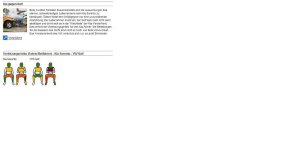
No teste do IIHS , o CRV alcança um resultado excelente no embae frontal ao contrário do que sucede no teste do Euroncap.
Quais serão as razões para se verificar este facto.
Já no crash test lateral , parece-me que os resultados se equivalem.


Hola, GTTDI.

La principal razón para la aparente "discrepancia" de resultados está en la manera de valorar los resultados biomecánicos obtenidos,

menos exigente en este sentido IIHS que Euroncap...

http://www.iihs.org/ratings/datatables.aspx?class=58&type=f

Me explico, si hechas un vistazo a los resultados biomecánicos que ha obtenido el Honda CR-V 2002-2006,

en las pruebas IIHS,

la compresión en el torso es de 34 mm, lo que suponer sacar algo más de 2 puntos:concretamente 2,28 puntos

(22 mm o menos hubieran correspondido 4 puntos y 50 mm o más entre otras muchas consideraciones 0 puntos,

"trasladando" el resultado biomecánico al sistema de valoración Euroncap)

El resultado biomecánico de muslos y rodillas, si bien es verdad que es correcto,

resultaría penalizado como en el caso de Euroncap por encontrar zonas duras en la parte inferior de la columna de dirección/salpicadero y por contacto de la rodilla con dicha zona: de ahí que también hubiera sacado 2 puntos de los 4 posibles.

Y en la parte de pies/piernas, con 0,58 de índice de tibia(equivaldrían a 3,2 puntos) y 3,5 kN de fuerza(equivaldría a 3,0 puntos) sobre las piernas obtendría por tanto 3 puntos sobre los 4 posibles.

Es decir que sumando las puntuaciones de cada zona corporal:

cabeza/cuello:4 puntos(verde);

torso: 2,28 puntos(naranja);

muslos/rodillas: 2 puntos(naranja);

pies/piernas: 3 puntos(amarillo).

En total resulta que habría obtenido 11,28 puntos...

Como ves no difiere mucho del resultado Euroncap/Ancap que aunque Euroncap "redondeando" le "concede" 11 puntos en el choque frontal,

Ancap detallando la información de dicha prueba publica que en realidad sacó 10,62 puntos sobre 16 posibles...

http://www.ancap.com.au/results/87/

IIHS

Ver anexo 28787

Ver anexo 28788


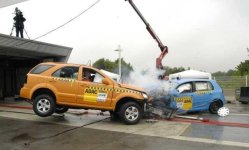
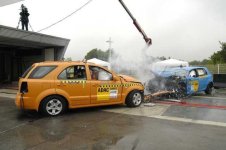
Euroncap

Ver anexo 28789

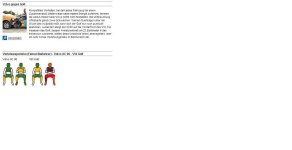
Os resultados do crash test do IIHS diferem dos do Euroncap.
Qual e o teste "valido"?

http://www.ancap.com.au/results/156/

Volviendo a hacer lo mismo que en el anterior caso nos vamos al siguiente enlace:

http://www.iihs.org/ratings/datatables.aspx?class=55&type=f

Vemos que la compresión del torso es de 36 mm, lo que supondría sacar 2 puntos en la zona del torso(desde luego este sería uno de los casos en que el resultado en el torso "mejora" el resultado del torso en la prueba Euroncap que con 41 mm le correspondieron solamente 1,25 puntos).

Por los mismos motivos que en el anterior caso, en la zona de muslos/rodillas, aún cumpliendo con los requisitos biomecánicos, por culpa de zonas duras en la parte inferior de salpicadero/columna de dirección y contacto de rodillas contra dicha zona, hubieran supuesto 2 puntos sobre 4 posibles.

Y en la zona de pies/piernas, con 3,6 kN sobre las piernas, supone sacar algo menos de 3 puntos en dicha zona.

En definitiva:

Cabeza/cuello:4puntos(Verde);

Torso:2 puntos(Naranja:aquí se diferencia de que Euroncap puntúa en "Marrón");

Muslos/rodillas:2 puntos(Naranja);

Pies/piernas:casi 3 puntos(Amarillo);

En total, hubiera sacado casi 11 puntos sobre 16 posibles, que tampoco hubiera supuesto "cambiar" la valoración final de 4 estrellas...


No sé si me habré explicado bien.


Saludos.

Globalcar.
 
Última edição:
E agora uns crash tests diferentes:
(Peço ao Lino, caso seja possivel, que faça uma tradução das legendas/resultados dos mesmos)

Hund und Katze sichern - aber richtig
s.gif

Ergebnis
s.gif

Auch wenn es keine ausdrückliche Tiersicherungs-Verordnung gibt: Vierbeiner im Auto müssen ebenfalls gesichert werden. Immerhin können Wuffi und Co bei einer Gewaltbremsung oder bei einem Unfall mit dem vielfachen ihres Eigengewichts nach vorne geschleudert werden - der Hund wird sozusagen zum Elefant. Dies kann sich für vorne sitzende Passagiere fatal auswirken. Um die Folgen deutlich zu machen, hat der ADAC auf seiner Crashanlage untersucht, was bei einem Aufprall mit 50 km/h Herr und Hund droht.

Die Aufnahmen der Hochgeschwindigkeitskameras an der Crashbahn liefern dramatische Bilder. Der ungesicherte 22 kg-Hundedummy fliegt mit knapp 50 km/h ungebremst von der Hutablage nach vorne, trifft mit dem rund 25-fachen seines Eigengewichts von hinten hart auf Kopfstütze und Rückenlehne des Fahrersitzes, schlägt am Kopf des Fahrers seitlich an und beendet seinen Flug an der Windschutzscheibe. Die Aufprallwucht entspricht hier dem Gewicht von über 500 Kilogramm. Die Folgen für einen echten Vierbeiner wären fatal und auch der Fahrer hätte erhebliche Verletzungen davon getragen.
Dementsprechend müsste der Tierausflug im Auto also ausfallen – es sei denn, man verwendet spezielle Tier-Rückhaltesysteme. Das Angebot auf diesem Sektor ist vielfältig – was schützt wirklich?


Crashtest: Ohne Sicherung
s.gif
</IMG>
Dem Hund das Fliegen beibringen? Geht ganz einfach - Sie müssen ihn nur nicht anschnallen. Die Foto-Sequenz zeigt deutlich, wie der Hunde-Dummy den Fahrzeug-Innenraum von hinten nach vorne in Kopfhöhe der Insassen durchmisst und im Nacken des Herrchens landet. Im Real-Unfall wäre das für beide fatal: Die Aufprallwucht entspricht einem Gewicht von über einer halben Tonne.

Bildergalerie: mit Klick aufs Foto zur Großansicht.
s.gif
</IMG>
s.gif
</IMG>
s.gif
</IMG>
 
Crashtest: Hundegurt
s.gif
</IMG>
Negativ-Beispiel mit einem Hundegurt der schwachen Art: Dieses Gurtsystem hat beim Aufprall nach dem Bruch eines Karabinerhakens zu einer extremen Vorverlagerung geführt. Der Hunde-Dummy bohrt sich tief in die Rückenlehne des Fahrers, die dabei massiv deformiert wird. Der Fahrer muss mit schweren Verletzungen im Rückenbereich rechnen, der Hund hätte keine Chance.

Bildergalerie: mit Klick aufs Foto zur Großansicht.
s.gif
</IMG>
s.gif
</IMG>
s.gif
</IMG>
s.gif
</IMG>
 
Crashtest: Transportbox im Fußraum

s.gif

SL0808FH01_m_tcm8-213612.jpg
s.gif


javascript:BigImage(sPic213661,sAlt213661,450,300)
s.gif
s.gif
s.gif
s.gif
Eine Foto-Sequenz erübrigt sich: Die Box im Bodenbereich bleibt sicher stehen. Eine empfehlenswerte Lösung, sofern Tier und Box nicht zu groß sind.
 
Crashtest: Transportbox auf Rücksitzbank
s.gif
</IMG>
Ebenfalls mit schlimmen Folgen, obwohl dieser Crashversuch mit einer gerade mal 4 Kilogramm schweren Plüsch-Katze stattfand: Beim Aufprall des Fahrzeugs mit 50 km/h beginnt die auf der Rücksitzbank platzierte Box an den Gurtverankerungen aufzureißen, der Dummy schießt mitsamt der zerbrechenden Gittertüre in die Rückenlehne des Beifahrers. Fürs Tier ginge das schlimm aus, aber auch beim Beifahrer wäre mit zusätzlichen Belastungen zu rechnen (wohlgemerkt: Bestandteil dieses Crashtests war eine vergleichsweise leichte Katze!).

Bildergalerie: mit Klick aufs Foto zur Großansicht.
s.gif
</IMG>
s.gif
</IMG>
s.gif
</IMG>
 
Crashtest: Transportbox im Kofferraum

s.gif

SL0808FH01h_m_tcm8-213621.jpg
s.gif


javascript:BigImage(sPic213662,sAlt213662,450,300)
s.gif
s.gif
s.gif
s.gif
Große Box und schwerer Hund: Die Box wird zwar beim Aufprall so massiv gegen die Rückenlehne gepresst, dass sich die Lehne verformt. Die Box bleibt aber stabil, der Hund wird über seine Länge gut in der Box aufgefangen, schwere Verletzungen würden ihm erspart bleiben. Da ein Verletzungsrisiko für Passagiere auf der Rücksitzbank bei schweren Kollisionen nicht völlig auszuschließen ist, wäre hier ein zusätzliches Trenngitter optimal. Unsere Empfehlung, wie hier in der Test-Konfiguration erprobt: Platzieren Sie die Box immer quer und direkt an der Rückenlehne! Diese Empfehlung gilt auch bei schweren Gepäckstücken jeder Art!


http://www.adac.de/Tests/Crash_Tests/Tiersicherung/default.asp?ComponentID=213536&SourcePageID=8645
 
O Ihhs difere do euroncap... mas tb há exemplos de carros que tem mais estrelas no euro que no ihhs... ;)

Para acabar com as duvidas;

24_Regular_0202.gif
24_Regular_0202.gif


Frontal impact1

B2.BitmapTextReplacer.ReplaceWith( 'dyntitle1', [ { "img": "\/cache\/text\/Frontal_5050\/24_Regular_0202.gif" }, { "img": "\/cache\/text\/impact1_4646\/24_Regular_0202.gif" } ] );

Frontal impact1 test is based on that developed by European Enhanced Vehicle-safety Committee as basis for legislation, but impact speed has been increased by 8 km/h.

Frontal impact takes place at 64kph (40mph), car strikes deformable barrier that is offset.

front_impact_how.gif


Readings taken from dummies are used to assess protection given to adult front occupants.

tests_frontalimpact_men.gif


Each car tested is subjected to an offset impact into an immovable block fitted with a deformable aluminium honeycomb face. This impact is intended to represent the most frequent type of road crash, resulting in serious or fatal injury. It simulates one car having a frontal impact with another car of similar mass. As most frontal crashes involve only part of the car’s front, the test is offset to replicate a half width impact between the cars. In the test, this is replicated by having 40 percent of the car impact the barrier. The barrier face is deformable to represent the deformable nature of the cars. This test is a severe test of the car’s ability to survive the impact without suffering passenger compartment intrusion.
Contact between the occupant and intruding parts of the passenger compartment is the main cause of serious and fatal injuries, for restrained adult car occupants. The test speed of 64 km/h represents a car to car collision with each car travelling at around 55 km/h. The difference in speed is due to the energy absorbed by the deformable face. Accident research has shown that this impact speed covers a significant proportion of serious and fatal accidents. By preventing intrusion, the chances of the occupant impacting the car’s interior is minimised with space remaining for the restraint system to operate effectively.
Steering wheel mounted airbags form an important part of the driver’s restraint system. Euro NCAP has encouraged designs where the driver’s head is given stable support from the airbag and where the head does not “bottom it out.” For a restrained occupant, the deceleration forces, generated in the crash, are transmitted to the occupant through the restraint system. Euro NCAP has encouraged the adoption of seat belt pretentioners, load limiters and dual stage airbags, to help attenuate the forces transmitted to the occupant. It has also helped to avoid situations where the chest is directly loaded by the steering wheel.
In most cars, the restraint system is unable to prevent the knees of the front seat occupants from impacting the facia. Euro NCAP has encouraged the removal of hazardous structures from the areas that the knees can impact. High forces on the knee can cause injury to the knee itself and can be transmitted up the thigh to the hip joint and pelvis. These load bearing parts of the skeleton are susceptible to severe, long term, disabling injuries.
With current car designs, there is no possibility of preventing contact between the occupants’ feet and the footwell. In order to minimise injuries, Euro NCAP has encouraged intrusion reduction of the footwell and greater control of foot pedals displacement.
 
The second most important crash configuration is car to car side impact. Euro NCAP simulates this type of crash by having a mobile deformable barrier (MDB) impact the driver’s door at 50 km/h. The injury protection is assessed by a side impact test dummy, in the driver’s seat..

tests_side_impact.gif


Although it is difficult to judge the level of protection provided from the extent of intrusion, control of how the car side intrudes is important. Through the programme, Euro NCAP has seen large improvements in side impact performance. The provision of side impact airbags has helped. It is now normal for the cars tested by Euro NCAP to be fitted with side impact airbags.

Side Impact Head Protection
In side impact accidents, the head is the most frequently seriously injured body region. The MDB test provides incentive to improve head protection. To address this issue, Euro NCAP adopted a low speed pole test, this provided a means of assessing the newly emerging head protecting side airbags. The pole test is carried out at 29 km/h and although it is a severe test of head protection devices, it does not represent the more severe impacts that commonly occur when cars hit poles at the roadside. The test is simply able to assess the performance of such devices, within their current range of capability.
tests_side_driver.gif
 
Accident patterns vary from country to country within Europe, but approximately a quarter of all serious-to-fatal injuries happen in side impact collisions. Many of these injuries occur when one car runs into the side of another.

To encourage manufacturers to fit head protection devices, an optional pole or head protection test may be performed, where such safety features are fitted. Side impact head airbags help to protect the head by providing a padding effect and by preventing the head from passing through the window opening.
In the test, the car tested is propelled sideways at 29kph(18mph) into a rigid pole. The pole is relatively narrow, so there is major penetration into the side of the car.

tests_pole.gif


In an impact without the head protecting airbag, a driver's head could hit the pole with sufficient force to cause a fatal head injury.

Typically a head injury criterion of 5000 is possible, five times that which indicates the likelihood of serious brain injury. In contrast, the head injury criterion in these new crash tests with a head protection airbag is around 100 to 300, well below the injury reference value. A side impact airbag with head protection makes this kind of crash survivable despite the severity
 
<SPAN>
In the frontal and side impact barrier tests, dummies representing 1½ and 3 year old children are placed in the rear of the car in the type of child restraint, recommended by the car manufacturer.

Euro NCAP has encouraged manufacturers to take responsibility for protecting children and to provide suitable facilities for the fitment of child restraints. Many child restraint users fail to attach the child restraint securely to the car and this compromises the protection afforded to the children. Euro NCAP has encouraged improved designs and the fitment of ISOFIX mounts and child restraints. ISOFIX provides a much more secure method of attaching the child restraint to the car, provided that additional provision is made to prevent rotation of the child restraint, due to seat cushion compression and rebound.

As a consequence, Euro NCAP has seen improved designs, where the child is less likely to strike the car’s interior, whilst at the same time experiencing reduced forces from the restraint system.


<DIV> series of tests are carried out to replicate accidents involving child and adult pedestrians where impacts occur at 40kph (25mph). Impact sites are then assessed and rated fair, weak and poor. As with other tests, these are based on European Enhanced Vehicle-safety Committee guidelines

tests_ped_impact.gif

It is very difficult to assess pedestrian protection using a full dummy. Although it is possible to control the point of impact of the bumper against the pedestrian’s leg, it is impossible to control where the dummy’s head will subsequently strike. To overcome this problem, individual component tests are used. A Legform test assesses the protection afforded to the lower leg by the bumper, an
 
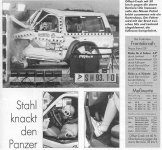
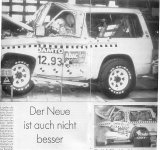
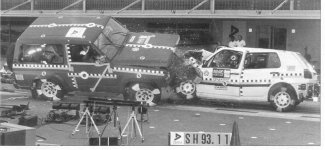
Nissan Patrol (Modelo de 1990)
Ver anexo 28932

Hola, GTTDI.

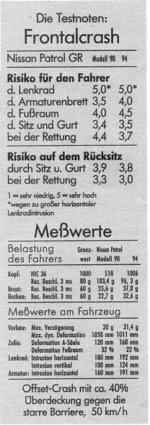
Es curioso observar como en los mismos tipos de prueba frontal, el Nissan Patrol contra un muro tiene una deceleración de la estructura entre 20 g´s(versión 1993) y 31 g´s(versión 1994)

con deformaciones totales dinámicas entre 1,058 mts y 1,011 mts y con deformaciones totales estáticas de 0,87 metros(versión 1993)

¿Y la del año 1994? Algo menos de 0,87 ó incluso 0,85 mts, aunque no sepamos el dato exacto...

¿Consecuencias? Que aunque la versión de Nissan Patrol de 1993 tenga una deceleración máxima en la cabeza algo mayor


(¿Quizás por la mayor deformación total?¿O por una eficacia en los cinturones en momentos puntuales algo peor a la del Nissan Patrol de 1994?Ya que en cuanto a deformaciones del habitáculo son incluso algo menores que la versión de 1994...),

por la menor deceleración media menor(20 g´s frente a 31 g´s y encima con ligerísimamente menores deformaciones del habitáculo), hace que baje el Head Injury Criterium(algo más de 500 frente a algo más de 1000 en la versión de 1994)...

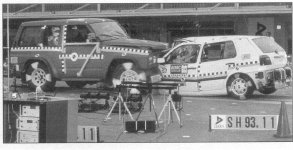
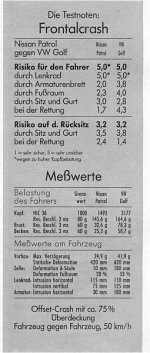
¿Y la prueba de compatibilidad contra el Golf III?

Fue realizada también a 50 k/h pero el solapamiento en la anchura del frontal del Golf III fue del 75%(al Nissan Patrol le correspondería entre 65 y 60%...)

La deceleración de la estructura estuvo a medio camino(24,9 g´s contra el Golf III) entre la versión 1993(20 g´s contra un muro) y la versión 1994(31 g´s contra un muro), pero con una diferencia: la deformación total estática en vez de estar en 0,87 mts(versión 1993 contra un muro a 50k/h y 40% de solapamiento) o de como mínimo más de 0,80 mts(versión 1994 contra un muro en las mismas condiciones citadas anteriormente),

fue de tan sólo 0,42 mts.

Es decir al deformarse la mitad (el "golpe" se lo llevan los ocupantes del coche "indeformable")

aunque el choque contra un Golf III,

en teoría le tenía que haber favorecido,

(ya que al ser casi el doble de pesado le correspondería chocar en términos de deceleraciones a menos de 40 k/h o incluso a poco más de 35 k/h, sobre todo teniendo en cuenta también la mayor altura...)

en vez de tener deceleraciones para el maniquí-conductor "razonables", pasó de tener una deceleración en la cabeza de 145,6 g´s frente a los 103 g´s del Patrol 1993 contra un muro; y frente a los 96 g´s del Patrol 1994 también contra un muro.

O de un H.I.C. de casi 1500(contra un Golf III) frente al Head Injury Criterium de poco más de 500 del Patrol 1993 contra un muro o de poco más de 1000 del Patrol 1994 también contra un muro...

De nada sirvió que la deformación del habitáculo fuera ligeramente menor(que tampoco tiene mucho mérito habiéndose "acortado totalmente" aproximadamente la mitad que en los anteriores casos contra un muro),

al haber obtenido resultados de deceleración tan extremadamente altos para el maniquí-conductor.

Es decir, que el resultado del Nissan Patrol en la prueba de compatibilidad contra el Golf III, fue todavía más dañino o con prácticamente nulas posibilidades de supervivencia para el maniquí-conductor, que en los casos probados contra un muro

(de modo que no se vea nada claro "consecuencia" del convencionalismo a la hora de valorar la gravedad de las lesiones que hacía entonces ADAC, es decir que su exigencia en cuanto a deformaciones y deceleraciones,

y que hacía igualar una situación grave: los casos del Nissan Patrol contra un muro,

con una situación mortal: la prueba de compatibilidad contra el Golf III. Aunque de paso sirviera para que los fabricantes de automóviles se esforzaran por sacar al mercado coches con menores deformaciones del habitáculo y menores deceleraciones...).

Post Data:

Del Golf III mejor no hablar(H.I.C. de 3177 y 164,6 g´s de deceleración en la cabeza), aunque con todo sus resultados de deceleraciones siendo mortales(0% de posibilidades de supervivencia), al haber sido deformado en mayor medida su habitáculo

que contra el Clase S en las mismas condiciones de choque(50 k/h cada uno, y mismo solapamiento:75% del frontal del Golf III),

fueron algo menos malos que contra el Clase S, (Golf III:H.I.C. de 4514 y 214,4 g´s de deceleración en la cabeza del maniquí-conductor).

A tener muy en cuenta en los resultados finales, la valoración que hizo ADAC del funcionamiento y/o eficacia del cinturón del maniquí-conductor del Golf III frente al Nissan Patrol, fuera de 2,8(de una escala de 1:muy bueno; a 5: muy malo) frente a 3,4(en el caso del Golf III frente al Clase S) o incluso de 3,0 en el caso del Nissan Patrol frente al Golf III...

En otro orden de cosas,de 3,4 y 3,5 fue la valoración ADAC de la eficacia/funcionamiento de los cinturones de seguridad del maniquí-conductor de los Nissan Patrol probados contra un muro: así que me reafirmo en lo dicho anteriormente de las posibles causas de la peor deceleración del Patrol frente al Golf III en relación con los resultados obtenidos contra un muro...

En los dos casos anteriores y en dichas situaciones concretas(contra el Nissan Patrol y contra el Mercedes Clase S), el resultado del Golf III fue tan desastroso que hubiera dado igual que el maniquí-conductor llevara o no puesto el cinturón...

Saludos.

Globalcar.
 
Última edição:
Voltar
Superior